Top 7 Passive Fibre TAPs for Trading Floors and Low-Latency Finance
Trading desks measure their edge in nanoseconds. Your monitoring layer has to respect that margin. Surveillance, latency analytics and compliance tools all need a complete copy of every order and market data packet. They need it without adding delay or a new point of failure.
SPAN sessions share resources with switching workloads and drop packets during bursts. Those bursts are exactly when trade reconstruction matters most. Passive fibre TAPs solve the access problem with optics alone. They need no power, run no software and add no switching delay to production links.
In 2027, regulators still expect firms to evidence complete detection and record-keeping. Many trading teams are also planning 100G and 400G refreshes in co-location racks. This guide compares seven vendors offering passive fibre TAPs or adjacent low-latency visibility tools for finance.
Passive Fibre TAP Vendors for Trading at a Glance
|
Vendor |
Key Feature / Strength |
Max Throughput |
|---|---|---|
|
Zero-power optical TAPs, up to 16 per 1RU, hybrid broker path |
Up to 100G |
|
|
G-TAP M Series needs no power, software or configuration |
Up to 400G |
|
|
Flex Tap modular range, up to 36 taps per 1U |
Up to 400G |
|
|
SelectTAP chassis with wide split ratio choice |
Up to 400G |
|
|
MOD-TAP mixes speeds and fibre types in one chassis |
Up to 400G |
|
|
Measured insertion loss results shipped with every TAP |
Up to 400G |
|
|
7130 MetaWatch tap aggregation with 1 ns timestamping |
Up to 40G |
1. Network Critical: Passive Fiber Optical TAPs
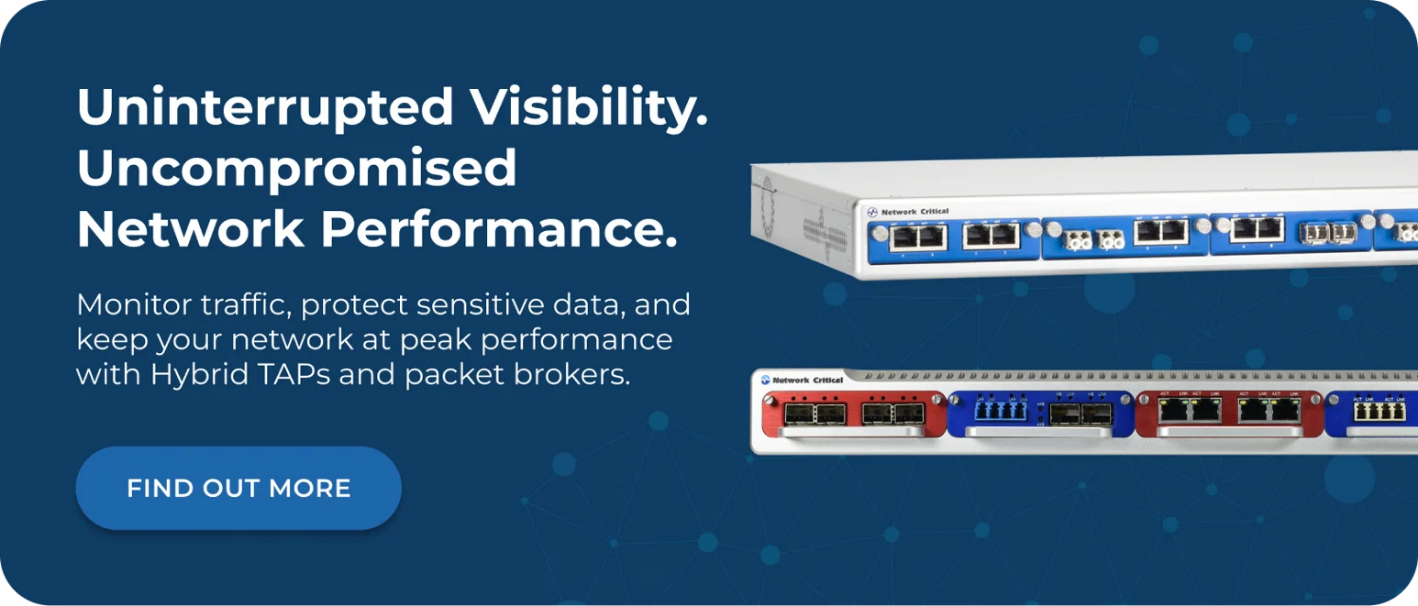
Network Critical's passive optical tap range gives trading networks zero-power access from 1G to 100G. Up to 16 TAPs fit in a single 1RU, which matters in co-location racks. Each TAP splits the optical budget, passing full-duplex traffic and errors to your tools. There are no active electronics, so there is nothing to configure or maintain. Units ship preconfigured to your chosen split ratio. Multimode models cover 1G to 10G. Single-mode models cover 1G, 10G, 40G and 100G.
Most trading estates need aggregation as well as access. SmartNA-PortPlus aggregates and filters TAP feeds across 48 to 194 ports at 1G to 100G. Its non-blocking architecture delivers 1.8 Tbps of line-rate throughput. Drag-n-Vu adds drag-and-drop filtering and port mapping, with typical deployments completing in under two hours. Output is standard PCAP, so feeds reach any capture or surveillance platform you already run.
Best for: Trading firms wanting zero-power access on order and market data links, plus a perpetual-licence aggregation path.
Proven results:
- HSBC: Passive Fiber Optical TAPs delivered zero-latency monitoring on global links from the UK to Hong Kong
- BP: Zero-power passive TAPs enabled centralised monitoring across refinery sites spanning 10 to 12 buildings
- Vodafone: Combined TAP and packet broker functions achieved 100% accurate traffic visibility on key links
2. Gigamon: G-TAP M Series
Gigamon's G-TAP M Series is a modular family of high-density passive fibre TAPs. The modules use passive full-duplex optical splitters, so they need no power source. Gigamon states they also need no software or configuration. Each module carries one to six TAPs, using LC duplex or MPO/MTP connectors. Current modules cover 1G to 400G across multimode and single-mode fibre. Breakout panels convert MPO links into 10G, 25G or 100G LC links.
Gigamon uses thin-film splitter technology to keep insertion loss low and consistent. This helps on short-reach multimode trading links that already run close to their optical budget. TAA-compliant part numbers are available for regulated buyers.
G-TAP M Series modules integrate with all GigaVUE nodes. Captured traffic then feeds Gigamon's wider Deep Observability Pipeline for filtering and analytics. For trading teams, the key question is architectural. The TAP hardware is passive and neutral at the optical layer. The downstream value, however, assumes investment in the GigaVUE platform and its licensing model. Model that three-year cost before committing.
3. Keysight: Flex Tap and Flex Tap II
Keysight's Flex Tap family, built on Ixia technology, is a modular passive fibre TAP range. Taps support 1G to 400G across single-mode and multimode fibre. Split ratios run from 50/50 to 90/10, with LC, MTP and BiDi variants available.
Density is a clear strength. The Flex Tap VHD module fits up to 36 taps in a 1U, 19-inch rack. Flex Tap II supports 24 standard LC taps, or 12 BiDi, Regen or MPO taps, per 1U. You can mix speeds and fibre types in the same chassis.
Keysight notes that its taps need no power and have no IP address. That removes a remote attack surface from links carrying order flow. A Secure+ model adds further isolation for sensitive applications. Keysight also publishes an insertion loss calculator to help you check light budgets before deployment.
Flex Taps pass all full-duplex traffic, including errors, which supports root cause analysis on market data feeds. The range is protocol-agnostic and works with third-party probes, analysers and intrusion detection systems.
4. Garland Technology: SelectTAP and Passive Fiber Network TAPs
Garland Technology is a US-based TAP specialist with a broad passive fibre portfolio. Its SelectTAP modular chassis supports 1G, 10G, 25G, 40G, 100G and 400G in 1U. Split ratio choice is wide, covering 90/10, 80/20, 70/30, 60/40 and 50/50. A three-way 33/33/33 option supports passive replication.
High-density 1U chassis hold 28 TAPs, or 56 when populated front and back. Garland also offers OM5 multimode support and dedicated BiDi TAPs for Cisco BiDi optics. That range helps when your estate mixes legacy 10G links with newer 100G and 400G optics.
Products are made, tested and certified in the USA. Garland states that no subscriptions or extra fees apply after purchase. That suits CapEx-led procurement, which many trading infrastructure teams prefer.
Garland's passive range is strongest for straightforward, high-density access. Advanced aggregation and filtering sit in separate packet broker and inline products. Factor in that second purchase if your design needs tool aggregation behind the TAPs.
5. Profitap: MOD-TAP
Profitap is a Netherlands-based visibility vendor with strong coverage in Europe. Its MOD-TAP is a modular passive fibre TAP system covering 100 Mbps to 400G. One 1U chassis holds up to 24 LC TAP modules, or 16 MTP or BiDi modules. You can combine different speeds, fibre types and split ratios in the same chassis.
MTP modules cover 40GBASE-SR4, 100GBASE-SR4 and 400GBASE-SR8 links. Profitap states it tests every fibre TAP before and after assembly. The modules are fully passive and unpowered, so the production link stays up regardless of power state.
Profitap sells through a certified reseller model, with particular strength in the Netherlands, Germany and the Nordics. That matters for trading teams supporting European venues.
The wider portfolio includes ProfiShark portable capture units and the IOTA appliance. IOTA combines capture, storage and analysis in a single device. That suits focused troubleshooting. Firms feeding several surveillance and analytics platforms may prefer to keep capture and analysis in separate layers.
6. Cubro: OptoSlim TAPs and 400Gbit SR8 TAP
Cubro's OptoSlim series provides passive optical TAPs in a compact form factor. Up to 24 LC links fit in 1RU, combining different split ratios, fibre types and connectors. OptoSlim TAPs support 10 Mbps to 100G and pass exact copies of all frames, including errors.
Quality documentation is Cubro's standout feature. Cubro measures insertion loss for every TAP it produces. The test results ship with the unit. That makes light budget sign-off simpler for change advisory boards. Single-mode split ratios can be delivered on demand.
For 400G links, Cubro's 400Gbit SR8 TAP is a passive breakout TAP using MPO16 connectors. It comes in two-link and four-link versions at a 50/50 split. Because the design is fully passive, it handles every frame size, including jumbo frames.
Cubro's strongest presence is in carrier-grade European deployments. Trading teams elsewhere should confirm local support and lead times for their co-location regions before standardising.
7. Arista Networks: 7130 Series With MetaWatch
Arista's 7130 Series is not a passive TAP. It is an FPGA-based Layer 1 platform built for ultra-low latency trading. It earns a place here because Arista positions built-in tapping on 7130L devices as an alternative to optical taps.
The MetaWatch application handles tapping, lossless tap aggregation and multi-port capture. It timestamps each incoming frame with 1 ns precision, using a clock disciplined by PTP, NTP or PPS. Deep 32 GB buffers smooth traffic peaks to prevent frame loss during microbursts. Pass-through latency on the on-board matrix switch is 5 ns.
MetaWatch inputs run at 1G, 10G, 25G or 40G, depending on the profile. Arista lists MiFID II RTS 25 compliance and latency measurement among its target use cases. Optional OCXO or rubidium clock modules improve holdover stability.
The trade-off is that MetaWatch is an active, powered device. It has electronics, firmware and a management plane that a passive splitter does not. One common design places passive fibre TAPs on production links and feeds MetaWatch from their monitor ports. That keeps the live link passive while adding precise timestamps downstream.
How to Choose the Right Passive Fibre TAP for Trading Networks
Calculate Your Light Budget First
A passive TAP diverts part of the optical signal to your monitor ports. That loss must fit within the receive sensitivity of your production optics. Short-reach multimode links at 40G and above usually have the least margin. Before you order, check:
- Network-side insertion loss for each candidate split ratio
- Connector and patch panel losses along the full path
- Receive sensitivity on both production and tool-side optics
- Whether the vendor ships measured results per unit
Match Fibre Type, Connectors and Speed
Trading estates often mix single-mode exchange cross-connects with multimode in-rack links. Confirm every TAP matches the fibre grade, wavelength and connector on its link. BiDi and MPO-based 100G and 400G optics need dedicated TAP variants. Plan for your next optics refresh, not only today's estate.
Weigh Density Against Co-Location Costs
Rack space in exchange co-location facilities is costly and often limited. High-density TAP chassis let you cover more order entry and market data links per unit. Compare TAPs per 1U across vendors. Then check that density still leaves room for clean cable management.
Plan Your Timestamping and Capture Path
Passive TAPs copy traffic, but they do not timestamp it. Trade reconstruction and latency analytics need precise timestamps applied downstream. Decide where that happens, whether in a capture appliance, a smart NIC or a Layer 1 device. Standard, tool-agnostic output means you can change analytics platforms without re-cabling your TAPs.
Protect Inline Tools Without Risking the Link
Some trading networks run inline security appliances or risk gateways. If one fails, order flow must keep moving. A bypass tap keeps the link up when an inline tool goes offline. Use passive TAPs for out-of-band monitoring and bypass protection for anything inline.
Model Total Cost of Ownership Over Three Years
Passive TAPs carry no licence fees, but the aggregation layer behind them often does. Subscription-based packet broker platforms can make three-year costs hard to predict. Ask every vendor for a three-year model covering hardware, support and per-port licences. Check the speed upgrade path too. The SmartNA-PortPlus HyperCore, for example, scales to 32 ports of 400G under perpetual licensing.
Frequently Asked Questions
Do passive fibre TAPs add latency to trading links?
No. A passive fibre TAP adds no switching, buffering or processing delay. It uses an optical splitter, so the only added delay is light travelling through its short internal path. That is why trading firms favour passive TAPs over SPAN, which shares switch resources with production traffic.
What split ratio should I use on a low-latency trading link?
Use whichever split ratio keeps both the production and monitor sides inside optical budget. Calculate insertion loss for each candidate ratio against your optics' receive sensitivity. Ratios such as 70/30 or 80/20 keep more light on the live link. A 50/50 split gives your tools a stronger signal. Vendor defaults differ, so never assume.
Can a passive fibre TAP timestamp packets?
No. Passive TAPs contain no electronics, so they cannot apply timestamps. A downstream device, such as a capture appliance or FPGA-based aggregation switch, must add them. MiFID II RTS 25 sets clock accuracy requirements for trading venues and their members. Place your timestamping device close to the TAP to keep measurements accurate.
Is SPAN good enough for trade surveillance and compliance?
No. SPAN is not a reliable source for compliance-grade capture. SPAN sessions oversubscribe during bursts and drop packets without raising an alarm. Market data microbursts are exactly when that happens. A passive TAP copies every frame, including errors, so your records stay complete.
How do passive fibre TAPs support DORA and other financial regulations?
Passive TAPs give your detection and recording tools a complete, unaltered copy of traffic. DORA requires financial entities to have mechanisms that promptly detect anomalous activity. Regulations rarely name a specific TAP technology, but auditors expect evidence that monitoring is complete. Purpose-built finance network visibility solutions pair zero-power access with aggregation, giving auditors a clear chain from link to tool.
How much does a passive fibre TAP cost?
Most vendors price passive fibre TAPs by quote rather than publishing list prices. Cost depends on speed, connector type, split ratio, density and chassis choice. Passive TAPs run no software, so they carry no licence or subscription fees. The bigger cost variable is usually the packet broker or capture layer behind them.
Build Your Trading Floor Visibility Architecture With Network Critical
On a trading floor, monitoring should never be the reason an order arrives late. The right passive fibre TAP protects both your latency and your audit trail.
Network Critical gives you zero-power optical network tap access from 1G to 100G. Hybrid TAP and broker options support you as you scale. Perpetual licensing removes subscription renewals from your budget. Network Critical modelling shows three-year TCO running 40 to 60 per cent lower than leading incumbent platforms. Drag-n-Vu lets your own network team configure filters and port maps, typically in under two hours. Standard PCAP output feeds whichever surveillance, capture or analytics tools you already trust.
Ready to map your order entry and market data links? Request a free network audit and speak to the Network Critical team about your trading floor and co-location requirements.