Top 6 Network TAPs With Traffic Aggregation in 2026
Deploying more monitoring tools almost always creates the same problem: too many links, not enough monitor ports, and security tools overwhelmed by duplicate or irrelevant traffic. Aggregating TAPs solve this directly. By combining full-duplex traffic streams from multiple links into a single, usable output, they let you feed fewer, better-utilized tools with cleaner, more complete data. For teams managing intrusion detection systems (IDS), Network Detection and Response (NDR) platforms, or application performance monitoring probes, the difference between a standard breakout TAP and an aggregating TAP is often the difference between accurate analysis and missed threats. This guide compares six verified vendors offering network TAPs with built-in or closely integrated aggregation capabilities in 2026, covering verified product specs, key differentiators, and practical guidance on selecting the right solution.
Network TAPs With Aggregation: At a Glance
| Vendor | Key Aggregation Feature | Max Supported Speed |
|---|---|---|
|
Network Critical — SmartNA-XL / SmartNA-PortPlus |
Hybrid TAP + packet broker in single chassis; 4:1 aggregation |
Up to 400G |
|
Garland Technology — AggregatorTAP / PacketMAX |
Multi-mode aggregation: breakout, regeneration, bypass |
Up to 100G |
|
Keysight Technologies — iLink Aggregator II |
Up to 32 ports in 1U; cascadable for tiered aggregation |
Up to 10G (iLink); up to 400G (Flex Tap) |
|
Cubro Network Visibility — EX48800 / Aggregation TAPs |
Multi-speed aggregation; tunnel-aware filtering (VXLAN, GRE, GTP) |
Up to 400G |
|
Niagara Networks — 3808E / Open Visibility Platform |
Modular hybrid platform; active TAP aggregation with bypass |
Up to 100G |
|
Datacom Systems — SINGLEstream G Series |
High-density aggregation with filtering and load balancing; 1G–400G fiber TAP chassis |
Up to 400G |
1. Network Critical — SmartNA-XL and SmartNA-PortPlus
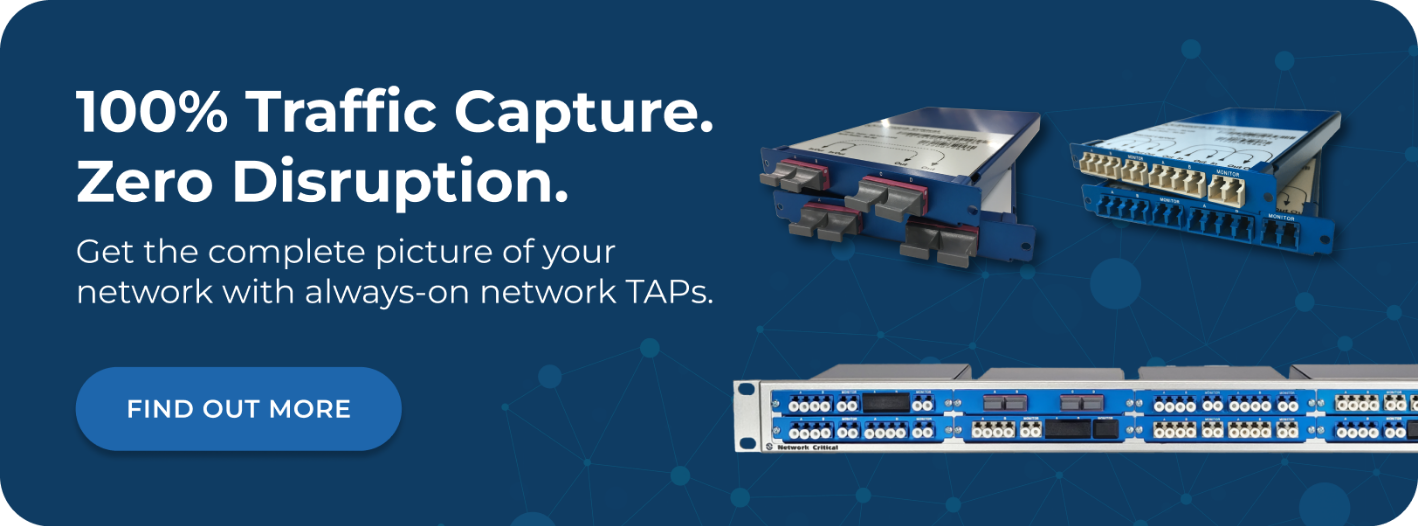
Network Critical takes a hybrid approach to TAP aggregation. Rather than treating the TAP and packet broker as separate devices, its platforms combine both functions in a single modular chassis. This directly addresses the most common friction point in aggregation deployments: organizations deploy TAPs, then discover they need a separate device to aggregate and distribute traffic to multiple tools.
The SmartNA-XL supports 1G, 10G, and 40G interfaces across five hot-swappable module slots in a 1RU chassis. Copper, passive fiber, and bypass TAP modules can be mixed in the same chassis. The system's 4:1 aggregation capability allows a single 10G monitoring tool to cover eight 1G links simultaneously, cutting tool costs by an equivalent margin. Aggregation, filtering, load balancing, packet slicing, and payload masking are all available in the same unit.
For higher-speed environments, the SmartNA-PortPlus scales from 48 to 194 ports across 1G, 10G, 25G, 40G, and 100G speeds in a 1RU chassis. The SmartNA-PortPlus HyperCore extends this to 400G with 32 QSFP-DD interfaces. All products are managed through Drag-n-Vu, Network Critical's patented graphical management interface, which handles filter rule computation automatically and eliminates misconfiguration risk. A RESTful API supports automated filter and port mapping updates without manual intervention.
The hybrid TAP and packet broker architecture eliminates a separate device from the visibility stack, reducing rack space, power draw, cabling complexity, and total cost of ownership for organizations running multiple monitoring tools against overlapping link sets.
Proven results:
- Vodafone: SmartNA-XL hybrid TAPs aggregated multi-generation copper and fiber links into a unified monitoring view, achieving 100% accurate traffic visibility on key links and reducing customer churn rates.
- BP: Passive fiber TAPs enabled centralized monitoring of IT and operational technology (OT) systems across refinery buildings spanning 10–12 buildings, with no configuration or ongoing maintenance required.
- HSBC: SmartNA TAPs and passive fiber TAPs deployed globally – from the UK to Hong Kong – achieved zero latency on monitoring technologies for real-time financial transaction visibility.
2. Garland Technology — AggregatorTAP and PacketMAX Advanced Aggregators
Garland Technology builds its entire product line around network visibility, and its aggregation portfolio reflects that focus. The AggregatorTAP line covers copper 10/100/1000M environments with portable and rack-mounted options. Each unit supports breakout, aggregation, and regeneration/Switch Port Analyzer (SPAN) modes, configurable via DIP switches for plug-and-play deployment. Hardware-based data diode design prevents any data flow from monitoring tools back to the live network, and fail-safe relay circuitry maintains link continuity on power loss.
For higher-density requirements, Garland's PacketMAX Advanced Aggregators deliver aggregation, filtering, and load balancing across multiple tools in a managed platform. The XtraTAP series combines TAP and packet broker functionality in a single device – an architecture similar in principle to Network Critical's hybrid approach. The broader TAP portfolio covers 1G to 100G across passive fiber, active copper, and inline bypass variants, with all units manufactured and tested in the US.
Garland maintains a dedicated traffic aggregation solutions page and publishes extensive educational resources – including whitepapers, use case guides, and product comparison tools – that help teams design aggregation architectures before procuring hardware. Their OT-specific product labeling and documented integration with Dragos makes Garland a strong choice for environments where IT and OT aggregation requirements coexist.
3. Keysight Technologies — iLink Aggregator II and Flex Tap Range
Keysight Technologies brings a test equipment heritage to TAP aggregation. The iLink Aggregator II is purpose-built for 1G aggregation and ships in two models: the LA2-INLN-T taps eight inline copper links with fail-to-wire protection, while the LA2-SPAN-T accepts 16 copper input ports from upstream TAPs or SPAN ports. Both models feature four SFP+ monitor ports supporting 1G or 10G transceivers, and two units fit in a single 1U rack space via an optional rack mount kit. Units can be cascaded monitor-port-to-monitor-port for tiered aggregation across larger deployments.
For higher speeds, Keysight's Flex Tap II range covers up to 400G across passive multimode and single-mode fiber, with up to 24 TAPs in a single 1U 19-inch chassis. The iLink aggregators are TAA-compliant and manufactured in the US, which matters for US federal and defense deployments with supply chain requirements.
Keysight's product line spans the broadest range of TAP types available from a single vendor – covering passive, active, patch, tough (industrial), and BiDi variants alongside the aggregation tier. The Vision ONE platform integrates TAPs, network packet brokers (NPBs), and management into a unified operational layer for organizations that need to scale aggregation beyond what standalone TAPs can deliver.
4. Cubro Network Visibility — EX48800 and Aggregation TAPs
Cubro Network Visibility covers the full spectrum from dedicated aggregation TAPs to high-performance NPBs that serve as the aggregation tier above standalone TAPs. Cubro's aggregation TAPs function as converter TAPs for copper-based links, outputting to SFP or SFP+ monitor ports – useful when fiber-based tools need access to copper OT or access layer infrastructure. In the event of failure, they fail-open to preserve the live link.
For higher-complexity aggregation deployments, the EX48800 NPB aggregates traffic from multiple inputs across 48 x 10/25Gbps and 8 x 40/100Gbps ports with hardware-level filtering for unmatched throughput. It supports multi-layer tunnel-aware filtering across VXLAN, GTP, ERSPAN, MPLS, and GRE – a meaningful advantage in environments where tunneled traffic would otherwise reach monitoring tools unprocessed and at full volume.
Cubro's optical TAP range extends from 1G to 400G with passive SR8 and MTP/MPO variants for high-speed data center links. Every unit undergoes individual testing and fiber connector inspection via precision microscope before shipping – a quality assurance step Cubro specifically references for 100G deployments where connector contamination can degrade performance.
5. Niagara Networks — 3808E and Open Visibility Platform
Niagara Networks delivers aggregation through a modular, platform-based approach built around its Open Visibility Platform. Active TAP devices integrated into the platform take part in link negotiation and provide configurable TAP aggregation – sending traffic from either side of a link to one or multiple monitoring ports. Passive TAP modules within the platform operate at the photonic level with no electronics, no IP address, and no management interface, providing a hard security guarantee for air-gapped segments.
The 3808E is Niagara's flagship hybrid platform. It combines dual-protection bypass with advanced packet broker functionality and supports up to eight network links – configurable as bypass segments or active TAPs. TAP aggregation, load balancing, and traffic filtering are all integrated into the same modular unit. Fail-safe optical relays ensure network flow continues uninterrupted on power loss, configurable as fail-open or fail-close to suit deployment requirements.
The FabricFlow management layer provides intent-based traffic flow configuration and supports API-driven automation for integration with orchestration platforms. A unified management interface covers network packet brokers, bypass switches, and TAPs from a single pane. Niagara also offers a Cloud Intelligence Platform (CIP) virtual packet broker for aggregation in hybrid and multi-cloud environments.
6. Datacom Systems — SINGLEstream G Series and SINGLEstream Link Aggregation TAPs
Datacom Systems has specialized in aggregation TAPs since 1992 and offers one of the most purpose-built product lines in this category. The SINGLEstream Link Aggregation TAPs handle copper and fiber aggregation at 1G, combining Rx and Tx data stream copies so that monitoring tools with a single Network Interface Card (NIC) can receive complete full-duplex conversations without specialized dual-NIC software.
The SINGLEstream G Series high-density aggregation system scales to support links from 1G to 400G in a modular fiber TAP chassis, with up to 24 fiber links in a 1U box. It adds managed capabilities including filtering, load balancing, and replication alongside the core aggregation function. The platform supports many-to-any port mapping, allowing traffic from multiple trunked links to be assembled into a single data stream – well-suited to environments with EtherChannel, load-balanced servers, or asymmetrically routed traffic.
Datacom's product breadth covers the gap between entry-level copper aggregation TAPs and full NPB platforms, making them a practical choice for organizations that need more than simple aggregation but don't require the full feature set of a high-end packet broker.
How to Choose the Right Aggregating Network TAP for Your Environment
Define Your Aggregation Ratio Requirements
Before selecting hardware, calculate the ratio of link inputs to monitoring tool outputs you need to support. A 4:1 aggregation ratio – four 1G links feeding a single 10G tool – is common in enterprise access layers, and most platforms handle it without difficulty. Where you need 8:1 or higher ratios, or where you're aggregating links of different speeds into a single higher-speed output, you'll need a platform with active traffic management rather than a simple passive aggregation device. Hybrid network TAP and packet broker platforms handle these ratios natively.
Match Speed Coverage to Your Current and Future Infrastructure
Select a platform whose TAP modules cover your current link speeds and your anticipated infrastructure within a three-to-five-year planning horizon. Replacing aggregation TAPs mid-deployment is costly and disruptive. Modular chassis systems that accept mixed-speed TAP modules – accommodating legacy 1G OT links alongside modern 100G backbone links in the same chassis – give you the most flexibility. Confirm that the vendor's aggregation tier matches the speed of your highest-priority links, not just the entry-level offering.
Consider the Distinction Between Passive and Active Aggregation
Passive aggregation TAPs split the optical budget and require no power, offering zero network impact and no single point of failure. They suit environments where tool availability is the primary constraint. Aggregation TAPs participate in link negotiation, support configurable port mapping, and can send traffic to multiple monitoring tools simultaneously. For deployments requiring intelligent filtering, load balancing, or traffic distribution to more than one tool, active aggregation or a hybrid platform is necessary.
Evaluate Total Device Count and Management Overhead
A common aggregation architecture mistake is deploying dedicated TAPs plus a separate aggregation layer plus a separate packet broker, creating three management interfaces and additional potential failure points. Hybrid architectures that combine TAP access, aggregation, and intelligent distribution in a single chassis reduce device count, cabling, and operational complexity. Consider the management interface as part of the selection: graphical configuration tools that eliminate manual filter rule entry reduce both deployment time and the risk of misconfiguration gaps.
Factor In Compliance and Data Handling Requirements
If your environment is subject to regulatory frameworks – such as NERC CIP for electrical utilities, NIS2 for EU critical infrastructure operators, or HIPAA for healthcare networks – confirm that your aggregation platform supports the traffic handling controls those frameworks require. Features like payload masking, packet slicing, and header stripping ensure that sensitive data fields don't reach monitoring tools that aren't authorized to process them. Hardware-based data diode designs, available in several products on this list, provide a hard guarantee that monitoring ports cannot inject data back into the live network.
Assess Scalability Without Replacement
The most expensive aggregation TAP decision is one that forces a full replacement when your port count outgrows the initial deployment. Network packet brokers and hybrid platforms with scale-out architectures let you add capacity incrementally – adding a second or third chassis unit that operates as a single managed system alongside the original. Validate the maximum port count and the mechanism for expansion before committing to a platform.
Frequently Asked Questions
What Is a Network TAP With Traffic Aggregation?
A network TAP with traffic aggregation is a hardware device that both copies live network traffic and combines full-duplex Rx and Tx streams – or traffic from multiple links – into a single output for monitoring tools. Standard breakout TAPs send Rx and Tx streams to separate monitor ports, which requires tools to have dual-NIC capability to reconstruct conversations. Aggregating TAPs remove that requirement by merging the streams before delivery, allowing a single-NIC tool to receive complete, bidirectional traffic data.
What Is the Difference Between a TAP and a Packet Broker?
A TAP creates a passive physical copy of live traffic from a single network link without affecting the production network. A packet broker sits above the TAP layer, aggregating traffic from multiple TAP points and distributing it intelligently to monitoring tools. Packet brokers add filtering, load balancing, deduplication, and policy-based traffic management that standalone TAPs don't provide. Many enterprises deploy both: TAPs for access and packet brokers for traffic management. Hybrid platforms that combine both functions in a single chassis reduce this to a single device.
How Many Links Can an Aggregating TAP Handle?
This depends on the platform. Basic copper aggregation TAPs typically handle one to four links. Mid-range managed aggregation systems handle 8–24 links in a 1U chassis. High-density platforms and hybrid TAP/packet broker systems can aggregate traffic from tens or hundreds of links and distribute it across multiple monitoring tools simultaneously. For environments with more than a handful of TAP points, a managed aggregation platform or hybrid chassis typically delivers better total cost of ownership than deploying large numbers of individual passive TAPs.
Do Aggregating TAPs Drop Packets?
A well-designed aggregating TAP passes 100% of packets including errored and malformed frames that SPAN ports would discard. The critical caveat is oversubscription: if the aggregate traffic rate across all input links exceeds the bandwidth of the monitor output port, the TAP must drop packets to prevent output saturation. Design your aggregation ratio conservatively – accounting for peak traffic, not average load – and select a platform with active flow management features if your links approach the oversubscription threshold.
Can an Aggregating TAP Work With Existing SPAN Port Feeds?
Yes. Several platforms on this list – including the Keysight iLink Aggregator II LA2-SPAN-T and Datacom Systems SINGLEstream products – are specifically designed to accept both TAP-sourced and SPAN-sourced inputs in the same aggregation layer. This supports incremental migration: you can feed existing SPAN outputs into the aggregation platform while adding dedicated TAPs link-by-link, avoiding a hard cutover that would require simultaneous replacement of all monitoring access points.
What Aggregation Ratio Is Typical for Enterprise Deployments?
A 4:1 aggregation ratio is common in enterprise access layers, where four 1G links are consolidated to a single 10G monitoring tool port. Higher ratios of 8:1 or greater are used in core aggregation and data center deployments where tool costs justify maximizing utilization. Telecom and carrier environments often require even higher ratios, particularly where legacy 1G subscriber links feed centralized monitoring infrastructure. The right ratio for your environment depends on your peak traffic volumes, the processing capacity of your monitoring tools, and whether you're deploying active filtering to reduce the traffic volume reaching each tool.
Build Your Aggregation Architecture With Network Critical
Choosing the right aggregating TAP determines whether your monitoring tools receive accurate, complete traffic data – or a noisy, oversubscribed stream that degrades the quality of every analysis downstream. The platform decision matters as much as the TAP specification.
Network Critical's hybrid TAP and packet broker architecture eliminates the need to deploy and manage separate devices at each function in the visibility stack. The SmartNA-XL combines passive fiber, active copper, and bypass TAP modules with full packet broker capabilities – aggregation, filtering, load balancing, and payload masking – in a single 1RU chassis. The SmartNA-PortPlus scales this to 194 ports and 100G, with the SmartNA-PortPlus HyperCore extending coverage to 400G. Every platform is managed through the Drag-n-Vu graphical interface, which eliminates manual filter rule computation and reduces deployment time.
Speak to the Network Critical team to discuss your aggregation requirements.