Top 5 Fiber Network TAPs for Telecom Networks in 2026
Fiber infrastructure carries the backbone of modern telecommunications. As 100G links become standard in core and metro networks, monitoring tools must match link performance. Passive fiber optical TAPs provide a zero-impact method of capturing traffic. They add no latency, disrupt no live traffic, and introduce no points of failure. For telecom operators, the right fiber TAP determines the accuracy of every QoS measurement. It also determines the integrity of every compliance report and every security alert downstream.
This article compares five verified vendors offering fiber TAP solutions for telecom-scale deployments in 2026.
Fiber Network TAP Vendors at a Glance
| Vendor | Key Feature / Strength | Max Throughput |
|---|---|---|
|
Passive optical TAPs plus hybrid TAP/packet broker in single chassis |
Up to 400G |
|
|
Pure-play TAP specialist; no-subscription pricing; OT ecosystem |
Up to 100G |
|
|
IOTA all-in-one capture appliance; strong European partner network |
Up to 100G |
|
|
FPGA-based zero-packet-loss; Tolly Group validation; 400G/800G packet broker |
Up to 400G |
|
|
On-box IDS capability; compliance-led positioning; 400G blade support |
Up to 400G |
Network Critical
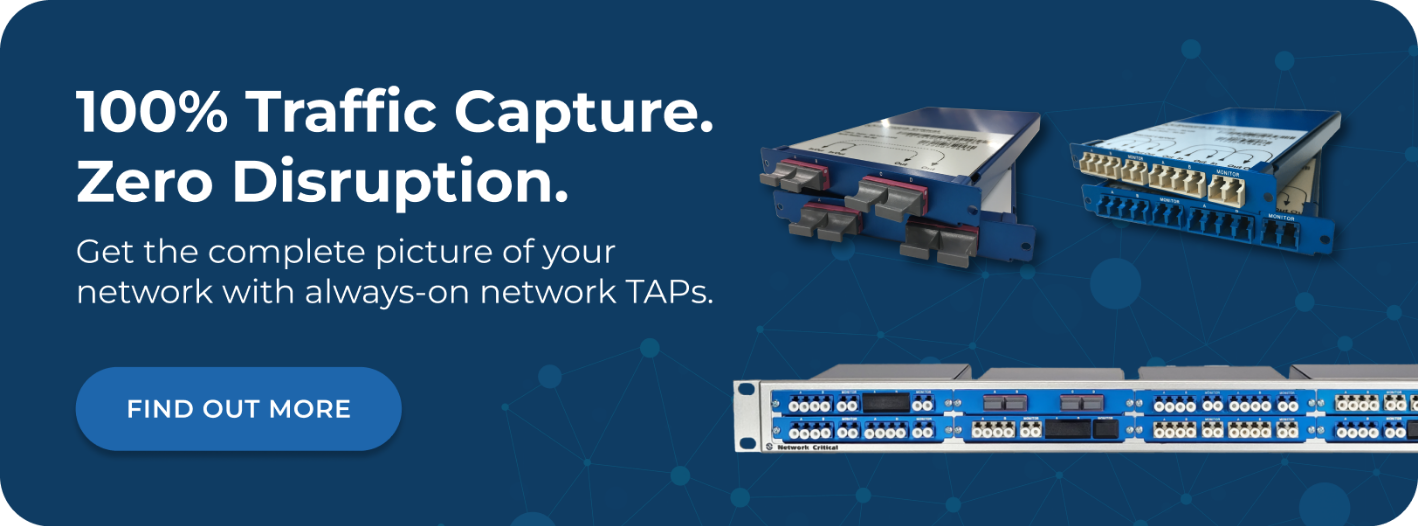
Network Critical manufactures a complete passive optical TAP portfolio from 1G to 100G. Up to 16 fiber taps fit within a single 1RU chassis. Each unit operates without external power, introduces zero latency, and creates no single point of failure on the monitored link. This makes them suited to telecom core, metro, and backhaul links where traffic integrity is non-negotiable.
Network TAPs are available in single-mode and multi-mode variants. Selectable split ratios balance signal distribution between the live link and monitoring output. In mixed-speed environments, the SmartNA-XL hybrid TAP and packet broker handles 1G to 40G links in a single 1RU chassis. The SmartNA-PortPlus extends coverage to 100G with 48 to 194 ports and 1.8 Tbps system throughput. TAP modules connect copper and fiber links. Traffic is then aggregated to higher-speed tool ports without impacting the monitored network.
Drag-n-Vu provides graphical port mapping and filter configuration. Network admins manage visibility infrastructure without specialist engineers. Deployments typically complete in under two hours. Perpetual hardware licensing with no per-port fees removes the subscription costs common with larger vendors.
Proven results:
- Vodafone: Achieved 100% accurate traffic visibility on key links across a multi-generation European mobile network, supporting QoS monitoring and compliance reporting
- BP: Enabled centralised monitoring of critical OT and IT systems across distributed refinery buildings using passive fiber TAPs
- HSBC: Deployed passive fiber optical TAPs for zero-latency monitoring, supporting real-time financial transaction assurance
Garland Technology
Garland Technology is a US-based pure-play TAP specialist. Their product line covers passive fiber TAPs, inline bypass, and packet brokers across 1G to 100G. The company publishes a "no hidden fees, no subscriptions, no extra fees after purchase" commitment on its homepage. This positions Garland alongside Network Critical on commercial transparency.
Garland's fiber TAP portfolio includes breakout and regeneration TAP options. Both single-mode and multi-mode fiber are supported, across 10G, 25G, 40G, and 100G links. Publicly documented specifications confirm these speed tiers on the Garland website.
Garland's OT security partner ecosystem is its most distinctive feature. Named integrations cover Nozomi Networks, TXOne, and Radiflow. For telecom operators with converged IT/OT infrastructure, this can simplify tool on-boarding. Garland does not offer a drag-and-drop GUI equivalent to Drag-n-Vu. Configuration follows a more traditional TAP-led workflow. Advanced packet broker features such as deduplication, masking, and slicing are available. However, they are less integrated than on platforms with unified management software.
Profitap
Profitap is a Netherlands-based vendor. Their fiber TAP range covers 1G to 100G passive optical access alongside the IOTA and ProfiShark product lines. In telecom environments, Profitap competes primarily on European field presence and strength in forensics-focused accounts. IOTA's combined capture-and-analysis capability is its primary draw in these accounts.
IOTA integrates TAP, capture, storage, and analysis in a single appliance. This suits network operations teams who want a self-contained troubleshooting tool. For larger telecom fabric deployments distributing traffic to multiple tools simultaneously, IOTA's all-in-one design limits routing flexibility.
Profitap's fiber TAP portfolio supports breakout and aggregation configurations. The Supervisor centralised management layer handles multi-device deployment across distributed sites. Public documentation confirms 10G and 100G support. Specifications above 100G were not publicly available at time of writing. Profitap's North American field presence is more limited than its European footprint.
Keysight (Ixia)
Keysight inherited its network visibility portfolio from the Ixia acquisition. The TAP range includes passive fiber options from 1G to 100G. The underlying FPGA-based architecture was independently validated for zero packet loss by The Tolly Group. Keysight positions its visibility line as part of a broader test-and-measurement portfolio serving service providers and regulated enterprise.
The Vision 400 packet broker series supports 400G and 800G configurations relevant to telecom core deployments. It received the Frost and Sullivan 2024 Global New Product Innovation Award. The IFC Centralised Manager provides unified management across Vision packet broker deployments. Keysight's service-provider credentials are strong, with documented deployments at tier-1 carriers.
Pricing is positioned at a premium relative to mid-market vendors. Network visibility sits within a broader business unit alongside wireless and test-and-measurement products. Visibility-specific support competes for attention alongside larger revenue lines. The OT motion is relatively recent. The Forescout partnership announced in January 2026 represents Keysight's initial step into that segment.
APCON
APCON is a Wilsonville-based packet broker and TAP specialist. Their IntellaView platform supports blade-based 400G configurations alongside a range of fiber TAP modules. The Q1 2026 launch of IntellaStore IV introduced bundled ThreatGuard IDS capability. This allows customers to run on-box intrusion detection against captured traffic. No separate appliance is required.
APCON's compliance positioning covers HIPAA, PCI-DSS, and related frameworks. Data masking and packet slicing are available on the IntellaView platform. A 60-day free trial is bundled with IntellaStore IV. Fiber TAP modules are available for 1G, 10G, 40G, and 100G links. 400G blade support is documented on the IntellaView platform.
APCON is a US-centric business with a smaller global footprint than Gigamon or Keysight. European and APAC coverage depends on distributor channels. UK and EU buyers with data sovereignty requirements should confirm local support availability during evaluation.
How to Choose a Fiber Network TAP for Telecom Infrastructure
Match TAP Speed to Your Link Portfolio
The first decision is link speed coverage. Most telecom environments mix legacy 1G copper and fiber with 10G metro links and 100G core routes. A fiber TAP covering only 100G will not serve the full network.
Vendors spanning multiple speed tiers within a single management framework avoid separate TAP platforms per link type. This becomes important when adding monitoring points during network upgrades.
Evaluate Aggregation and Media Conversion Needs
Passive fiber TAPs output a copy of traffic at the same speed as the monitored link. If monitoring tools run at higher speeds, aggregation brings multiple lower-speed inputs to a single higher-speed tool port.
Platforms combining passive optical tap access with packet broker aggregation in a single chassis reduce rack space, power, and cabling. Compared to separate TAP and broker deployments, this is a meaningful saving. It matters most in co-location facilities and remote equipment rooms where space is constrained.
Assess Management and Configuration Complexity
TAP and packet broker deployments grow over time. A platform requiring specialist engineers to reconfigure accumulates operational costs. Consider whether the management interface allows network admin self-service or whether every filter and mapping change requires a vendor engagement.
GUI-driven platforms reduce maintenance window duration and lower error risk. Look for platforms offering:
- Drag-and-drop port mapping
- Filter rule generation without manual rule set input
- One-click rollback for failed configuration changes
- API integration for automated workflows
Confirm Zero-Latency and Zero-Packet-Loss Architecture
In telecom QoS monitoring, dropped packets produce inaccurate KPIs. In compliance environments, incomplete capture can invalidate audit evidence. Passive fiber TAPs with a zero-packet-loss guarantee provide stronger assurance than SPAN-based alternatives. SPAN is oversubscribed by design at peak load and drops packets silently.
Request independent validation data where available. FPGA-based architectures and passive optical splitting provide the strongest basis for zero-drop performance claims.
Assess Total Cost of Ownership Over Three Years
Initial hardware cost is a fraction of the full 3-year ownership picture. Factor in these additional items:
- Subscription costs versus perpetual licensing
- Per-port licence fees on expansion
- Engineer time for deployment and ongoing changes
- Tool consolidation savings from aggregation
Vendors with perpetual licensing, no per-port fees, and admin-deployable management can reduce 3-year TCO by 40 to 60 per cent. This compares to subscription-based platforms of equivalent throughput at higher-tier vendors.
Plan for Multi-Generation Network Longevity
Telecom infrastructure carries investment cycles of 10 to 20 years. A fiber TAP platform procured today must support link upgrades from 10G to 100G. Confirm whether the platform supports a path to 400G without chassis replacement. Modular designs accepting new speed modules on existing infrastructure protect the initial capital investment and simplify the upgrade path.
Frequently Asked Questions
What Is a Passive Fiber Network TAP?
A passive fiber network TAP is a hardware device that splits an optical signal on a live fiber link. It creates a copy of all traffic for monitoring tools. It introduces no latency and does not disrupt live traffic. It operates without power for the splitting function, so it creates no single point of failure. Telecom operators use passive fiber TAPs to access core and metro links transparently.
How Is a Fiber TAP Different From a SPAN Port?
A fiber TAP creates a physical copy of every packet at wire speed with zero packet loss. A SPAN port is a software-configured mirror on a managed switch. SPAN drops packets when the switch CPU is under load and supports only a limited number of sessions per switch. In telecom environments, QoS measurement accuracy and compliance fidelity depend on complete capture. SPAN's silent packet drop behaviour makes it unsuitable as a primary monitoring access method.
What Throughput Should a Fiber TAP Support for Telecom Core Networks?
Modern telecom core links typically run at 10G, 40G, or 100G. A fiber TAP platform for this environment should support at least 100G per port. Network packet brokers that aggregate multiple lower-speed inputs to higher-speed tool ports can also reduce total monitoring tool count. For next-generation 400G core deployments, confirm that the platform has a documented upgrade path without a chassis replacement.
Do Fiber TAPs Require Changes to the Monitored Network?
No. Passive fiber TAPs are inserted into the fiber span. They create a copy of the optical signal. They require no configuration change on connected switches or routers. In live telecom environments, this is a significant advantage. Changes to production network devices require change control approval and carry risk. TAP insertion avoids both.
How Many Fiber TAPs Can a Single Chassis Support?
This depends on the platform. Network Critical's passive fiber TAP chassis supports up to 16 TAPs per 1RU. Multiple chassis can be managed through a unified software interface. Telecom deployments monitoring dozens of links across a national network typically combine passive fiber TAPs with a centralised packet broker. This aggregates traffic and reduces the total number of monitoring tool connections required.
Build Telecom Visibility With Network Critical
Selecting the right fiber TAP platform determines the reliability of every monitoring, security, and compliance function downstream. For telecom operators, the requirements are exacting: zero packet loss, multi-speed coverage, scalability, and low long-term cost.
Network Critical's telecommunications network visibility solutions combine passive fiber TAPs, hybrid TAP and packet broker platforms, and Drag-n-Vu management software. The portfolio spans 1G to 400G. Perpetual hardware licensing carries no per-port fees. Typical deployments complete in under two hours without specialist engineers. The 3-year TCO runs 40 to 60 per cent lower than subscription-based alternatives at comparable throughput.
To discuss your telecom visibility architecture or to request a network audit, speak to the Network Critical team.