Top 8 Network TAPs for SWIFT CSP Compliance
SWIFT's Customer Security Programme (CSP) now demands continuous evidence, not annual paperwork. CSCF v2027 was published in July 2026. It governs attestations submitted between 1 July and 31 December 2027.
The framework keeps 32 controls, and 26 of them are mandatory. Every attestation must also be backed by an independent assessment. Several of those controls depend on what your monitoring tools can actually see. Logging and monitoring under control 6.4 now explicitly covers the SWIFT HSM. Intrusion detection under 6.5A remains advisory but sits in the same detection objective. Secure zone protection under 1.1 now recognises microsegmentation as a valid approach.
Each outcome relies on complete, unaltered traffic reaching your security stack. SPAN ports cannot guarantee that under load. This guide compares eight network TAP vendors on the capabilities that matter for SWIFT CSP evidence in 2027.
At a Glance: Network TAPs for SWIFT CSP Compliance
|
Vendor |
Key Feature / Strength |
Max Throughput |
|---|---|---|
|
Passive TAPs plus hybrid TAP and broker chassis with payload masking and perpetual licensing |
Up to 400G |
|
|
Passive G-TAP modules feeding the GigaVUE deep observability pipeline |
Up to 400G |
|
|
Unpowered Flex Tap II, up to 24 TAPs per 1U |
Up to 400G |
|
|
Switch-based TAP aggregation with a multi-tenant monitoring fabric |
Up to 400G |
|
|
TAPs and packet flow switches tied to nGeniusONE analytics |
Up to 400G |
|
|
IntellaView chassis plus on-box capture and intrusion detection |
Up to 400G |
|
|
US-made passive TAPs and brokers without feature licence fees |
Up to 400G |
|
|
Passive MTP TAPs with a ten-year warranty |
Up to 400G |
1. Network Critical
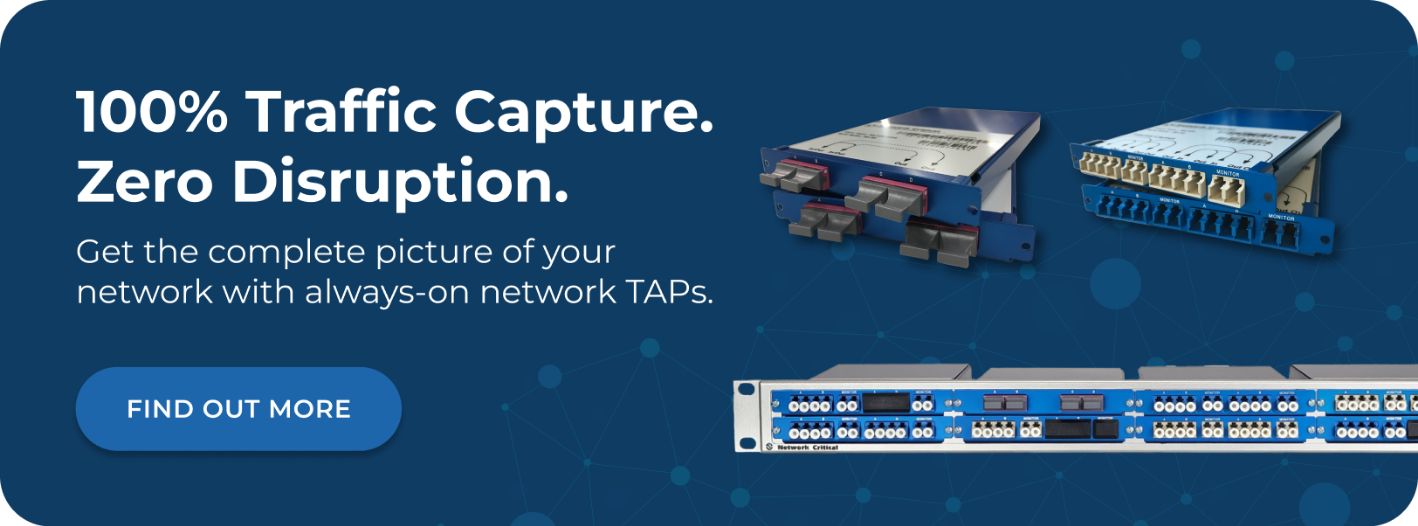
Network Critical: Passive Fiber TAPs, SmartNA-XL, SmartNA-PortPlus, Drag-n-Vu Network Critical manufactures TAPs and packet brokers in the UK, with a US office in Georgia. For the SWIFT secure zone, its passive fiber tap range is the logical starting point. These TAPs draw no power and contain no active electronics or management system. They support 1G to 100G links, with up to 16 TAPs in a single 1RU. You get a full-duplex copy of every packet, including errors, without adding a reachable device to the zone. Where links need aggregation or filtering, the SmartNA-XL combines TAP modules and packet brokering in one 1RU chassis. Its five slots accept passive, active and bypass modules across 1G, 10G and 40G. Payload masking and packet slicing strip sensitive message content before traffic reaches your tools. Role-based accounts, TACACS+ and SNMPv3 support the access controls your assessor will review. For larger payment hubs, the SmartNA-PortPlus scales from 48 to 194 ports at 1G to 100G. It delivers 1.8 Tbps of non-blocking, line-rate throughput. The SmartNA-PortPlus HyperCore extends the platform to 400G across 32 QSFP-DD interfaces. Drag-n-Vu manages the whole estate from one graphical interface. It warns you before an invalid filter is applied and offers one-click rollback. Its open API lets security tools adjust filters automatically. Hardware is sold on perpetual licences rather than subscriptions.
Best for: Financial institutions that need fail-safe secure zone access and audit-ready configuration control without subscription costs.
Proven results:
- HSBC: Passive fibre TAPs and SmartNA delivered zero-latency monitoring with zero network impact from the UK to Hong Kong
- Bourne Leisure: SmartNA-XL connected eight live 1Gbps links to a single 10Gbps security tool protecting customer financial data
- Darktrace: The SmartNA-PortPlus API let Darktrace control filters and port maps automatically, with no human intervention
2. Gigamon
Gigamon: G-TAP M Series, GigaVUE HC Series, GigaVUE-FM Gigamon is the largest vendor in the network visibility category. It holds 51 per cent of the deep observability segment, according to 650 Group figures released in March 2026. The G-TAP M Series provides passive optical TAP modules that need no power source. Singlemode models support links up to 400G, with 50/50 and 70/30 split ratios. A half-rack-unit chassis taps up to 18 full-duplex links, while the 1RU chassis handles 36. The chassis is TAA compliant. G-TAP modules typically feed GigaVUE HC Series nodes running GigaSMART traffic intelligence. That pipeline adds TLS/SSL decryption, application filtering and application metadata generation. GigaVUE-FM provides centralised fabric management across physical and cloud estates. Gigamon positions the platform for compliance validation and Zero Trust architectures, with a dedicated financial services practice. The platform suits large banks running broad observability programmes that extend well beyond SWIFT. Commercial terms lean towards subscription licensing. For a contained secure zone, model licensing costs across several attestation cycles before committing. Advanced GigaSMART configuration also typically calls for specialist engineering skills.
3. Keysight Technologies
Keysight Technologies: Flex Tap II, Vision 400 Series Keysight's network visibility business is built on its acquisition of Ixia. The Flex Tap II is a fully passive fibre TAP supporting 1G to 400G links. It requires no power and has no IP address, so it stays invisible inside a segmented zone. Split ratios range from 50/50 to 90/10. Up to 24 TAPs fit in a 1U, 19-inch rack space. A one-third-width mini-chassis is available for tight racks. Both multimode fibre, including OM5, and singlemode fibre are supported. Downstream, the Vision 400 Series packet brokers won a Frost and Sullivan 2024 Global New Product Innovation Award. Their FPGA-based architecture has been validated for zero packet loss by The Tolly Group. A drag-and-drop interface removes the need to build filters through CLI commands or regular expressions. Keysight suits institutions that already use Ixia test and visibility equipment. Visibility is one business line inside a much larger test and measurement portfolio. Pricing sits at the premium end of the market, close to Gigamon on three-year cost.
4. Arista Networks
Arista Networks: DANZ EOS TAP Aggregation, DANZ Monitoring Fabric (DMF) Arista approaches visibility from the switch side rather than the TAP side. DANZ EOS turns Arista 7280R and 7500R Series switches into TAP aggregation platforms. Arista quotes scale of up to 576 ports of 400G. Features include wire-rate Layer 2 to 4 filtering on every port and nanosecond-precision timestamping. Packet truncation supports data privacy by removing payloads before tools receive them. Source tagging records exactly where in the network each packet was captured. DANZ Monitoring Fabric (DMF) adds a controller-driven, multi-tenant visibility layer. Delegated administration lets NetOps and SecOps teams share one fabric under separate policies. Recording and replay functions support historical investigation after an incident. DANZ aggregates traffic arriving from upstream TAPs and mirror sessions. You will still need a passive TAP layer at the secure zone boundary. Arista's value is strongest where it is already the incumbent switching vendor. Outside that install base, adopting DMF means committing to Arista hardware for the monitoring fabric.
5. NETSCOUT
NETSCOUT: Fiber Optic TAPs, External PowerSafe TAPs, nGenius 5000 and 7000 Series Packet Flow Switches NETSCOUT sells visibility as part of a wider service assurance and security stack. Its fibre optic TAPs have no moving parts, need no power and carry no IP address. Copper TAPs cover 10Mbps to 1Gbps links, with automatic failover on power loss. External PowerSafe TAPs add active inline bypass from 1G copper to 100G fibre. That protects inline security tools deployed in front of SWIFT infrastructure. The nGenius 5000 and 7000 Series packet flow switches aggregate and distribute traffic at up to 400G. They feed NETSCOUT's nGeniusONE performance platform and Omnis Cyber Intelligence for network detection and response. A January 2026 nGeniusONE update added SSL/TLS certificate expiry monitoring. The trade-off is architectural. NETSCOUT delivers the most value when you also buy into its analytics stack. Institutions that prefer to choose their own SIEM and NDR tools may find the platform less flexible. Pricing is enterprise grade.
6. APCON
APCON: ApconTAP, IntellaView, IntellaStore IV, ThreatGuard APCON is a packet broker specialist based in Wilsonville, Oregon. ApconTAP network TAPs provide the access layer, delivering packet payloads to downstream cybersecurity tools. The IntellaView platform spans 1G to 400G in chassis from 1RU to 9RU. HyperEngine processing handles advanced functions such as deduplication. APCON positions its platform around regulatory compliance, including data masking and packet slicing. In February 2026, APCON launched IntellaStore IV. The appliance combines visibility, packet capture and on-box security applications. It stores up to 32TB of traffic, recorded by filter, custom criteria or event-based trigger. The optional ThreatGuard intrusion detection system runs on the APCON Intelligent Processor. Each IntellaStore IV ships with a 60-day ThreatGuard trial. For SWIFT users, that combination could address 6.5A intrusion detection and forensic retention in one appliance. The model is new, however, and scaled public customer references remain limited. Pricing is quote-based through partners.
7. Garland Technology
Garland Technology: Passive Fiber TAPs, PacketMAX, EdgeSafe Bypass TAPs, Data Diodes Garland Technology is a TAP specialist that designs and manufactures its hardware in the USA. Its passive, unpowered fibre TAPs cover 1G to 400G links. PacketMAX Advanced Feature packet brokers cover 1G to 100G. Garland states these include all features with no additional port or feature licence fees. EdgeSafe bypass TAPs and EdgeLens inline packet brokers protect inline tools from 1G to 100G. A hardware data diode line enforces one-way traffic flow. That is relevant where monitoring must never send traffic back into a protected zone. Garland's homepage also commits to no subscriptions and no extra fees after purchase. That model aligns well with fixed compliance budgets. The trade-offs sit at the high end. The packet broker range is narrower in advanced features than the larger platforms. Configuration is more traditional and less visual than GUI-led rivals. Garland's field presence is US-centric, so European coverage depends mainly on distributors.
8. Profitap
Profitap: 1-Link MTP Fiber TAP, X2 Series Packet Brokers, IOTA Profitap is a Netherlands-based vendor with a strong European reseller footprint. Its 1-Link MTP fibre TAP supports 40G, 100G and 400G links over MTP/MPO connectors. It is passive and unpowered, with 50/50 and 70/30 split options. Every Profitap fibre TAP carries a ten-year warranty from the date of purchase. That suits secure zone hardware you want to install once and leave untouched. The X2 Series packet brokers scale from 100G models up to the X2-12800G. That model provides 32 QSFP56-DD ports at 400G, with breakout to 128 ports of 100G. The IOTA line combines capture, storage and analysis in a single device. That suits forensic investigation at a branch or a single SWIFT connection point. Profitap's North American presence is thinner than its European one. Its 400G positioning for large service-provider deployments is also less established than the enterprise incumbents. For EU institutions focused on data sovereignty, a European vendor may still carry weight.
How to Choose a Network TAP for SWIFT CSP Compliance
Start With Your Architecture Type
SWIFT defines five architecture types: A1, A2, A3, A4 and B. Your type decides which controls apply and where your secure zone boundary sits. A1 to A3 users protect a local SWIFT secure zone under control 1.1. A4 users attest against control 1.5 instead. Map every link that crosses the boundary before you size any hardware.
Prioritise Passive, Unaddressable Access
Any device you add inside the secure zone enters the assessment scope. Passive fibre TAPs with no IP address, MAC address or power supply minimise that footprint. Check how each vendor's copper or active TAPs behave on power loss. Fail-safe designs keep payment links up even when monitoring hardware fails.
Confirm Full-Fidelity Feeds for 6.4 and 6.5A
Your SIEM, NDR and intrusion detection tools can only log what they receive. Validate that the TAP and broker layer delivers lossless traffic at peak volume, including error frames. Where several tools need the same feed, network packet brokers replicate it without SPAN contention.
Control Exposure of Payment Data
SWIFT message traffic carries highly sensitive transaction data. Ask each vendor whether its platform supports:
- Payload masking before traffic reaches third-party tools
- Packet slicing to forward headers only
- Role-based access with TACACS+ or RADIUS authentication
- Audit trails for every filter and port map change
Plan for the Independent Assessment
Your assessor will ask how monitoring is configured and who can change it. Graphical configuration with rollback and change logging shortens that conversation. API control also lets security tools adjust filters without manual change tickets. Hybrid TAPs reduce the number of separate devices you need to document.
Model Cost Across Attestation Cycles
SWIFT attestation recurs every year. Subscription licensing compounds across those cycles, while perpetual licensing fixes most of the cost up front. Compare three-year totals, including support and feature licences, not just the purchase price.
Frequently Asked Questions
Does SWIFT CSP Require Network TAPs?
No, SWIFT CSP does not name network TAPs in any control. It does require outcomes that TAPs support, including logging and monitoring under mandatory control 6.4. Advisory control 6.5A covers intrusion detection. Both depend on complete traffic reaching your security tools, which hardware TAPs provide without touching production links.
What Changes in SWIFT CSCF v2027?
CSCF v2027 is an incremental update that keeps 32 controls, with 26 mandatory and 6 advisory. It confirms the SWIFT HSM is in scope for logging and monitoring under 6.4. Microsegmentation is now recognised for protecting critical systems under 1.1 and 1.5. Control 2.2 addresses AI-driven threats and faster vulnerability remediation. Attestations against v2027 run from 1 July to 31 December 2027.
Can SPAN Ports Support SWIFT CSP Monitoring?
SPAN ports can supplement monitoring, but they are a weak foundation for compliance evidence. They drop packets when oversubscribed and raise no alert when they do. They also compete with switching workloads for CPU resources. Hardware TAPs copy every packet regardless of load. Our guide to network TAPs vs SPAN explains the differences in detail.
Is Intrusion Detection Mandatory Under SWIFT CSP?
No, control 6.5A Intrusion Detection is advisory in CSCF v2027. Advisory controls do not count towards mandatory compliance, but SWIFT recommends implementing them. If you deploy inline intrusion prevention, protect the link with a bypass tap. Payment traffic then keeps flowing if the appliance fails or is taken offline.
Can Network TAPs See Encrypted SWIFT Traffic?
Network TAPs copy encrypted traffic exactly as it crosses the link, but they do not decrypt it. Your tools still receive headers, flow records, session timing and handshake metadata. That is enough for connection logging and anomaly detection. Decryption, where policy permits, happens in a dedicated tool further downstream.
Build Your SWIFT CSP Visibility Architecture With Network Critical
Your 2027 attestation is only as strong as the evidence behind it. That evidence starts with complete, unaltered traffic from every link touching the secure zone. Network Critical provides that foundation with passive, fail-safe access and hybrid TAP and broker platforms. Perpetual licensing delivers 40 to 60 per cent lower three-year TCO than the leading enterprise incumbents. Drag-n-Vu lets your network team configure and roll back changes without specialist engineers. Typical deployments complete in under two hours. Every feed is standard PCAP, so it works with whichever SIEM, NDR or capture tool you choose. Explore the full range of network taps for your secure zone. Ready to prepare for your next attestation window? Speak to the Network Critical team to request a free network audit.