Top 8 Network TAPs for Teams Deploying NDR Tools in 2026
Network Detection and Response (NDR) tools are only as effective as the traffic data they receive. Feed an NDR sensor partial traffic from an overloaded Switch Port Analyzer (SPAN) port and you're handing it an incomplete picture — one where threats hide in dropped packets and blind spots created by port contention. Purpose-built network TAPs eliminate that risk entirely.
A TAP creates a passive, full-duplex copy of every packet traversing a link, including malformed frames and physical-layer errors that SPAN ports suppress. Under any traffic load, the copy is complete. When power fails, the link stays up. NDR tools receive exactly what they need to build accurate baselines and detect anomalies with confidence.
This guide compares eight verified TAP vendors across the specifications that matter most for NDR deployments: packet fidelity, throughput support, bypass protection, traffic filtering, and integration with modern security architectures.
At a Glance: Network TAPs for NDR Deployments
| Vendor | Key Products | Max Speed Supported | NDR Deployment Strengths |
|---|---|---|---|
|
SmartNA series, SmartNA-XL, SmartNA-PortPlus |
Up to 400G |
RESTful API for automated NDR filter control; hybrid TAP/packet broker in one chassis; zero packet loss; scale-out architecture |
|
|
Breakout TAPs, EdgeLens, PacketMAX, XtraTAP |
Up to 400G |
TAP-to-tool philosophy; built-in data diode circuitry; no per-port license fees; explicit NDR partner integrations |
|
|
G-TAP M Series, G-TAP A Series, GigaVUE Universal Cloud Tap |
Up to 400G |
Deep Observability Pipeline feeds NDR tools across physical and cloud; SSL/TLS decryption; broad ecosystem integrations |
|
|
Flex Tap II, Flex Tap VHD, Flex Tap Secure+, Patch Tap, Tough Taps |
Up to 400G |
Highest density (36 TAPs per 1U); Secure+ blocks monitor-port injection; broadest tap type range of any vendor |
|
|
OptoSlim TAP Series, Copper TAPs, Converter TAPs |
Up to 400G |
Vendor-neutral design; feeds multiple NDR tools simultaneously; Vitrum single-pane management; carrier-grade reliability |
|
|
ApconTap passive optical TAPs, IntellaView Bypass TAP Blade, IntellaTap-VM |
Up to 400G |
Auto-detects and bypasses failed inline tools in milliseconds; application-aware filtering; hybrid physical/virtual coverage |
|
|
nGenius Packet Flow Switches, vTAPs |
Up to 100G |
Integrated with nGeniusONE for service assurance alongside NDR feeds; physical and virtual TAP coverage including Azure |
|
|
ProfiShark, IOTA Network Probes, fiber TAPs |
Up to 10G (portable); fiber TAPs to 100G |
Portable hardware timestamping at 8ns resolution; useful for ad hoc NDR sensor deployment and field troubleshooting |
1. Network Critical — SmartNA Series and SmartNA-PortPlus
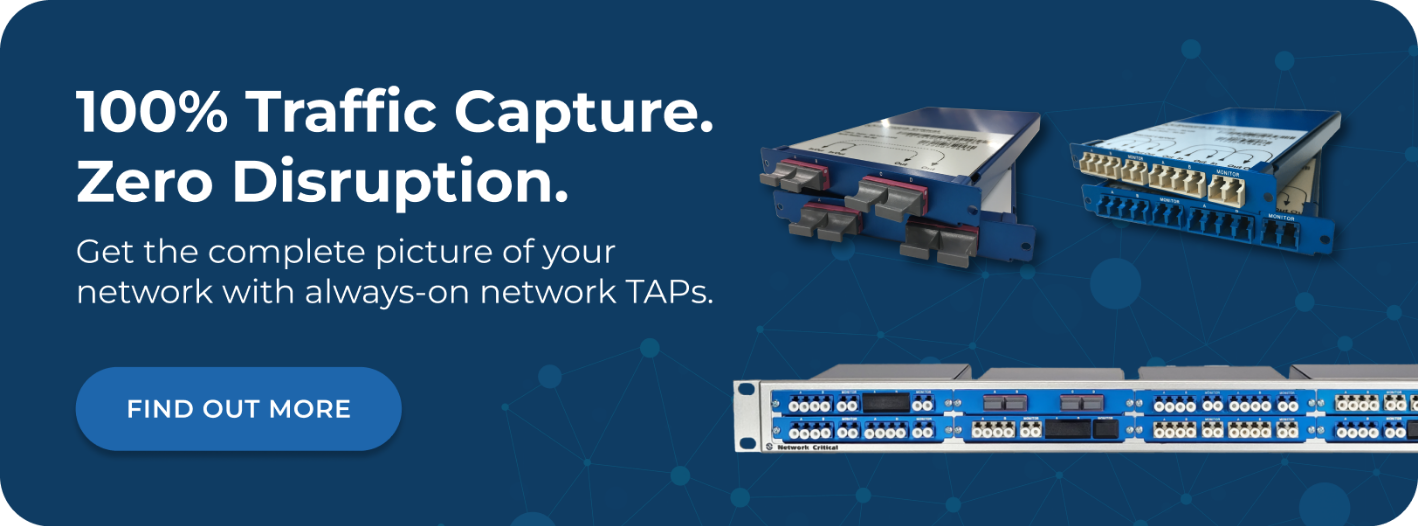
Network Critical builds its TAP portfolio around a scale-out architecture that combines access and intelligence in a single platform. The SmartNA modular chassis handles 1G environments with up to 17 ports across hot-swappable copper, passive fiber, and bypass TAP modules. The SmartNA-XL extends this to 1G/10G/40G in a 1RU hybrid chassis. At the high end, the SmartNA-PortPlus scales from 48 to 194 ports across 1G/10G/25G/40G/100G speeds, while the SmartNA-PortPlus HyperCore delivers up to 400G with 32 QSFP-DD interfaces.
What sets Network Critical apart for NDR deployments is its RESTful API integration within the Drag-n-Vu management interface. NDR platforms can programmatically control port mapping and traffic filters without human intervention, allowing the tool to adapt its traffic intake dynamically as network behavior changes. This machine-to-machine capability has been demonstrated in production with Darktrace, enabling autonomous filter updates in direct response to detected anomalies.
The hybrid TAP and network packet broker architecture eliminates the need for separate devices. Network TAPs feed directly into the SmartNA-PortPlus, with Layer 2–4 packet filtering, traffic aggregation, persistent and dynamic load balancing, deduplication, and payload masking all managed from a single graphical interface. Scale-out expansion requires no replacement of existing hardware — new units connect to the base chassis and operate as a single logical system.
Proven results:
- Vodafone: Reduced customer churn rates and achieved 100% accurate traffic visibility on key links using the SmartNA-XL hybrid TAP/packet broker.
- BP: Enabled centralized monitoring of critical IT and Operational Technology (OT) systems across refinery buildings using passive fiber TAPs.
- HSBC: Achieved zero latency on monitoring technologies for real-time financial updates across a global infrastructure spanning the UK to Hong Kong.
2. Garland Technology — Breakout TAPs and EdgeLens Inline Security Packet Broker
Garland Technology positions itself as a purpose-built TAP and packet broker vendor with an explicit "TAP to Tool" philosophy — meaning it designs its products to feed security tools rather than compete with them. The breakout TAP portfolio spans passive fiber and active copper TAPs from 1G to 400G, with unidirectional data diode circuitry built into many models. This design characteristic is significant for NDR deployments: the TAP itself becomes a physical security enforcement layer, guaranteeing that no data can be injected back into the production link from the monitoring infrastructure.
The EdgeLens Inline Security Packet Broker combines bypass TAP and packet broker functionality for inline tool deployments, with automatic failover to maintain network connectivity if a connected tool goes offline. The PacketMAX advanced aggregators support aggregation and load balancing across multiple monitoring tools, and the XtraTAP combines TAP and packet broker capabilities in a single device for environments where consolidation matters.
Garland maintains NDR-specific integration partnerships, including a documented joint solution with Darktrace for OT environments. All features across Garland's packet broker range are included with the hardware purchase — there are no per-port or per-feature software licenses. Products are manufactured in the USA.
3. Gigamon — G-TAP M Series and G-TAP A Series
Gigamon integrates its TAP portfolio directly into its Deep Observability Pipeline, a platform designed to feed NDR, Security Information and Event Management (SIEM), and observability tools with optimized network-derived intelligence. The G-TAP M Series covers medium and high-density passive fiber-optical deployments at 1G through 400G, including BiDi and breakout options for parallel fiber environments. The G-TAP A Series adds active monitoring capability with battery backup, SNMP trap alerts for power and link state changes, and fail-to-wire functionality at 10/100/1000 and 1G/10G speeds.
For cloud and container environments, the GigaVUE Universal Cloud Tap (UCT) acquires North-South and East-West traffic within AWS, Azure, GCP, Red Hat OpenShift, and VMware environments. This enables NDR tools to monitor lateral movement traffic between virtual machines — a critical capability that physical TAPs alone cannot address.
Gigamon's Precryption technology provides tools with plaintext visibility into encrypted cloud traffic without requiring traditional decryption infrastructure. The Deep Observability Pipeline can lower cloud data visibility costs by up to 80% compared to deploying individual sensors at each workload, according to Gigamon's published infrastructure cost analysis.
4. Keysight Technologies — Flex Tap II and Flex Tap VHD
Keysight Technologies brings test equipment heritage to its TAP portfolio, offering the broadest range of tap types of any vendor — passive and active, single-mode and multimode fiber, LC and MTP/MPO connectors, and explicit Cisco BiDi support. The Flex Tap II is 100% passive, supports speeds from 1G to 400G, and is available with split ratios from 50/50 through 90/10 to control the optical power balance between the live link and the monitoring copy. Up to 24 Flex Tap II modules deploy in a single 1U rack chassis.
The Flex Tap VHD increases density further to 36 taps in a 1U 19-inch rack — the highest passive TAP density available from any vendor in this list. For NDR teams deploying sensors at many access points in a constrained data center environment, this density advantage reduces cabling complexity and rack space requirements considerably.
The Flex Tap Secure+ variant provides an additional security layer suited to sensitive NDR deployments. It uses optical technology to block all incoming light on monitor ports with greater than 35dB isolation, preventing any accidental or intentional data injection from the monitoring infrastructure back into the production network. The Patch Tap offers the smallest possible form factor — reduced to the size of its three duplex LC connectors — for deployments where the tap must fit directly into existing patch panels.
5. Cubro Network Visibility — OptoSlim TAP Series
Cubro Network Visibility is a European carrier-grade vendor with a strong emphasis on vendor-neutral operation. Its TAPs and packet brokers are designed specifically to enable organizations to run multiple NDR or security tools simultaneously against the same traffic, compare solutions head-to-head, and switch vendors without redesigning their visibility infrastructure. The OptoSlim TAP Series covers fiber speeds from 10Mbps to 400G in 1RU and 3RU form factors. The 400G SR8 TAP supports high-speed parallel optics links common in hyperscale data center interconnects.
Cubro's copper TAP range covers 10/100/1000 environments, with a USB interface option on certain models for local status retrieval and link partner configuration diagnostics. Converter TAPs handle media conversion for environments where link types must be bridged before reaching monitoring tools.
The Vitrum management platform provides centralized single-pane-of-glass oversight across Cubro devices, with filtering, alerting, and monitoring in a multi-user application. Cubro's technology partner ecosystem includes NDR vendors such as Trellix, supporting flexible hardware sensor deployments up to 100G alongside virtual sensors.
6. APCON — ApconTap Passive Optical TAPs and IntellaView Bypass TAP Blade
APCON integrates its passive optical TAP portfolio directly into the IntellaView visibility fabric — an architecture that combines access, aggregation, filtering, and bypass protection in a chassis-based platform. ApconTap passive optical TAPs support 1G/10G/25G/40G/100G/400G speeds with 50/50, 60/40, and 70/30 split ratio options, including BiDi models for high-density parallel optics environments. TAPs are designed to co-locate with IntellaView switches in the same data center rack, reducing cabling runs between access and processing layers.
The IntellaView Bypass TAP Blade provides inline bypass behavior for up to six network TAPs simultaneously. It automatically detects a failed or offline inline security tool in milliseconds using heartbeat and link state monitoring, then redirects traffic around the tool to keep the network operational. This is particularly relevant for NDR deployments where sensor appliances may require periodic updates or maintenance without taking the monitored link offline.
APCON's application-aware filtering automatically classifies over 1,600 applications and 400 protocols in real time, enabling NDR tools to receive pre-filtered, relevant traffic rather than processing the full raw stream. The IntellaTap-VM software extends this visibility into virtual machine environments, providing East-West traffic capture for hybrid deployments where NDR coverage must span both physical and virtual workloads. APCON products are deployed in data centers across more than 40 countries.
7. NETSCOUT — nGenius Packet Flow Switches
NETSCOUT approaches TAP and packet flow switch deployment as part of an integrated service assurance and security visibility platform. The nGenius Packet Flow Switches provide enterprise-grade traffic aggregation and filtering with support for copper and fiber interfaces up to 100G. For cloud environments, NETSCOUT's vTAPs extend visibility into platforms including Microsoft Azure, enabling NDR tools to monitor hybrid-cloud traffic alongside on-premises feeds.
NETSCOUT's primary differentiation is its integration with the nGeniusONE service assurance platform, which correlates NDR sensor inputs with application performance data. This combined view is useful for security operations teams that also carry performance management responsibilities, as it reduces the number of separate management interfaces needed to respond to a network incident.
The platform supports real-time and historical traffic analysis and includes DDoS protection capabilities alongside forensic visibility features — an advantage for organizations dealing with volumetric attack traffic that would otherwise saturate NDR sensor ingest capacity.
8. Profitap — ProfiShark and IOTA Network Probes
Profitap specializes in portable and all-in-one visibility solutions that combine TAP access with inline packet capture and analysis. The ProfiShark series uses USB-C and Thunderbolt connectivity for rapid deployment in the field, capturing full-duplex traffic from links up to 10G with hardware timestamping at 8ns resolution. The IOTA Network Probes extend this capability with built-in analysis software in a compact form factor.
For NDR teams, Profitap's primary value is in temporary or ad hoc deployments — instrumenting a new network segment before permanent TAP infrastructure is installed, validating NDR sensor placement, or supporting incident response investigations where a portable capture device is needed quickly. Profitap also offers permanent infrastructure fiber TAPs with a 10-year warranty for 1G through 100G links.
Industrial protocol support and tamper-evident seal options on certain models make Profitap suited to OT environments where portable access to a monitored link is occasionally required alongside a permanent visibility architecture.
How to Choose the Right Network TAP for Your NDR Deployment
The right TAP for an NDR deployment depends on more than port speed. NDR tools have specific data quality requirements — packet completeness, timestamp precision, traffic reduction — that differ from general monitoring use cases. The criteria below address those requirements directly.
Packet Fidelity and Zero Packet Loss
Your NDR tool builds behavioral baselines from traffic data. If that data has gaps, the baseline is inaccurate and detection quality degrades. Passive fiber TAPs are the only access method that guarantees 100% packet capture regardless of traffic load, including physical-layer errors and malformed frames that SPAN ports suppress. Confirm that any TAP vendor you evaluate can demonstrate zero packet loss under full-duplex load at your target speeds.
Bypass Protection for Inline NDR Sensors
If your NDR deployment includes inline sensors, bypass TAP solutions are non-negotiable. An inline sensor that goes offline — for maintenance, update, or malfunction — must not take the monitored link down with it. Bypass TAPs with heartbeat monitoring detect tool failures in milliseconds and redirect traffic around the offline device automatically. Evaluate whether bypass behavior is built into the TAP hardware or requires a separate appliance.
Traffic Filtering and Load Balancing
NDR tools have finite ingest capacity. Feeding a sensor raw, unfiltered traffic from multiple aggregated links simultaneously will degrade detection performance. Look for TAP vendors that support Layer 2–4 packet filtering, deduplication, and session-aware load balancing across sensor arrays. These capabilities ensure each sensor receives the right traffic at the right volume — not more, not less.
API Integration for Automated NDR Response
Advanced NDR platforms can dynamically adjust their traffic intake requirements as threat patterns evolve. A TAP or packet broker with a published RESTful API enables the NDR tool to programmatically update traffic filters and port maps without manual intervention. This machine-to-machine integration can reduce detection-to-response time significantly compared to architectures that require human reconfiguration.
Scalability Without Infrastructure Replacement
NDR coverage typically expands over time — more links, higher speeds, additional sensor tools. Choose a TAP architecture that scales incrementally. Scale-out designs that allow new units to be added and managed as a single logical system protect your initial investment and avoid reconfiguration of existing TAP deployments when coverage grows.
Physical and Virtual Coverage
If your environment includes virtualized workloads or cloud infrastructure alongside physical data center links, consider whether your TAP vendor offers virtual TAP capabilities. East-West traffic between virtual machines on the same host is invisible to physical TAPs. For comprehensive NDR coverage, you need a visibility strategy that addresses both physical and virtual traffic sources.
Frequently Asked Questions
What Is the Difference Between a Network TAP and a SPAN Port for NDR?
A network TAP creates a passive, hardware-level copy of all traffic traversing a link — including malformed frames and physical-layer errors — with no impact on the production network. A SPAN port mirrors traffic using switch software, which drops packets under high load, shares CPU resources with production traffic, and strips physical-layer errors. For NDR tools that rely on complete traffic data to build accurate behavioral baselines, TAPs are the correct access method. SPAN ports may be acceptable for initial pilots but are generally considered inadequate for production NDR deployments.
Do I Need a Separate Packet Broker Alongside My TAPs for NDR?
In most production NDR deployments, yes. A TAP provides the traffic copy; a packet broker aggregates traffic from multiple TAP points, applies filters, deduplicates redundant flows, and distributes the processed stream to one or more NDR sensors. Without a packet broker, a single NDR sensor may receive more traffic than it can process, degrading detection quality. Hybrid TAP solutions that combine both functions in a single chassis reduce deployment complexity for teams with limited rack space or budget.
What Happens to My NDR Sensor If the TAP Loses Power?
A passive fiber TAP requires no power to operate — it splits the optical signal physically, so power failure has no effect on the live link or the monitoring copy. Copper TAPs include fail-to-wire capability that maintains the network link even during power loss or device failure. Bypass TAPs add a further layer of protection for inline deployments, automatically keeping traffic flowing around an offline sensor. Confirm that any TAP you deploy has documented fail-safe behavior under both power failure and hardware fault conditions.
Can Network TAPs Support Encrypted Traffic Analysis for NDR?
TAPs copy all traffic regardless of encryption — including Transport Layer Security (TLS)-encrypted flows — and deliver that copy to connected tools. Whether the NDR tool can inspect encrypted content depends on the tool itself and whether a decryption capability is present in the visibility architecture. Some packet brokers include SSL/TLS decryption that produces plaintext traffic for tools that cannot decrypt independently. Others pass encrypted traffic as-is, relying on the NDR tool's metadata and behavioral analysis to detect threats without full decryption.
How Many TAPs Do I Need for an NDR Deployment?
The number of TAPs depends on how many network links you want to instrument and what coverage your NDR policy requires. A minimum viable deployment typically instruments your internet perimeter links, internal core switching connections, and any links carrying sensitive data. Large enterprises commonly deploy between five and 20 TAP points before connecting to a central packet broker, which then feeds one or more NDR sensors. Starting with your highest-risk links and expanding incrementally is a practical approach for most organizations.
Deploy NDR-Ready Visibility With Network Critical
Selecting the right TAP architecture is a foundational decision for any NDR deployment. Get it wrong and your NDR tool is working with incomplete data — building inaccurate baselines and generating detections you can't trust.
Network Critical's SmartNA and SmartNA-PortPlus platforms deliver the zero-packet-loss access, integrated packet brokering, and RESTful API integration that NDR tools require to operate at full effectiveness. The scale-out architecture means your visibility infrastructure grows with your coverage requirements — no forklift upgrades, no infrastructure replacement. Trusted by HSBC, Vodafone, BP, and Airbus, Network Critical's network visibility solutions serve blue-chip enterprises across finance, telecommunications, energy, and aerospace.
Speak to the Network Critical team to discuss your NDR deployment requirements and request a free network audit.