Top 8 Network TAPs for Passive Network Monitoring in 2026
Every monitoring decision you make downstream depends on the quality of data coming off the wire. Passive Network Test Access Points (TAPs) are the access layer that makes that data available — copying 100% of traffic from a live link without touching the link itself, without dropping packets under load, and without creating a single point of failure. When power fails, the link stays up. When traffic bursts, nothing is missed.
The case for passive TAPs over Switch Port Analyzer (SPAN) ports is well established: SPAN ports share switch CPU resources with production traffic, can drop packets during periods of high utilization, and strip Layer 1 errors that security tools need to see. For teams running Intrusion Detection Systems (IDS), Network Detection and Response (NDR) tools, Security Information and Event Management (SIEM) feeds, or lawful intercept probes, the difference is architectural — not marginal.
This guide compares eight verified vendors offering passive fiber TAP solutions in 2026. Each entry covers confirmed product specifications, key differentiators, and the use cases each solution fits best.
Passive Network TAP Solutions at a Glance
| Vendor | Key Product(s) | Max Speed |
|---|---|---|
|
Passive Fiber TAPs, SmartNA-XL |
Up to 400G |
|
|
Multi-mode & Single-mode Passive Fiber TAPs |
Up to 400G |
|
|
Flex Tap II, Flex Tap VHD, Flex Tap Secure+ |
Up to 400G |
|
|
G-TAP M Series |
Up to 400G |
|
|
OptoSlim TAP Series, 400G SR8 TAPs |
Up to 400G |
|
|
3225 Passive Fiber TAP Platform |
Up to 400G |
|
|
MOD-TAP, LC Fiber TAPs, MTP TAPs |
Up to 400G |
Network Critical — Passive Fiber TAPs & SmartNA-XL
Network Critical's passive fiber TAPs deliver zero-latency, zero-packet-loss visibility across fiber links from 1G to 100G. These fully passive optical devices require no power on the live link path, have no IP or MAC address, and cannot be remotely accessed or disabled. Traffic continues to flow through the network link even in the event of a complete hardware failure.
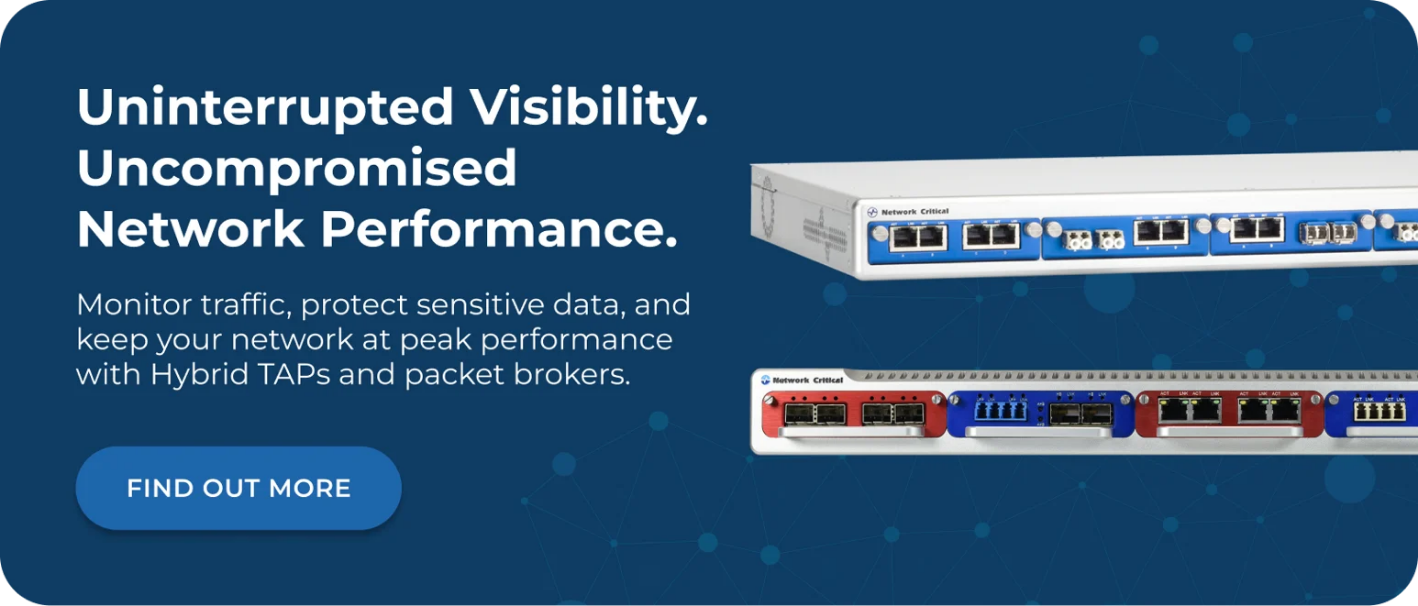
The SmartNA-XL extends this foundation by combining passive TAP modules with packet broker aggregation in a single 1RU hybrid chassis. This eliminates the need for a separate broker device, reducing rack space, cabling complexity, and power draw. For environments where multiple monitoring tools need to share traffic from a single tap point, the SmartNA-XL aggregates links from 1G to 40G into higher-speed tool ports — cutting tool costs through aggregation ratios of up to 4:1.
Both copper and fiber network TAPs are available across the product range. Passive fiber TAPs ship pre-configured for the desired split ratio and deploy with no initial configuration or ongoing maintenance. The modular SmartNA architecture accommodates a mix of copper, multi-mode fiber, and single-mode fiber tap modules in the same chassis, making it well-suited to environments with diverse cabling infrastructure.
All products are managed through Drag-n-Vu, Network Critical's patented graphical configuration interface, which uses automated rule generation to eliminate misconfiguration risk. A RESTful API supports automated filter and port mapping updates without manual intervention.
Proven results:
- Vodafone: Achieved 100% accurate traffic visibility on key links across a multi-generation European mobile network, directly supporting churn rate reduction
- BP: Deployed passive fiber TAPs across refinery buildings spanning 10–12 structures, enabling centralized monitoring of IT and Operational Technology (OT) systems with no power dependency
- HSBC: Deployed passive fiber TAPs and SmartNA TAPs globally — from the UK to Hong Kong — achieving zero latency on monitoring technologies for real-time financial transaction visibility
Garland Technology — Multi-Mode & Single-Mode Passive Fiber TAPs
Garland Technology builds passive fiber TAPs exclusively for network visibility. Its product range covers multi-mode and single-mode variants, MPO/MTP-based TAPs for 40G/100G SR4 networks, portable form factors for field deployments, and high-density 1U chassis accommodating 16 to 24 TAP modules. Network speeds supported span 1G through 400G. Garland was among the first vendors to introduce Optical Multi-Mode 5 (OM5) fiber TAP support, extending coverage to both extended long-range and short-range data center applications.
All passive fiber TAPs are non-powered devices. They carry no IP or MAC address, cannot be hacked, and pass physical layer errors that SPAN ports strip. The modular chassis design supports a mix of TAP module types in a single 1U enclosure, giving network teams flexibility across environments with varying fiber types. Garland's product line also includes hardware Data Diode TAPs — devices that enforce strict unidirectional traffic flow from the monitored link to the security tool, adding a physical enforcement layer suited to air-gapped segments.
Garland TAPs are manufactured and tested in the USA. The company supports a broad technology partner ecosystem and maintains dedicated documentation covering split ratio selection, loss budget calculation, and OT-specific deployment guidance.
Keysight Technologies — Flex Tap II & Flex Tap VHD
Keysight Technologies' Flex Tap family delivers 100% passive visibility across 1G to 400G fiber links, with single-mode Flex Taps tested across that full range at wavelengths between 1260–1340 nm and 1550 nm. The Flex Tap VHD chassis supports up to 36 LC TAP modules in a single 1U 19-inch rack — the highest published density in this comparison. Up to 24 modules deploy in the Flex Tap II chassis, also in 1U.
Split ratios range from 50/50 through 90/10 across multi-mode and single-mode fiber variants, with LC and MTP (MPO) connector options. The Flex Tap Secure+ variant adds an optical diode on monitor ports, preventing any light from being injected back into the live link from the monitoring infrastructure. This is specifically designed for applications where assurance against traffic injection from the monitoring side is required — including lawful intercept and government deployments.
Keysight holds large inventories of Flex Tap units for rapid shipment. The Patch Tap variant integrates into standard patch panels, enabling passive tapping with reduced rack footprint and insertion loss. Keysight's test equipment heritage means its TAPs are validated using the same instrumentation the company deploys in its core testing business.
Gigamon — G-TAP M Series
Gigamon's G-TAP M Series is a modular family of passive fiber optical TAPs covering 1G, 10G, 25G, 40G, 100G, and 400G networks. The 1RU chassis supports up to six TAP modules; a half-RU chassis supports up to three. Module options include standard breakout configurations, BiDi TAPs for Cisco bidirectional links, and Unidirectional TAPs — a variant where data flows strictly from the network to the monitoring tool, with no path back into the production link.
All G-TAP M Series modules use optical splitting to replicate 100% of full-duplex traffic, including error frames and non-standard packets that SPAN ports may discard. G-TAPs are fully compatible with GigaVUE HC Series and GigaVUE TA Series visibility nodes, providing a direct integration path into Gigamon's Flow Mapping and GigaSMART traffic intelligence platform. For organizations building a broader deep observability pipeline, this integration simplifies the handoff from passive access to active traffic processing. Trade Agreements Act (TAA) compliant versions are available across the product line.
Cubro Network Visibility — OptoSlim TAP Series
Cubro Network Visibility's OptoSlim TAP Series uses a 1/3RU form factor — three units mount in a single 1U rack space — delivering what the company describes as industry-leading port density for passive optical TAPs. Each chassis supports up to eight LC links, giving up to 24 LC-linked TAP points per 1U. Cubro also offers MTP/MPO variants, supporting up to 12 MTP links in 1U.
Every Cubro optical TAP supports speeds from 10 Mbps to 400G and is fully transparent to protocol and data rate. The 400G SR8 TAP addresses environments running 400GBASE-SR8 multimode links. Cubro tests each individual TAP unit after production and ships verified insertion loss measurements with the device — a quality assurance step the company uses to reduce deployment risk in high-sensitivity fiber runs.
Passive optical TAPs in the OptoSlim range require no power, carry no IP or MAC address, and continue to pass traffic on the live link regardless of TAP hardware status. BiDi TAP variants are available for bidirectional links where TX and RX signals share a single fiber strand. Cubro has deployed its TAPs at European carrier and enterprise customers including Orange Slovensko.
Niagara Networks — 3225 Passive Fiber TAP Platform
Niagara Networks' 3225 is a high-density, fully passive modular fiber TAP chassis supporting up to 24 single-width or 12 double-width TAP modules in 1U, with a maximum of 35 TAP links per chassis depending on configuration. Supported speeds cover 1G, 10G, 25G, 40G, 50G, and 100G through to 400G. The platform is completely passive — no power, no configuration, no software.
Because the 3225 operates at the photonic level, it is rate-transparent: it supports any fiber network speed within optical specifications without requiring reconfiguration as link speeds change. Split ratio options include 50/50, 60/40, 70/30, 80/20, and 90/10 depending on module type, giving teams control over how much optical power is allocated to the monitoring path versus the live link.
The chassis has no MAC address, no IP address, and no management interface — it cannot be probed, scanned, or hacked. TAP modules are snap-in and can be installed with minimal disruption to surrounding fiber. Niagara designs and manufactures its products in Silicon Valley and also offers active TAP, packet broker, and bypass switch products, giving teams the option to expand from a passive TAP foundation into a full visibility stack from a single vendor.
Profitap — MOD-TAP & LC Fiber TAP Range
Profitap's passive fiber TAP range spans fixed-installation and portable form factors, covering LC, SC, MTP/MPO, and BiDi connector types across 1G to 400G speeds. The MOD-TAP is a modular chassis solution supporting up to 24 TAP modules with a mix of fiber types and speeds in a single enclosure — useful for environments where multiple link standards coexist. The F8L high-density TAP supports eight LC links in a unit thin enough to stack three in 1U, providing up to 24 LC-linked monitoring points per rack unit.
All Profitap passive fiber TAPs require no power, have no IP address, and include an optical data diode on monitor ports that prevents light injection from the monitoring infrastructure back into the operational network. Tamper-evident security seals cover screw heads on the housing; randomized paint patterns on the seals make unnoticed replacement impossible — a physical security feature relevant to high-sensitivity deployments. Passive fiber TAPs in the Profitap range are covered by a ten-year warranty. MTP Fiber TAPs provide in-line access to 40GBASE-SR4, 100GBASE-SR4, and 400GBASE-SR8 networks. Portable variants support field deployment without a rack, covering links from 1G to 400G.
How to Choose the Right Passive Fiber TAP for Your Network
Confirm Your Link Speed and Fiber Type First
Your TAP must match both the speed and fiber type of the link you're monitoring — single-mode, multi-mode, BiDi, or MTP/MPO parallel optics. Getting this wrong means either a failed deployment or packet loss on the monitored link. Check the exact 400G variant in use (SR8, DR4, LR4) before specifying a TAP, since each requires different optics. Most vendors in this guide offer TAPs across all common fiber types, but confirm module availability for your specific link standard before committing.
Calculate Your Light Budget
Passive fiber TAPs split optical power between the live link and the monitoring path. A poorly calculated split ratio can reduce signal strength below the minimum receiver sensitivity of downstream equipment, causing dropped packets on the production link — the opposite of what a TAP is supposed to achieve. Split ratios of 70/30 or 80/20 (70–80% to the live link, 20–30% to the monitor port) are common for links with limited power budget. Vendors including Keysight, Cubro, and Garland publish detailed loss budget guidance; use it.
Match Density Requirements to Rack Constraints
If you're deploying TAPs across many links in a constrained rack environment, chassis density matters. Options range from Keysight's Flex Tap VHD (up to 36 TAPs/1U) and Niagara's 3225 (up to 35 links/1U) to Cubro's OptoSlim format (up to 24 LC links/1U in 1/3RU units) and Garland's high-density chassis (16–24 modules/1U). Portable or mini-chassis variants are available from several vendors for space-constrained or temporary deployments.
Decide Whether You Need Aggregation at the TAP Layer
A standard passive fiber TAP delivers one copy of traffic from one link to one monitoring port. If your deployment requires traffic from multiple tap points to reach a single security tool — or if you want to connect several tools to a single link — you'll need aggregation capability alongside the TAP. Network Critical's hybrid TAPs and packet brokers combine passive TAP access and packet broker aggregation in a single chassis, removing the need for a separate device in the monitoring stack. This is particularly relevant for environments with limited rack space or where operational simplicity is a priority.
Assess Security and Injection Risk
For deployments where accidental or malicious traffic injection from the monitoring infrastructure into the production network is a concern — government, financial services, lawful intercept, and OT environments — look for TAPs with optical data diodes or unidirectional variants. Profitap includes an optical diode on all fiber TAP monitor ports. Keysight's Flex Tap Secure+ adds >35dB isolation loss on monitor ports. Gigamon's G-TAP M Series Unidirectional TAP enforces strict one-way data flow. Network Critical's passive fiber TAPs carry no IP or MAC address and cannot be remotely accessed.
Plan for Scalability Before You Deploy
Replacing TAP infrastructure is disruptive and expensive. Choose a platform that scales incrementally alongside your network. Modular chassis designs — available from Network Critical, Garland, Keysight, Niagara, Profitap, and Gigamon — let you add modules or expand port count without replacing existing hardware. If your network includes links at mixed speeds today, confirm that the chassis you select supports those speeds without requiring separate hardware per speed tier.
Frequently Asked Questions
What Is a Passive Network TAP and How Does It Work?
A passive network TAP is a hardware device that splits the optical signal on a fiber link, sending an exact copy to a monitoring tool while the original signal continues to the live network endpoint. It requires no power, introduces no active electronics into the link path, and cannot cause a network outage. Because it operates at the physical layer, it captures 100% of traffic — including error frames and malformed packets — regardless of traffic volume.
What Is the Difference Between a Passive TAP and a SPAN Port?
A passive TAP copies traffic at the physical layer without consuming any switch resources, without the possibility of dropping packets, and without stripping Layer 1 errors. A SPAN port is a software feature on a switch that mirrors traffic to a designated port; it shares CPU resources with production traffic, can drop packets under load, and discards certain error frames. For security monitoring, IDS deployments, and any use case where complete packet capture is required, passive TAPs are the more reliable choice. You can read more about network TAPs vs SPAN ports on the Network Critical blog.
Do Passive Fiber TAPs Affect Network Performance?
No. A passive fiber TAP introduces no active electronics into the live link path and requires no power to pass traffic. The only effect is a reduction in optical signal strength due to the split ratio — which is why light budget calculation matters during design. When specified correctly, a passive fiber TAP has no measurable impact on network latency, throughput, or reliability.
Can a Passive TAP Monitor 400G Links?
Yes. Passive fiber TAPs from all vendors in this guide support speeds up to 400G, subject to the correct fiber type and connector matching the specific 400G standard in use on your link. The 400G variants include SR8, DR4, LR4, and others — each with different fiber and connector requirements. Confirm the exact standard deployed on your link before specifying a TAP, as a mismatch in 400G optics is a common deployment error.
When Do I Need a Packet Broker Alongside My Passive TAPs?
You need a network packet broker when traffic from multiple TAP points needs to reach a single tool, when a single link's traffic needs to be distributed across multiple tools, or when filtering is required to reduce the volume of traffic delivered to any individual tool. A passive TAP provides the access point; a packet broker manages what happens to that traffic once it's been copied. Organizations running more than two or three monitoring tools — or operating tools at different speeds than their network links — typically see significant efficiency gains from deploying both.
Are Passive TAPs Suitable for OT and Industrial Environments?
Passive fiber TAPs are well-suited to OT environments precisely because they are fully passive. They require no power on the link path, cannot be remotely accessed, have no IP or MAC address, and maintain network continuity even in the event of complete hardware failure. These characteristics align with the availability and safety priorities of industrial networks. Vendors including Garland Technology offer explicit OT product labeling and Data Diode variants for air-gapped segments. Network Critical's OT network monitoring solutions include passive TAP options validated in industrial deployments including BP refineries and Airbus aircraft systems.
Build Your Visibility Architecture With Network Critical
Passive TAPs are the foundation of any reliable monitoring architecture — but the access layer is only as useful as what you do with the traffic it captures. The right vendor combines accurate, fail-safe passive TAP access with the aggregation, filtering, and management capabilities to put that traffic to work.
Network Critical's modular approach lets you start with the links and tools you need today and expand without replacing existing hardware. The hybrid TAP and packet broker architecture removes a device from your stack while giving you more control over traffic distribution. Deployments at Vodafone, BP, HSBC, and Airbus demonstrate what that translates to in practice: zero-latency visibility, centralized monitoring across distributed sites, and complete packet capture under real-world enterprise load.
Speak to the Network Critical team to discuss your passive monitoring requirements.