Top 8 Network TAP Solutions for Zero Packet Loss in 2026
Dropped packets are not a monitoring inconvenience -- they're a security gap. When a Switch Port Analyzer (SPAN) port saturates under load or a misconfigured mirror port skips frames, your Intrusion Detection System (IDS), forensics tool, or performance probe operates on incomplete data. The consequence is blind spots: threats that pass undetected, incidents that can't be reconstructed, and compliance audits that fail.
Network Test Access Points (TAPs) eliminate this problem entirely. By creating a passive, hardware-level copy of every packet traversing a link -- including malformed frames and error traffic -- TAPs give monitoring and security tools the complete, unfiltered view they need. The challenge is choosing the right TAP solution for your environment, speed requirements, and growth plans.
This guide compares eight verified vendors delivering zero packet loss TAP solutions in 2026, with technical specs, deployment strengths, and guidance on matching each to real-world use cases.
How These Solutions Compare at a Glance
| Vendor | Key Strength | Max Speed |
|---|---|---|
|
Scale-out hybrid TAP/packet broker, 400G HyperCore |
Up to 400G |
|
|
Deep Observability Pipeline, Always-On battery backup |
Up to 400G |
|
|
Purpose-built TAP specialist, Cisco-certified zero packet loss |
Up to 400G |
|
|
High-density deployments, 36 TAPs in 1U |
Up to 400G |
|
|
Integrated TAP and packet flow switching ecosystem |
Up to 400G |
|
|
Carrier-grade density, 1ns timestamping |
Up to 400G |
|
|
Open Visibility Platform, modular bypass and aggregation |
Up to 400G |
|
|
Portable TAPs with 8ns hardware timestamping |
Up to 10G |
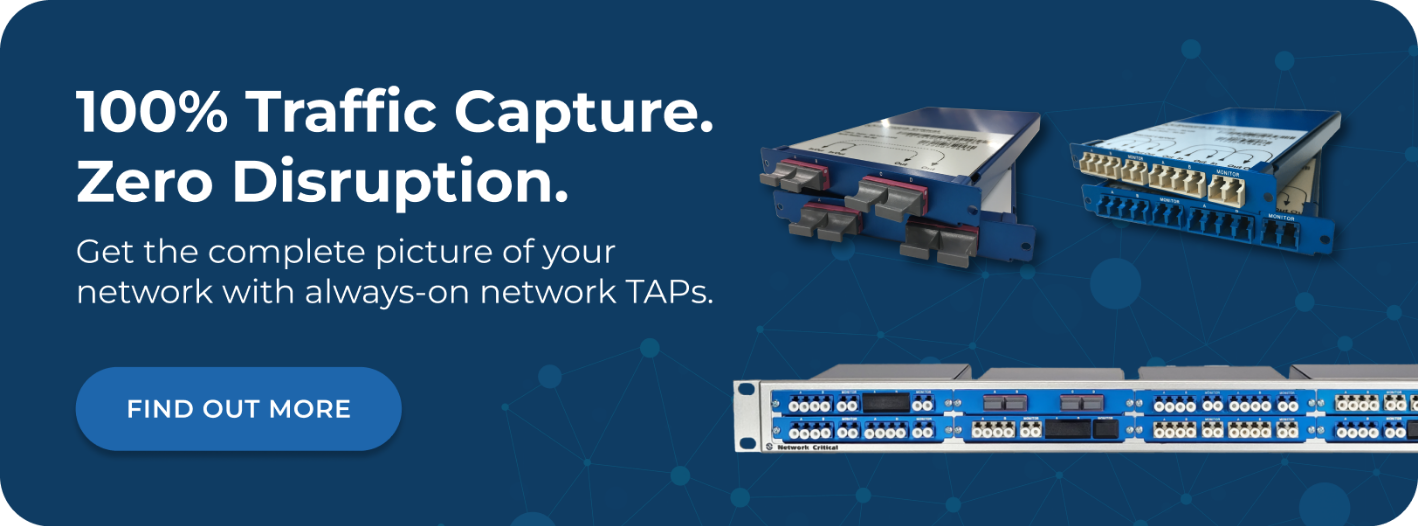
1. Network Critical — SmartNA-XL & SmartNA-PortPlus
Network Critical's TAP and packet broker platforms are designed for environments where packet loss is simply not acceptable. The SmartNA-XL delivers a modular hybrid architecture combining TAP access and packet brokering in a single 1 Rack Unit (RU) chassis across 1G, 10G, and 40G speeds. Its hot-swappable module design allows copper, passive fiber, and bypass TAP modules to be mixed within the same unit -- removing the need for separate access devices at different points in the network.
For higher-density environments, the SmartNA-PortPlus scales from 48 to 194 ports across 1G, 10G, 25G, 40G, and 100G, with a non-blocking 1.8Tbps backplane. Additional units connect and behave as a single managed system, so port counts grow incrementally without rearchitecting the visibility layer. The SmartNA-PortPlus HyperCore extends this to 400G via 32 QSFP-DD interfaces and 25.6Tbps aggregate throughput.
All platforms ship with Drag-n-Vu, a patented graphical configuration engine that eliminates filter rule misconfiguration through automatic rule generation. The RESTful Application Programming Interface (API) enables machine-to-machine integration with security tools -- Darktrace, for example, uses the API to dynamically adjust port mappings without human intervention.
Passive fiber TAPs and failsafe copper modules ensure network continuity even during complete power loss. These network TAPs carry no IP or MAC address, removing any attack surface from the monitoring path.
Proven results:
- Vodafone: Reduced customer churn rates and achieved 100% accurate traffic visibility on key links across a multi-generation European mobile network
- BP: Enabled centralized monitoring of critical IT and Operational Technology (OT) systems spanning 10-12 refinery buildings using passive fiber TAPs requiring zero power
- HSBC: Achieved zero latency on monitoring technologies for real-time financial updates, deployed globally from the UK to Hong Kong
2. Gigamon — G-TAP M Series & G-TAP A Series 2
Gigamon's TAP portfolio forms the access layer of its Deep Observability Pipeline, which feeds traffic intelligence to security and monitoring tools across physical, virtual, and cloud environments. The G-TAP M Series provides high-density passive optical tapping using advanced thin-film technology to minimize insertion loss -- no special patch cords or software are required, even for 40G, 100G, and 400G deployments.
The G-TAP A Series 2 adds active management for copper and direct-attach copper environments. Its Always-On architecture uses up to four power sources -- primary AC, DC, or Power over Ethernet (PoE), plus an on-board battery backup -- to eliminate link downtime during power transitions. Simple Network Management Protocol (SNMP) traps report changes in power or link state to network operations teams in real time.
Gigamon's GigaVUE Universal Cloud Tap (UCT) extends the same access model into Kubernetes, AWS EKS, Azure AKS, GCP GKE, and VMware environments, capturing east-west traffic that physical TAPs cannot reach. The UCT supports Gigamon Precryption technology, providing monitoring tools with plaintext visibility into encrypted cloud traffic.
Gigamon serves more than 4,000 customers worldwide, including over 80% of Fortune 100 enterprises.
3. Garland Technology — Breakout TAPs & EdgeSafe Bypass
Garland Technology is 100% focused on delivering packets to network tools -- no competing product lines, no mandatory transceivers, and no subscription fees for any feature. Their Breakout TAP range covers passive fibre and copper TAPs from 1G through 400G. All products are manufactured in the USA and carry Garland's industry-first Cisco Compatible certification, validated against interoperability, health check, full packet capture, and zero packet loss standards.
The AggregatorTAP series merges bidirectional traffic from multiple links into a single monitoring port -- reducing appliance costs where tools are fewer than tapped links. Regeneration TAPs replicate traffic from a single link to up to five simultaneous monitoring destinations without additional Network Packet Broker (NPB) hardware.
Garland's EdgeSafe Bypass TAP range protects inline security tools by sending heartbeat packets to confirm appliance health and automatically rerouting traffic if a tool goes offline. Failsafe technology at the physical layer ensures the network link stays up even if the TAP loses power entirely.
Garland's modular copper TAPs support link speed synchronization, link failure propagation, media conversion, and PoE -- all without per-port licensing.
4. Keysight Technologies — Vision Edge Series & Flex Tap
Keysight's TAP portfolio draws on its test and measurement heritage to deliver high-precision traffic access across multi-speed environments. The Flex Tap VHD supports up to 36 TAPs in a single 1RU chassis -- the highest density form factor in the market for organisations running large numbers of monitored links in space-constrained environments.
Vision Edge TAPs integrate with Keysight's Vision ONE platform, enabling hardware-based packet timestamping, packet-level filtering before traffic reaches monitoring tools, and load balancing across tool pools. This reduces per-tool traffic volume and extends the useful life of existing security infrastructure.
Keysight's Tough TAP range is designed for industrial and harsh environments with ruggedised construction. The Flex Tap Secure+ variant is verified for lawful interception applications. Multi-speed TAPs support 1G through 400G on single-mode and multi-mode fibre, with Cisco Bidirectional (BiDi) support included.
Keysight maintains extensive inventory for rapid shipment, which shortens deployment cycles in time-sensitive projects.
5. NETSCOUT — nGenius Packet Flow Switches & TAPs
NETSCOUT's TAP and packet flow switch portfolio is engineered around service assurance. Their passive fibre TAPs have no moving parts, require no power, and carry no IP address -- meeting the same passive, unhackable design criteria as hardware-only TAP vendors. Copper TAPs include automatic failsafe: if the TAP loses power, the production network link stays operational.
The nGenius 5000 and 7000 Series Packet Flow Switches extend TAP functionality into intelligent traffic distribution, with speeds from 1G to 400G. The External PowerSafe TAP (EPT) series provides active-inline bypass functionality for the nGenius 7000, with up to four modules per chassis and eight bypass segments per RU covering 1G copper through 100G fibre.
NETSCOUT's disaggregated packet flow switch architecture supports strategic placement of InfiniStream appliances and security tools anywhere in the network -- physically or logically. Tool chaining directs traffic sequentially through decryption, firewall, and sandbox appliances in a managed workflow.
NETSCOUT TAPs support 10Mbps through 100G copper and fibre interfaces.
6. Cubro Network Visibility — OptoSlim TAP Series
Cubro is a European vendor with a carrier-grade focus, recently confirmed as a Vodafone supplier. Their OptoSlim TAP Series offers a compact 1RU or 3RU form factor covering 1G through 400G speeds. The 400G SR8 TAP and MTP/MPO TAP range are designed for high-speed spine layer deployments where port density and physical footprint are both constrained.
Cubro TAPs support every speed from 10Mbps to 400Gbps, with individual testing and certification for each unit before shipment. Their packet broker range adds 8-byte timestamp information with 1 nanosecond resolution -- enabling precise latency measurement and traffic correlation across multiple links.
Advanced tunnelling protocol support includes Multi-Protocol Label Switching (MPLS), Generic Routing Encapsulation (GRE), NVGRE, VXLAN, CFP, ERSPAN, and GTP -- making Cubro TAPs and brokers suitable for service providers with complex overlay networks. A copper TAP variant includes a USB interface for direct local access.
7. Niagara Networks — Open Visibility Platform
Niagara Networks builds its TAP range around the Open Visibility Platform -- a modular architecture that integrates passive TAPs, active TAPs, bypass switches, and packet broker functions within a single management framework. TAP devices support passive fibre and active copper configurations, with fail-safe circuitry on copper models to maintain link integrity if the TAP loses power.
The platform supports traffic speeds up to 400Gbps with a range of connector types and fibre modes. Active TAPs include link negotiation capabilities to handle mixed-speed environments. Centralised management across all TAP and packet broker devices reduces operational complexity in multi-site deployments.
Niagara's advanced packet broker functions include Transport Layer Security (TLS) decryption, deep packet inspection, payload masking, and traffic deduplication. These are delivered through the same platform as the physical TAPs, reducing the number of separate appliances in the monitoring architecture.
8. PROFITAP — ProfiShark & IOTA Series
PROFITAP specializes in portable and field-deployable visibility solutions. The ProfiShark series connects via USB-C or Thunderbolt directly to a laptop, delivering full-duplex packet capture from 10M through 10G links without requiring rack-mounted infrastructure. Hardware timestamping at 8 nanosecond resolution preserves precise timing data for latency analysis and forensic investigation.
PROFITAP's rack-mounted Fiber TAPs carry a 10-year warranty and support passive optical connections on single-mode and multi-mode fiber. Secure TAPs include tamper-evident seals for deployments where physical access controls must be documented. The IOTA network probe combines TAP access with inline capture and analysis in a compact appliance.
PROFITAP's products support industrial protocols and ruggedized deployments, making the range relevant to field engineers who need temporary monitoring without returning to a data center for equipment.
Selecting the Right Network TAP for Zero Packet Loss
Match Speed to Your Current and Future Links
The most common cause of preventable packet loss is deploying a TAP that cannot keep pace with actual link utilisation. Confirm the line rate of every link you intend to monitor -- including headroom for peak traffic. A 10G TAP on a 10G link operating at 80% average utilisation may still suffer micro-bursts that exceed capacity.
For environments migrating from 10G to 25G or 40G to 100G, prioritise TAP platforms that support multiple speeds within the same chassis. This avoids a complete hardware replacement when links are upgraded.
Passive Fibre vs. Active Copper
Passive fiber TAPs require no power, have no active electronics, and cannot introduce failure modes into the monitored link. In environments where power reliability is uncertain -- remote sites, industrial facilities, or older data centers -- passive fiber is the most resilient choice.
Copper TAPs offer link negotiation and media conversion capabilities that passive optical designs cannot. They require power management, typically with dual-supply redundancy and battery backup for critical links.
Hybrid TAP and Packet Broker Functionality
Deploying separate TAPs and packet brokers simplifies individual component selection but multiplies rack footprint, power draw, and cabling complexity. Hybrid TAP solutions that combine access and traffic management in a single chassis reduce Capital Expenditure (CAPEX) and simplify change management. This is particularly relevant when aggregating multiple lower-speed links into a single high-speed monitoring tool -- an 8:1 aggregation ratio, for example, can reduce tool costs proportionally.
Scalability Without Replacement
Consider how the TAP platform handles growth. Some vendors require a new chassis and reconfiguration when additional ports are needed. Scale-out architectures that add expansion units to an existing base -- using the same management interface and policy framework -- reduce operational disruption as network capacity grows.
Compliance and Data Handling Requirements
Regulated industries including financial services, healthcare, and government frequently require that monitoring infrastructure:
- Carries no IP or MAC address (unhackable by design)
- Provides complete packet capture including error frames
- Supports payload masking or header stripping for data privacy
- Maintains documented audit trails for access and configuration changes
Confirm that your chosen TAP platform supports the specific compliance requirements for your environment -- Federal Information Security Management Act (FISMA), NIS2, NERC CIP, or Health Insurance Portability and Accountability Act (HIPAA) -- before deployment.
Total Cost of Ownership
Per-port licensing and mandatory proprietary transceivers significantly inflate the long-term cost of some TAP platforms. Vendors that require subscription fees for filtering or load balancing features shift costs from CAPEX to recurring Operational Expenditure (OPEX). Confirm the full pricing model -- including transceiver compatibility, feature licensing, and support tiers -- before committing to a platform.
Frequently Asked Questions
What causes packet loss in network monitoring, and how do TAPs prevent it?
Packet loss in monitoring environments occurs when a SPAN or mirror port drops frames under high traffic load to protect the priority of live network traffic. A network TAP prevents this by creating a dedicated hardware copy of the link at the physical layer, entirely independent of switch resources or configuration. Because the TAP operates passively and continuously, it cannot be over-subscribed in the way a SPAN port can.
What is the difference between a passive TAP and an active TAP?
A passive TAP uses optical splitting to copy light-based signals without requiring power. It introduces no active components into the monitoring path and continues to pass traffic even during a complete power failure. An active TAP regenerates signals electronically -- enabling features like copper link negotiation and media conversion -- but requires reliable power and typically includes battery backup to manage failover. For network TAPs on fibre links, passive designs are generally preferred for maximum reliability.
Do I need a packet broker if I already have network TAPs?
If you're feeding a single monitoring tool from a single TAP, a packet broker adds no immediate value. Once you have multiple TAPs, multiple tools, or need to filter, aggregate, or load-balance traffic, a network packet broker becomes necessary. Without one, individual monitoring tools receive all traffic from all tapped links -- quickly overwhelming their processing capacity and causing them to drop packets internally.
How do I choose between a dedicated TAP and a hybrid TAP/packet broker?
A dedicated TAP is the right choice when you need a minimal footprint at a single access point and plan to manage traffic distribution separately. A hybrid TAP makes sense when you're deploying monitoring across multiple links and tools in the same environment. Hybrid platforms reduce rack space, cabling complexity, and the number of managed devices, at the cost of some flexibility in replacing individual components independently.
Can network TAPs be used in OT and industrial environments?
Yes, and they're often the preferred approach. OT environments prioritise availability above all else, and a passive TAP with failsafe design cannot cause a network outage regardless of what happens to the monitoring tool connected to it. Environments with extreme temperatures, vibration, or DC power requirements should confirm that the TAP vendor offers ruggedised variants with appropriate operating specifications.
What speeds do modern network TAPs support?
Current TAP platforms support links from 10Mbps copper through 400G single-mode fibre. Most enterprise-focused vendors support 1G, 10G, 25G, 40G, and 100G within a single chassis. 400G support is available from Network Critical, Gigamon, Garland, Keysight, NETSCOUT, Cubro, and Niagara Networks. Portable TAPs from PROFITAP currently support up to 10G.
Build Your Zero-Packet-Loss Visibility Architecture With Network Critical
Choosing a TAP platform is a foundational infrastructure decision. Once monitoring tools, security appliances, and compliance workflows depend on the traffic access layer, replacing it is disruptive and expensive. Getting it right from the start means selecting a platform built on verifiable zero packet loss, proven at scale, and capable of growing with your network.
Network Critical's SmartNA-PortPlus delivers exactly that: a scale-out hybrid architecture that combines TAP access and packet brokering in a single platform, eliminates the need for separate infrastructure as ports are added, and is validated in production by global enterprises including HSBC, Vodafone, BP, and Airbus.
To find out which solution is right for your environment, speak to the Network Critical team and request a free network audit.