Top 8 Network TAPs for 400G Network Upgrades
A 400G upgrade changes more than link speed. It changes the optics, the fibre plant and the loss budget your monitoring has to survive. Many teams find the gap after cutover. SPAN sessions oversubscribe, legacy TAPs lack SR8 or DR4 support, and 100G tools cannot ingest 400G feeds. The result is a blind spot on the busiest links in your data centre.
Planning visibility hardware alongside the upgrade avoids that. You need passive access that matches your 400G optics. You also need a way to aggregate, filter and break out traffic for the tools you already own. This guide compares eight vendors supporting 400G visibility in 2026. It covers passive TAP portfolios, packet broker platforms and the buying criteria that separate them.
400G Network TAP Vendors at a Glance
|
Vendor |
Key Feature / Strength |
Max Throughput |
|---|---|---|
|
Hybrid TAP and packet broker portfolio, 32 x 400G QSFP-DD ports in 1RU |
Up to 400G |
|
|
G-TAP M Series passive modules for 1G to 400G links |
Up to 400G |
|
|
Flex Tap modular passive TAPs, up to 36 taps per 1U |
Up to 400G |
|
|
SelectTAP passive fibre chassis with OM5 and BiDi support |
Up to 400G |
|
|
MTP fibre TAPs for 400GBASE-SR8, ten-year warranty |
Up to 400G |
|
|
IntellaView modular platform, 1RU to 9RU chassis |
Up to 400G |
|
|
nGenius 7000 Series packet flow switches |
Up to 400G |
|
|
DANZ Monitoring Fabric, up to 576 x 400G aggregation ports |
Up to 400G |
1. Network Critical
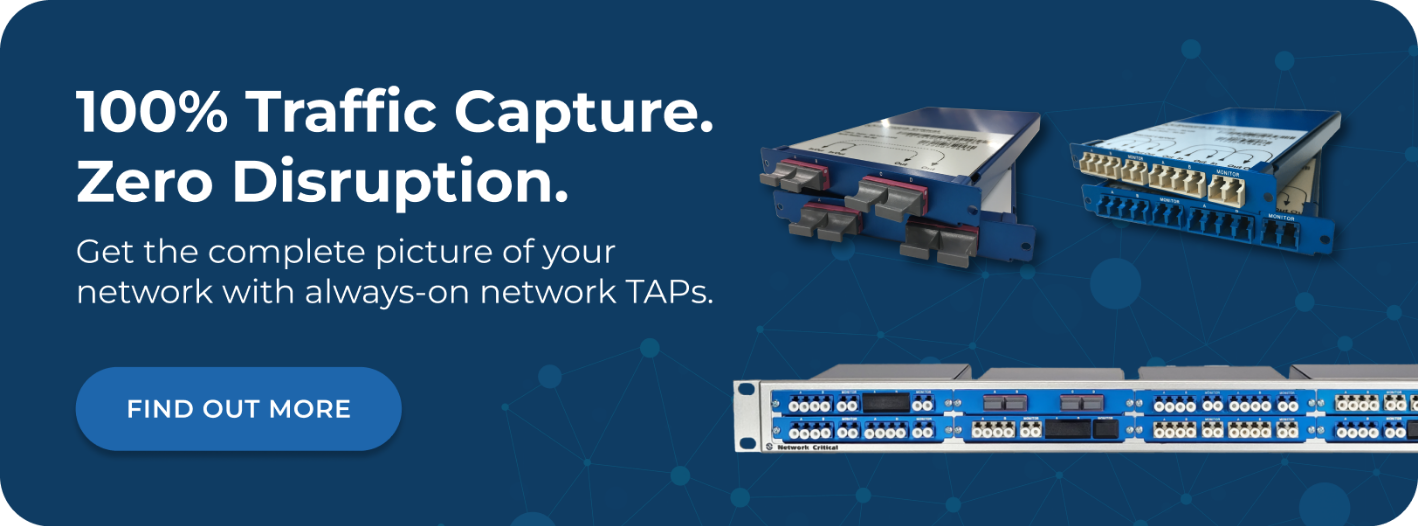
Network Critical builds TAPs and packet brokers as one visibility layer, covering 10 Mbps to 400 Gbps. For 400G upgrades, the lead platform is the SmartNA-PortPlus HyperCore. It provides 32 QSFP-DD interfaces in a 1RU chassis with 25.6 Tbps of bi-directional throughput. Ports run at 400G or break out to 200G, 100G, 50G, 25G or 10G. So you can feed 400G traffic into existing 100G and 25G tools without replacing them.
The HyperCore scales to 5RU by adding SmartNA-PortPlus units. For mixed-speed estates, the SmartNA-PortPlus covers 1G to 100G at 1.8 Tbps line rate. It grows from 48 to 194 ports. Expansion units connect to the base unit and run as a single system. Your first chassis stays in service.
Both platforms run Drag-n-Vu, which generates filter rules automatically. It warns you before an invalid path or filter is applied. Typical deployments complete in under two hours. A RESTful API lets security tools change filters and port maps without manual work. Output is standard, so traffic feeds any SIEM, NDR, APM or capture platform you choose.
Best for: Teams moving core and data centre links to 400G who want to keep existing tools in service.
Proven results:
- Vodafone: Gained 100% accurate traffic visibility on key links, supporting a programme to reduce customer churn.
- Darktrace: Used the SmartNA-PortPlus API to adapt filters and port maps automatically, with no manual reconfiguration.
- HSBC: Achieved zero latency on monitoring technologies across its international banking network.
2. Gigamon
Gigamon's G-TAP M Series is a modular family of passive fibre TAPs covering 1G to 400G. The 40/100/400G modules use MPO connectors and tap up to three links each. LC singlemode modules support 1G to 400G and tap two links each. Modules fit a half-RU or 1RU chassis. BiDi, unidirectional and breakout modules cover less common designs. The modules are TAA compliant, which matters for US public sector buyers.
Gigamon uses thin-film optics to keep insertion loss low and consistent across transceiver vendors. That helps in multimode deployments with narrow optical budgets. The TAPs need no power, software or special patch cords.
G-TAP feeds the wider Gigamon Deep Observability Pipeline. That adds packet brokering, application metadata and encrypted traffic visibility on a subscription basis. Gigamon reports 51 per cent share of the deep observability segment, citing 650 Group data for Q1 2026. That scale gives enterprise buyers a deep reference base. Confirm split ratio and fibre type against your 400G transceivers, as both vary by module.
3. Keysight
Keysight's Flex Tap family offers fully passive fibre TAPs from 1G to 400G. Each TAP is a module, so you can mix speeds and fibre types in one chassis. A base chassis holds 36 LC taps or 12 MTP-based modules. The Flex Tap VHD module fits up to 36 taps into a 1U space.
Split ratios run from 50/50 to 90/10 across multimode and singlemode models. Keysight also offers Flex Tap Secure+ for sensitive environments and Patch Tap for ad hoc access. A published insertion loss calculator helps you plan light budgets before deployment. Flex Taps are protocol-agnostic and work with all major monitoring devices. Keysight also sells bypass switches and the IFC Centralised Manager alongside its TAPs.
On the broker side, the Vision 400 series won a Frost and Sullivan 2024 Global New Product Innovation Award. Its FPGA-based architecture has zero packet loss validation from The Tolly Group. Keysight suits service providers and regulated enterprises with strong test and measurement requirements.
4. Garland Technology
Garland Technology focuses on TAPs and packet brokers, with a passive fibre line spanning 1G to 400G. The SelectTAP Fiber Modular Chassis supports breakout mode, passive replication and Cisco BiDi optics. Garland describes its OM5 multimode TAPs as an industry first, extending reach for data centre links. Its multimode TAPs use prism-based technology designed to reduce bit errors. Split ratios run from 50/50 to 90/10. Singlemode TAPs come in portable and 1U form factors.
The wider portfolio includes copper, aggregator, regeneration, filtering and bypass TAPs. Garland tests each TAP before shipping and publishes guidance on split ratios and loss budgets. It also states plainly that products carry no subscriptions or post-purchase fees.
Products are manufactured in the USA, which suits buyers with sourcing requirements. Garland's partner ecosystem includes OT security vendors such as Nozomi Networks and TXOne. That helps where a 400G core also feeds industrial monitoring.
5. Profitap
Profitap, based in the Netherlands, offers passive fibre TAPs for 1G to 400G networks. Its MTP fibre TAPs support 40GBASE-SR4, 100GBASE-SR4 and 400GBASE-SR8 links. They use US Conec MTP connectors exclusively. The F8MY model taps eight links in a 1/3U footprint.
Maximum insertion loss on the OM4 MTP range is 4.2 dB, excluding connector loss. For singlemode links, the F1RL LC TAP covers 1G to 400G. The MOD-TAP chassis lets you combine TAP modules of different speeds in one unit. BiDi, SC and regeneration fibre TAPs complete the range.
All Profitap fibre TAPs carry a ten-year warranty from the date of purchase. Most products ship from stock by next-day courier. The MTP range operates from 0°C to 50°C. Profitap also sells ProfiShark portable capture units for field troubleshooting. Its IOTA line combines capture, storage and analysis in a single device. That suits forensics-led teams more than large brokering fabrics.
6. APCON
APCON has more than 30 years in network visibility. Its IntellaView platform delivers packet brokering from 1G to 400G. Chassis range from 1RU to 9RU, and blades move between chassis sizes. That lets you grow hardware without replacing it. APCON positions IntellaView 400G switching as the upgrade path from 10G to 100G monitoring estates. The platform also monitors Cisco ACI fabrics in on-premises and hybrid data centres.
The HyperEngine blade adds advanced packet processing, including deduplication. IntellaView Enterprise manages up to 200 switches from one application. In 2026, APCON launched ThreatGuard, an AI-assisted security monitoring platform with deep packet inspection. IntellaStore IV combines visibility and security functions in one purpose-built appliance.
ApconTap passive optical TAPs offer 50/50, 60/40 and 70/30 split ratios. Public ApconTap listings focus on 40G and 100G models. Specifications for 400G passive TAPs are not publicly available, so confirm optics support directly. Pricing is quote-based through channel partners.
7. NETSCOUT
NETSCOUT's nGenius 7000 Series packet flow switches are dense 1G to 400G models. They bridge 1GbE through 400GbE networks to your existing tools. Beyond filtering, load balancing and aggregation, they add header stripping, L2GRE tunnelling and time stamping.
The 7000 Series integrates with the NETSCOUT External PowerSafe TAP for inline deployments. The 5000 Series runs on Open Compute Platform hardware for cost-sensitive brokering. It offers SFP+, SFP28, QSFP+ and QSFP28 ports in 1RU, 2RU and 4RU fixed configurations. Both support pfsMesh, a self-organising architecture that builds a fault-tolerant monitoring mesh.
NETSCOUT offers HD Fiber TAPs to feed the switches. The 5000 Series covers the same 1G to 400G speed range. Its all-in-one pricing aims to avoid surprises from artificial resource limits. The platform pairs with nGeniusONE for service assurance and Omnis for network detection and response. NETSCOUT also covers DDoS protection through its Arbor products. That integrated stack suits teams already standardised on NETSCOUT analytics.
8. Arista Networks
Arista's DANZ Monitoring Fabric (DMF) is a software-defined packet broker built on merchant-silicon switches. An SDN controller manages Arista, Dell or Accton switches as one monitoring fabric. Arista's DANZ EOS TAP aggregation platforms support up to 576 ports of 400G.
Service nodes add deduplication, packet slicing, header stripping, masking and NetFlow or IPFIX generation. Recorder nodes scale packet storage to multiple petabytes. DMF also supports multi-tenant monitoring for NetOps, SecOps and CloudOps teams. Egress filtering, added in DMF 8.6 in 2024, lets each delivery port receive different traffic. Verified scale reaches 150 switches and 1,500 filter interfaces per fabric.
DMF relies on passive TAPs or SPAN feeds at the network edge. Arista partners with Siemon for passive TAP modules. DMF Labs lets you test the fabric online before purchase. DMF is usually sold alongside Arista switching and CloudVision. The strongest fit is a data centre already running Arista switching.
How to Choose the Right Network TAPs for a 400G Upgrade
Match the TAP to Your 400G Optics
400G arrives in several physical forms, and each needs a matching TAP. Check which optics your switches use before you shortlist hardware:
- 400GBASE-SR8 over multimode, using 16-fibre MPO connectors
- 400GBASE-DR4 over singlemode, using 12-fibre MPO connectors
- 400GBASE-FR4 and LR4 over duplex LC singlemode
- 400G BiDi (SR4.2) over multimode MPO
A vendor quoting "400G support" may only cover some of these.
Budget for Insertion Loss
Passive TAPs split light, so every monitored link loses optical power. 400G optics use PAM4 signalling, which leaves less margin than older NRZ links. Calculate the loss budget for each link, including split ratio and connector losses. Then pick split ratios that keep both production and monitor outputs within specification.
Plan How 400G Traffic Reaches Your Tools
Few security or performance tools ingest 400G natively. You will usually need network packet brokers to break out and filter 400G feeds. They then load balance traffic across 100G or 25G tool ports. Check whether breakout and session-aware load balancing are included or licensed separately. That answer often decides whether your existing tools survive the upgrade.
Keep Lower-Speed Links Covered
Most 400G programmes leave 10G, 25G and 100G links in service for years. Those links still need passive access. Look for a portfolio covering every speed in your estate, so one management model spans old and new links.
Scale Without a Forklift Upgrade
400G port counts rarely stay fixed after the first phase. Favour platforms that add capacity by stacking units or adding modules, not by replacing chassis. Ask how expansion units are managed and whether existing policies carry over automatically.
Compare Total Cost of Ownership
Upfront hardware price tells you little at 400G. Subscription licensing, per-port fees and support renewals often decide the three-year cost. Ask each vendor for a three-year model covering:
- Hardware and transceivers
- Port or feature licences
- Annual subscription or maintenance
- Deployment and training time
Perpetual licensing gives you predictable capital spend. Subscriptions move cost into operating budgets, where renewal increases are harder to control.
Frequently Asked Questions
Do 400G networks need different TAPs from 100G networks?
Often, yes. Passive TAPs are protocol-agnostic, but they must match each link's optics, connector and loss budget. Some singlemode LC TAPs are rated from 1G to 400G and carry over between speeds. Multimode SR8 links need 16-fibre MPO TAPs, which most 100G deployments never used.
Can a SPAN port monitor 400G traffic?
Not reliably. SPAN oversubscribes when several source ports feed one destination at line rate, and it drops packets silently. Most switches also support only two to four concurrent SPAN sessions. Hardware network taps copy every packet regardless of switch load.
What is the difference between a 400G TAP and a 400G packet broker?
A 400G TAP copies traffic from a live link, while a 400G packet broker decides where that traffic goes. The TAP gives access with no impact on production. The packet broker aggregates, filters and breaks out feeds to lower-speed tool ports. Most 400G upgrades need both, or a hybrid platform combining them.
What drives the cost of a 400G visibility deployment?
Packet broker licensing usually moves the total more than the TAPs do. Passive TAP modules are a one-off purchase with no power or software to maintain. Broker cost depends on 400G port density, feature licences and any annual subscription. Budget separately for transceivers on monitor and tool ports.
Should you install TAPs before or after a 400G cutover?
Before, wherever you can. Installing passive TAPs during the upgrade window avoids a second interruption to production links. It also gives you a traffic baseline from day one to validate the migration. Retrofitting later means another change window on your busiest links.
Build Your 400G Visibility Architecture With Network Critical
A 400G upgrade is the right moment to close monitoring gaps, because the fibre and change windows are already open. Network Critical gives you packet brokering and 400G breakout from one vendor focused only on visibility. For lower-speed segments, its hybrid packet brokers combine TAP and broker functions in one chassis, saving rack space and power.
Perpetual licensing removes subscription renewals from the equation. Network Critical's modelling shows a 40 to 60 per cent lower three-year TCO than subscription-based alternatives. Drag-n-Vu configuration means most deployments complete in under two hours. Tool-agnostic output keeps you free to change SIEM, NDR or capture tools later. Network Critical visibility already runs in production at Vodafone, HSBC and BP.
To scope your 400G monitoring design and request a free network audit, speak to the Network Critical team.