Top 7 Network TAPs With Built-In Traffic Filtering in 2026
Basic TAPs copy everything. That's fine if every downstream tool can handle the full traffic volume — but in practice, most can't. Security appliances, Intrusion Detection Systems (IDS), and performance probes are built to analyze specific traffic types, not process entire raw link feeds at line rate. Overloaded tools miss events, generate false positives, and inflate license costs.
The solution is a TAP with built-in traffic filtering: a device that copies traffic from the live link and applies intelligent filtering, aggregation, and distribution before passing data to your tools. These hybrid architectures eliminate the need for a separate packet broker at each access point, reduce the number of devices in your visibility stack, and let each monitoring tool receive only the traffic it's designed to process.
This guide compares seven vendors offering verified TAP solutions with integrated filtering capabilities, across speeds from 1G to 400G.
Network TAPs With Built-In Filtering at a Glance
| Vendor | Key Filtering Capability | Max Speed |
|---|---|---|
|
Network Critical — SmartNA-XL / SmartNA-PortPlus |
Layer 2–4 filtering, API-driven automation, payload masking |
Up to 400G |
|
Garland Technology — XtraTAP, EdgeLens |
Layer 2–4 filtering, bypass TAP + NPB hybrid |
Up to 100G |
|
Keysight Technologies — Vision Edge Series |
3-stage filtering, FPGA-accelerated, dynamic filter compiler |
Up to 400G |
|
Gigamon — GigaVUE TA Series + G-TAP |
Aggregation, filtering, load balancing via GigaVUE-OS |
Up to 400G |
|
Cubro Network Visibility — Packetmaster / EXA Series |
L2–7 filtering, P4-programmable, regex search, GTP support |
Up to 400G |
|
APCON — IntellaView + HyperEngine |
L7 DPI, 1,600+ application detection, app-aware filtering |
Up to 400G |
|
Niagara Networks — Open Visibility Platform |
L2–7 filtering, TLS decryption, payload masking |
Up to 400G |
1. Network Critical — SmartNA-XL and SmartNA-PortPlus
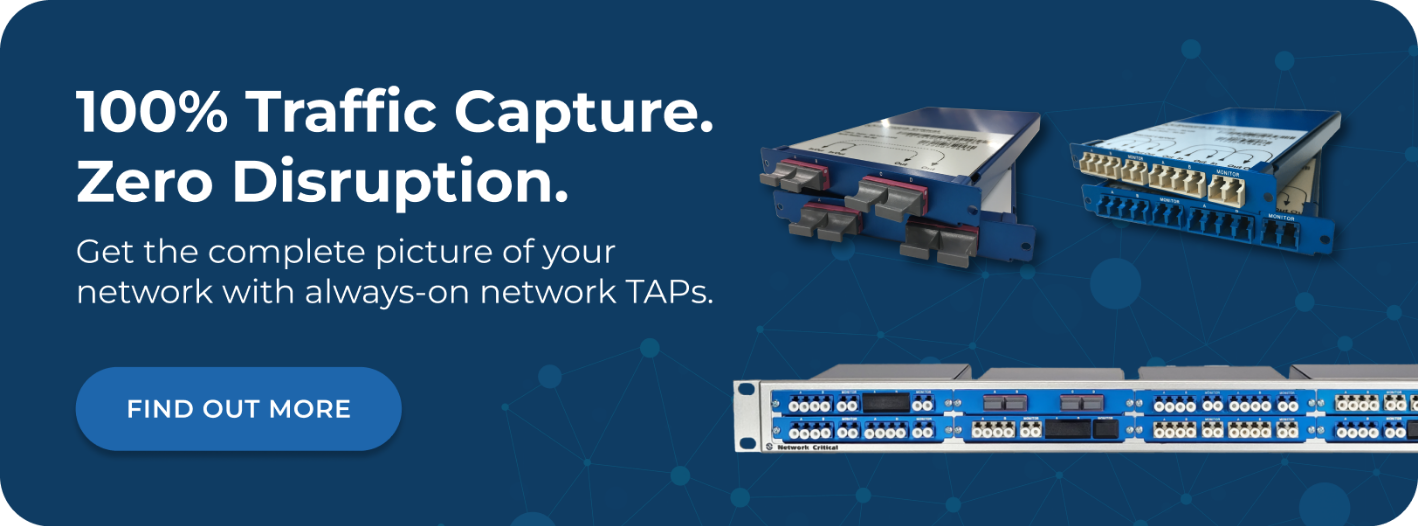
Network Critical delivers hybrid TAP and network packet broker functionality in a single modular chassis — one of the clearest architectural advantages in this category. Rather than deploying a TAP and a separate broker at each access point, you get both in one device, managed through a single interface.
The SmartNA-XL supports 1G to 40G environments in a 1RU modular chassis with five slots accepting passive fiber, active copper, and bypass TAP modules. Filtering capabilities include user-defined bit-level rules, Layer 2–4 packet filtering, application session filtering, header stripping, packet slicing, payload masking, and persistent load balancing. These features are available through Drag-n-Vu — Network Critical's patented graphical configuration interface — which uses a rule-generation engine to eliminate misconfiguration risk without requiring manual filter rule entry.
The SmartNA-PortPlus scales from 48 to 194 ports across 1G, 10G, 25G, 40G, and 100G speeds. A RESTful Application Programming Interface (API) enables direct machine-to-machine integration with security tools — demonstrated in a published integration with Darktrace, where the platform dynamically adjusted traffic filters without human intervention. The SmartNA-PortPlus HyperCore extends the architecture to 400G with 32 QSFP-DD interfaces and a maximum aggregate throughput of 25.6 Tbps.
Fail-safe copper and fiber TAP modules maintain link continuity under complete power loss. The scale-out architecture allows organizations to add ports incrementally without replacing or reconfiguring existing units — a direct CapEx advantage compared to chassis-based systems that require full replacement cycles.
Proven results:
- Vodafone: Achieved 100% accurate traffic visibility on key links, supporting QoS monitoring and European compliance reporting across multi-generation network infrastructure
- BP: Enabled centralized monitoring of IT and OT systems across refinery buildings spanning 10–12 buildings using passive fiber TAPs requiring no configuration or ongoing maintenance
- HSBC: Deployed SmartNA TAPs and passive fiber TAPs globally — from the UK to Hong Kong — achieving zero latency on monitoring technologies for real-time financial transaction visibility
2. Garland Technology — XtraTAP All-in-1 and EdgeLens
Garland Technology is a pure-play visibility specialist that offers a dedicated range of filtering TAPs alongside its broader network TAP and packet broker portfolio. The XtraTAP All-in-1 chassis combines passive and active TAP modules with built-in filtering and port mapping across Layers 2, 3, and 4. It supports Garland's full modular TAP range — copper, aggregation, regeneration, and bypass — in a single 1G chassis, with the ability to aggregate multiple low-speed links and apply per-tool filter rules before forwarding.
The EdgeLens is a bypass TAP and packet broker hybrid, purpose-built for edge deployments managing multiple inline tools simultaneously. It supports traffic aggregation, filtering, and load balancing to out-of-band monitoring tools from the same chassis that protects inline appliances. Configurable heartbeat packets monitor the health of each inline tool, with automatic failover if a tool becomes unavailable. The EdgeLens supports TAP speeds up to 100G with models offering 32 SFP+ and up to 8 QSFP+ packet broker ports. The EdgeLens Focus provides a compact version for single inline tool deployments at remote sites. Garland's products carry no subscription, port, feature, software, or license fees — a licensing model that simplifies total cost of ownership calculations.
3. Keysight Technologies — Vision Edge Series
Keysight Technologies brings a test and measurement heritage to network TAP design, producing filtering-capable visibility platforms where hardware acceleration is the defining differentiator. The Vision Edge series — including the Vision Edge 40, Vision Edge 100, and Vision Edge 400P — are network packet brokers with integrated TAP access and FPGA-based packet processing at full line rate.
Three-stage filtering (ingress, dynamic, and egress) supports complex Boolean logic without manual rule entry. Keysight's patented Dynamic Filter Compiler automatically resolves overlapping filter rules in real time, eliminating blind spots when visibility policies change under live network conditions. Packet transformation capabilities include deduplication, header stripping, packet trimming, data masking, and timestamping — all executing at line rate without dropped packets. The Vision Edge 400P supports up to 400G with 32 QSFP-DD ports and full breakout flexibility down to 10G. PacketStack features, including FPGA-based deduplication and burst protection, run at 400G in increments of 25G. SSL/TLS decryption is available for encrypted traffic inspection. Keysight launched AppFusion in January 2025, enabling Forescout, Instrumentix, and Nozomi Networks software to run directly on Vision NPB hardware, reducing the number of separate appliances in the security stack.
4. Gigamon — GigaVUE TA Series and G-TAP
Gigamon separates the access and filtering functions across two product families that work together as part of the Deep Observability Pipeline. G-TAP passive and active TAPs provide the physical access layer — they copy traffic from the link with no built-in filtering. Traffic filtering, aggregation, and distribution happen in GigaVUE TA Series aggregation nodes, which form the intelligence layer between the TAPs and downstream tools.
The GigaVUE TA Series delivers selective aggregation, filtering, replication, and load balancing via GigaVUE-OS. AI-enhanced capabilities from the GigaVUE HC Series can analyze traffic and forward only what's relevant to each monitoring or security tool, improving signal-to-noise ratio across the tool estate. The GigaVUE TA Series supports speeds from 1G to 400G and integrates with GigaVUE-FM Fabric Manager for centralized management across distributed deployments. For virtual and cloud environments, the GigaVUE Universal Cloud Tap (UCT) extends visibility into AWS, Azure, GCP, VMware, and Kubernetes workloads. Gigamon serves over 4,000 customers worldwide, including over 80% of Fortune 100 enterprises and nine of the ten largest mobile network providers.
5. Cubro Network Visibility — Packetmaster and EXA Series
Cubro Network Visibility produces carrier-grade packet brokers with TAP integration, built on P4-programmable switch chipsets that execute filtering entirely at the hardware level. The Packetmaster and EXA series deliver Layer 2 through 7 filtering alongside extensive tunneling protocol support — including Multi-Protocol Label Switching (MPLS), Generic Routing Encapsulation (GRE), NVGRE, Virtual Extensible Local Area Network (VXLAN), ERSPAN, and GPRS Tunneling Protocol (GTP).
The EXA32400 provides 32 ports of 100G/400G with QSFP-DD interfaces. The EXA64100 delivers 64 ports of 40G/100G with terabit-scale GTP inner IP load balancing for mobile user data. Built-in ARM CPUs support demanding on-board applications including deduplication, regex search filtering, and NetFlow generation — functions that typically require separate processing hardware on other platforms. Eight-byte hardware timestamping at 1 ns resolution meets the precision requirements of financial-grade and telecom-grade monitoring. Cubro received ISO 27001:2022 certification in 2024. All features are included in the unit price with no additional port licensing fees. Vitrum, Cubro's management software, provides centralized topology visualization and multi-user management across all deployed units.
6. APCON — IntellaView With HyperEngine
APCON offers a chassis-based approach to packet brokering with application-aware filtering at the hardware level. The IntellaView platform supports modular blade configurations from 1RU to 9RU, covering 1G through 400G connections with a backplane throughput reaching 19.2 Tbps in fully populated configurations.
The HyperEngine service blade is the platform's differentiating component. It provides real-time Deep Packet Inspection (DPI) and Layer 7 application-aware filtering, automatically detecting over 1,600 applications and 400 protocols without requiring manual rule definition. This enables organizations to apply precise monitoring policies by application type, protocol, or port — directing specific application traffic to dedicated tools without duplicating the full traffic stream. The HyperEngine supports real-time processing at 100G line rate, with up to 400G total throughput per chassis through four concurrent processing engines. APCON uses a separated control plane and data plane architecture, so traffic continues to pass through line cards even if both controllers fail — a high-availability design relevant to environments where monitoring continuity is a compliance requirement. IntellaView Enterprise software provides centralized single-pane management with mobile access via iOS and Android.
7. Niagara Networks — Open Visibility Platform
Niagara Networks combines network TAPs, packet brokers, and bypass switches under a unified orchestration layer in its Open Visibility Platform. The platform supports physical, virtual, and cloud network domains, with NPBs rated for speeds up to 400G.
Filtering capabilities include advanced filtering across Layers 2 through 7, Transport Layer Security/Secure Sockets Layer (TLS/SSL) decryption, payload masking, and deduplication. Passive and active TAP configurations are supported across a wide range of fiber types and connector formats. The 3225 TAP chassis provides up to 35 TAP links in a 1U modular form factor. Niagara's platform is designed and manufactured in Silicon Valley with a unified orchestration layer for centralized management across distributed deployments. Technology alliance partnerships with major security and monitoring vendors provide verified integration across enterprise security stacks.
How to Choose a Network TAP With Built-In Traffic Filtering
Understand What "Built-In Filtering" Actually Means
Not all products in this category work the same way. Some vendors — like Network Critical and Garland — integrate filtering into the same chassis as the TAP access function. Others, like Gigamon, separate the two functions across distinct device families that work together. Both approaches can be effective, but they have different implications for rack space, cabling complexity, management overhead, and cost. Decide which architecture fits your deployment constraints before comparing individual products.
Match Filtering Depth to Your Tool Requirements
Layer 2–4 filtering — by MAC address, IP, protocol, and port — covers the majority of enterprise use cases. Layer 7 application-aware filtering, available on platforms like APCON's HyperEngine and Cubro's Packetmaster series, is valuable when you need to direct specific application traffic to dedicated tools without sending the full feed. If you're monitoring encrypted traffic, check whether the platform supports SSL/TLS decryption — an increasingly essential capability given that over 80% of enterprise traffic is now encrypted.
Assess Scalability Against Your Growth Path
Your network TAPs and filtering infrastructure should scale with your network — not require rip-and-replace cycles. Consider:
- Whether the vendor uses a scale-out or chassis-replacement model for capacity growth
- The maximum port count and speeds supported today vs. your three-year projection
- Whether existing units remain in service as you add capacity
Evaluate Automation and API Integration
Static filter configurations require manual updates every time your network or tool estate changes. Platforms with RESTful APIs — including Network Critical's SmartNA-PortPlus and Keysight's Vision series — allow security tools to dynamically adjust traffic filters without human intervention. This is particularly relevant for environments running AI-driven security tools, where the tool itself needs to control what traffic it receives as its detection models evolve.
Consider Total Cost of Ownership
Platforms that combine hybrid TAP and packet broker functionality in a single chassis typically deliver lower total cost than separate point solutions — fewer devices, fewer cables, fewer management interfaces, and lower power draw. Factor in licensing models as well. Some vendors, including Garland Technology and Cubro, include all features without per-port or per-feature fees. Others require licensing add-ons for advanced filtering, decryption, or load balancing.
Verify Compliance and Data Handling Requirements
If your environment is subject to regulatory frameworks — including PCI-DSS, HIPAA, MiFID II, NERC CIP, or NIS2 — check what data handling features the platform supports. Payload masking prevents sensitive data from reaching unauthorized tools. Header stripping removes encapsulation before forwarding. Packet slicing reduces payload size while preserving headers for analysis. These capabilities directly affect your ability to meet data minimization and audit requirements.
Frequently Asked Questions
What Is a Network TAP With Built-In Traffic Filtering?
A network TAP with built-in traffic filtering is a hardware device that both copies traffic from a live network link and applies filtering rules before forwarding that traffic to monitoring tools. Unlike basic passive TAPs — which forward an unfiltered copy of all traffic — filtering-capable TAPs or hybrid TAP/packet broker platforms allow you to define which traffic each downstream tool receives, based on criteria such as IP address, VLAN, protocol, or application type. This reduces tool overload, lowers false positive rates, and extends the useful life of existing monitoring appliances.
What Is the Difference Between a TAP and a Packet Broker?
A network TAP creates a passive physical copy of all traffic on a live link without affecting the production network. A network packet broker sits between TAPs and monitoring tools, aggregating traffic from multiple access points, filtering it, and distributing relevant subsets to each tool. Many modern deployments combine both functions: TAPs for physical access and packet brokers for traffic management. Hybrid platforms like Network Critical's SmartNA-XL combine both functions in a single chassis, reducing the infrastructure required at each access point.
Do I Need Filtering If I'm Only Running One Monitoring Tool?
If you're running a single tool on a single link, a basic TAP without filtering may be sufficient — provided your tool can process the full traffic volume at line rate. Once you add a second tool, mix link speeds, or need to direct specific traffic types to specific tools, filtering becomes necessary to prevent tool overload and ensure each appliance receives the traffic it's designed to process. Most enterprise environments with more than two or three monitoring tools benefit significantly from integrated filtering.
How Does Layer 7 Application Filtering Differ From Layer 2–4 Filtering?
Layer 2–4 filtering operates on packet headers — matching against MAC addresses, IP addresses, protocols, ports, and VLANs. Layer 7 filtering adds application-layer awareness, identifying specific applications — such as a database protocol, VoIP session, or web application — regardless of the port or encapsulation used. Layer 7 filtering is available on platforms including APCON's HyperEngine (which detects over 1,600 applications) and Cubro's Packetmaster series. It's particularly valuable when directing traffic to specialized tools built for specific application protocols.
Can a Filtering TAP Also Support Inline Security Tool Deployment?
Yes — bypass TAP platforms with built-in filtering, such as Garland's EdgeLens and Network Critical's bypass TAP solutions, support both inline and out-of-band monitoring simultaneously. Inline tools receive live traffic through the bypass path; out-of-band tools receive filtered copies from the same device. If an inline tool fails or is taken offline for maintenance, the bypass TAP automatically redirects traffic around it, maintaining network continuity while you resolve the issue.
What Should I Look for in a Filtering TAP for a High-Compliance Environment?
Look for platforms that support payload masking, packet slicing, and header stripping — these capabilities let you limit what sensitive data reaches each tool, directly supporting data minimization requirements under frameworks including PCI-DSS, HIPAA, and GDPR. Audit logging, role-based access control, and API-driven configuration management are also relevant for compliance-driven environments where configuration changes must be tracked and authorized.
Build Your Visibility Architecture With Network Critical
Choosing a TAP with integrated filtering isn't just a hardware decision — it's an architectural one. The right platform reduces your device count, simplifies management, and ensures every monitoring tool receives precisely the traffic it needs, at the right speed, without manual intervention.
Network Critical's hybrid TAP and packet broker architecture combines access, filtering, and traffic distribution in a single modular chassis. The scale-out design means your visibility infrastructure grows with your network — without replacing existing equipment. The Darktrace API integration demonstrates what's possible when your TAP infrastructure responds dynamically to your security tools rather than requiring manual reconfiguration.
Whether you're deploying across a financial data center, a multi-site enterprise, or an industrial OT environment, Network Critical's engineers can map the right solution to your specific requirements. Speak to the Network Critical team to discuss your network and request a free audit.