Top 6 Network Visibility Tools for Data Center Uptime Assurance in 2026
Data center downtime costs enterprises an average of $9,000 per minute, according to Gartner research. For network teams responsible for uptime, visibility isn't optional — it's the foundation of everything else. Security tools can only protect traffic they can see. Performance monitoring only works when it receives a complete, unaltered copy of live packets.
Hardware-based network visibility tools — Test Access Points (TAPs), packet brokers, and bypass switches — sit at the physical layer of this architecture. They ensure your network monitoring and security stack receives 100% of network traffic, with zero dropped packets and zero risk of disrupting production links. This guide compares six verified vendors delivering these capabilities in 2026, with a focus on data center uptime assurance.
At a Glance: Top 6 Network Visibility Tools for Data Centers
| Vendor | Key Strength | Max Throughput |
|---|---|---|
|
Scale-out hybrid TAP and packet broker architecture |
Up to 400G |
|
|
Deep Observability Pipeline for hybrid cloud and physical environments |
Up to 400G |
|
|
High-density TAP and packet broker with AI-powered visibility |
Up to 400G |
|
|
Purpose-built TAP and bypass design with strong OT coverage |
Up to 100G |
|
|
Carrier-grade hybrid bypass and packet broker platform |
Up to 400G |
|
|
Integrated packet flow switching with service assurance analytics |
Up to 100G |
1. Network Critical — SmartNA-PortPlus
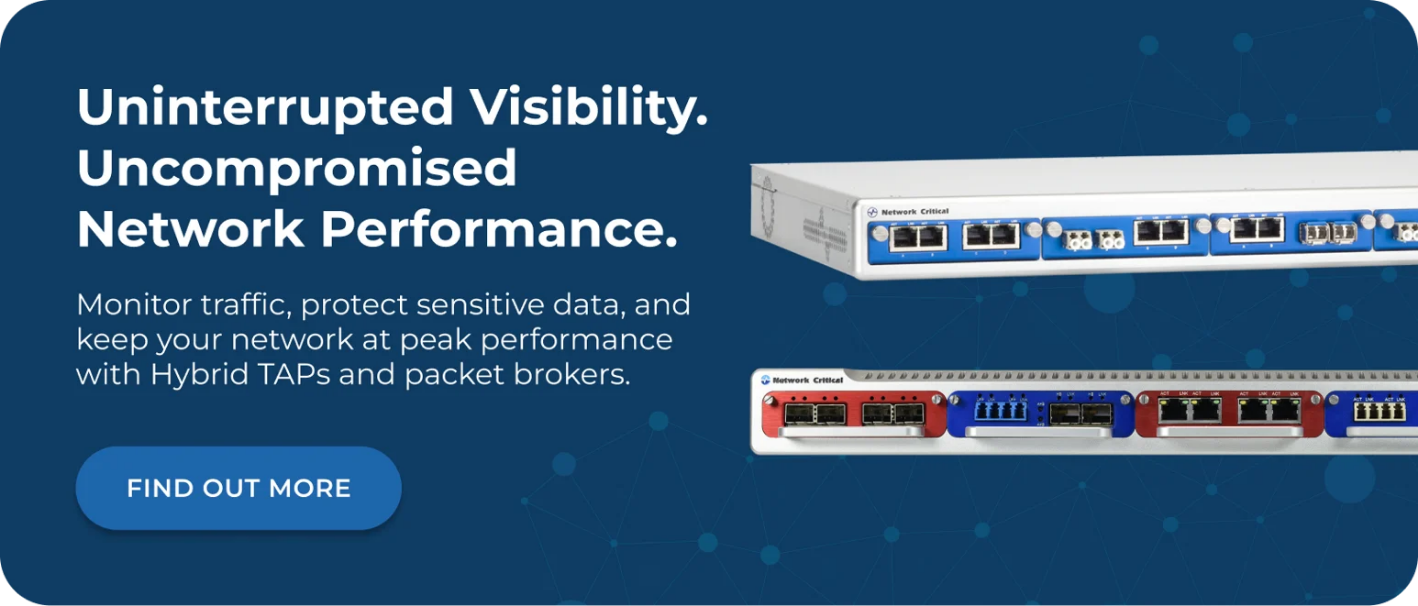
Network Critical's SmartNA-PortPlus delivers scalable packet brokering from 48 to 194 ports, supporting speeds of 1G, 10G, 25G, 40G, and 100G from a single rack unit (RU) chassis. The SmartNA-PortPlus HyperCore extends capacity to 400G with 32 QSFP-DD interfaces and a maximum aggregate throughput of 25.6 Tbps — built for hyperscale data center environments and high-density AI workloads.
A core differentiator is the scale-out architecture. When port density grows, additional units connect to the base chassis and operate as a single logical system. There is no need to remove or re-deploy existing infrastructure. Traffic mapping, filtering, and load balancing continue seamlessly across the expanded footprint. This approach protects capital expenditure (CapEx) and significantly reduces operational expenditure (OpEx) during growth cycles.
The platform combines network TAP and packet broker functionality in a single hybrid chassis, removing the need for separate access and aggregation devices. Drag-n-Vu software provides graphical, drag-and-drop configuration with a RESTful Application Programming Interface (API) for automated port mapping and filter management. Advanced features including packet slicing, payload masking, header stripping, deduplication, and persistent load balancing support both compliance and tool optimization requirements.
Fail-safe copper and fiber TAP modules maintain link continuity even under full power loss — a critical requirement for data centers operating 24/7 with no scheduled maintenance windows.
Proven results:
- Vodafone: Achieved 100% accurate traffic visibility on key links, reducing customer churn rates across a multi-generation mobile network
- BP: Enabled centralized monitoring of critical IT and Operational Technology (OT) systems across refinery buildings with no impact on live traffic
- HSBC: Deployed passive fiber TAPs globally — from the UK to Hong Kong — achieving zero latency on monitoring technologies for real-time financial updates
2. Gigamon — Deep Observability Pipeline
Gigamon's Deep Observability Pipeline is one of the most widely deployed network visibility platforms in enterprise data centers. The GigaVUE HC Series chassis supports physical environments from 1G to 400G, while G-TAP modules provide passive and active access across copper and fiber links.
The platform's principal strength is breadth. It spans physical data centers, private cloud, and public cloud environments including AWS, Azure, and Google Cloud Platform (GCP). GigaVUE-FM Fabric Manager provides centralized management across distributed deployments, enabling consistent policy enforcement across hybrid infrastructure. Advanced features include SSL/TLS decryption, application intelligence for Layer 7 filtering, and metadata generation for Security Information and Event Management (SIEM) integration.
Gigamon holds approximately 30% market share in the network visibility space and is the most searched vendor in the packet broker category as of December 2025. The platform suits organizations managing complex, multi-site environments where unified visibility across physical and virtual traffic is the primary requirement. Its scale and feature depth come with corresponding licensing and deployment complexity.
3. Keysight Technologies — Vision Edge Series
Keysight's network visibility portfolio draws on decades of test and measurement heritage. The Vision Edge Series supports speeds from 1G to 400G and is available in configurations supporting up to 36 TAPs in a single 1U chassis — one of the highest density options in the market. Multi-speed, single-mode TAPs eliminate the need for separate hardware at each link speed.
The packet broker platform incorporates hardware-accelerated packet processing with a zero-packet-loss architecture, SSL/TLS decryption, and a dynamic filter compiler that manages overlapping filter rules automatically. This removes the need for manual Regex configuration and reduces misconfiguration risk. AI-powered visibility features, introduced across recent generations, assist with anomaly detection and traffic classification.
Keysight maintains an extensive inventory for fast-order fulfillment, which is advantageous for organizations with rapid deployment requirements. The Vision ONE platform provides centralized management across physical and virtual visibility infrastructure. Keysight is best positioned in high-speed data center and carrier environments where throughput density and test-grade accuracy are non-negotiable.
4. Garland Technology — EdgeSafe & AggregatorTAP
Garland Technology is a pure-play visibility specialist with an exclusive focus on TAPs, packet brokers, and bypass switching. The EdgeSafe series provides inline bypass protection for 1G to 100G links, with sub-microsecond failover to ensure security tools never create a single point of failure on critical data center paths. The AggregatorTAP line aggregates traffic from multiple access points, reducing tool port requirements and monitoring costs.
Garland's portfolio spans passive fiber TAPs, active copper TAPs, bypass TAPs, and aggregation TAPs, making it straightforward to build end-to-end visibility architectures without multi-vendor complexity. The company invests heavily in educational content and customer support resources, which reduces deployment friction for teams implementing visibility for the first time or upgrading legacy access infrastructure.
Products support speeds up to 100G across enterprise deployments. Garland also offers FieldTAP portable options for temporary deployments and troubleshooting, and has developed explicit product lines for Operational Technology (OT) and industrial network environments. Compliance-focused organizations benefit from TAA-compliant options suitable for US government and regulated enterprise deployments.
5. Niagara Networks — Open Visibility Platform
Niagara Networks delivers carrier-grade network visibility through its Open Visibility Platform, which integrates TAP functionality, bypass switching, and packet brokering in a unified system. The Hybrid Packet Broker and Bypass platforms are engineered to maintain continuous traffic flow during tool failure or power loss — a direct requirement for data centers prioritizing uptime assurance.
The platform supports speeds up to 400G and covers copper, multimode fiber, and single-mode fiber connections across a wide range of connector types. Active TAPs include link negotiation capabilities and fail-safe circuitry, while passive fiber TAPs are available for zero-power access on critical links. Advanced features include TLS decryption, payload masking, deduplication, and deep packet inspection across physical, virtual, and cloud domains.
Niagara's architecture is particularly well-suited to environments where inline security inspection must coexist with high availability requirements. Traffic continues to flow through bypass paths even when inline tools are taken offline for maintenance or experience failures — removing the traditional tension between security tool deployment and network uptime.
6. NETSCOUT — nGenius Packet Flow Switches
NETSCOUT integrates packet flow switching with its broader service assurance platform. The nGenius Packet Flow Switch (PFS) series provides traffic aggregation, filtering, and replication for data centers and service provider networks, with physical TAPs supporting copper and fiber interfaces up to 100G.
The differentiating factor for NETSCOUT is the integration between packet flow infrastructure and the nGeniusONE service assurance platform. Organizations using both benefit from a unified workflow: packet access infrastructure feeds directly into service-level monitoring and root cause analysis tools, without data hand-offs across separate management systems. This tightly coupled architecture suits enterprises whose primary use case is Service Level Agreement (SLA) monitoring and application performance management alongside security visibility.
NETSCOUT also offers virtual TAPs for cloud environments including Microsoft Azure, extending visibility into hybrid deployments without separate hardware. The platform is widely deployed in service provider and large enterprise environments where service assurance is the dominant operational requirement.
How to Choose the Right Network Visibility Tool for Your Data Center
Uptime and Fail-Safe Requirements
The core question for data center visibility is simple: what happens when the visibility tool itself fails? Passive fiber TAPs require no power and create no single point of failure. Bypass TAPs ensure inline security tools are automatically bypassed if they go offline, keeping production traffic flowing uninterrupted. Any visibility architecture for a mission-critical data center must specify fail-safe behavior explicitly — not assume it. If your security tools sit inline, bypass TAP solutions are non-negotiable.
Throughput and Speed Requirements
Verify the maximum line rate your current infrastructure requires and plan for one generation ahead. Standard enterprise data centers operate at 10G to 100G per link. High-density AI and hyperscale environments are migrating to 400G. TAPs and packet brokers must match or exceed the link speed they access — under-specified hardware introduces packet loss. Confirm specifications cover full-duplex throughput, not single-direction capacity.
Scalability and Future-Proofing
A visibility architecture that requires full replacement when port counts grow adds cost and operational risk. Modular, scale-out architectures allow additional capacity to be added while maintaining existing configurations and management workflows. When evaluating vendors, ask specifically how the platform handles port expansion: can existing units remain in service, or does growth require rip-and-replace?
Integration With Monitoring and Security Tools
Your visibility infrastructure is only as valuable as the tools it feeds. Confirm that packet broker filtering, load balancing, and API capabilities align with the specific requirements of your Security Operations Center (SOC) tools, Intrusion Detection Systems (IDSs), Intrusion Prevention Systems (IPSs), and performance monitoring platforms. Vendors offering open APIs allow security tools to dynamically adjust traffic feeds without manual reconfiguration — a significant advantage for teams using machine learning-based threat detection.
Compliance and Data Handling
Regulated industries including financial services, healthcare, and government require specific data handling capabilities. Features such as payload masking, header stripping, and packet slicing allow organizations to feed monitoring tools without exposing sensitive payload content. Verify that any visibility solution you evaluate supports the specific compliance framework applicable to your environment — whether that is PCI DSS, HIPAA, or government security standards.
Total Cost of Ownership
Hardware purchase price is rarely the dominant cost factor in visibility architecture decisions. Factor in rack space, power consumption, licensing, management overhead, and the cost of replacing infrastructure when requirements change. Solutions that combine TAP and packet broker functionality in a single chassis reduce both CapEx and OpEx. Modular architectures that scale without requiring replacement protect the initial investment as network demands grow.
Frequently Asked Questions
What Is a Network Visibility Tool?
A network visibility tool is a hardware or software solution that provides access to network traffic for monitoring, security, and analysis purposes. In the context of data center uptime assurance, this typically refers to hardware devices — TAPs, packet brokers, and bypass switches — that sit on physical network links and deliver accurate copies of traffic to downstream tools without affecting production performance.
What Is the Difference Between a Network TAP and a Packet Broker?
A network TAP creates a passive, physical copy of live traffic without interrupting the production link. A packet broker sits downstream of TAPs and manages how that copied traffic is aggregated, filtered, and distributed to monitoring and security tools. Most enterprise data center deployments use both: ethernet TAPs for physical access and packet brokers for intelligent traffic management. Using only TAPs without packet brokering often results in monitoring tools receiving more traffic than they can process.
Do I Need a Bypass TAP for Inline Security Tools?
Yes, if any security appliance — such as a Next-Generation Firewall (NGFW), Intrusion Prevention System (IPS), or Data Loss Prevention (DLP) tool — sits inline on a production link, a bypass TAP is required. Without one, a tool failure or power outage will take down the production link entirely. Bypass TAPs automatically route traffic around failed tools, maintaining network uptime while the appliance is offline or being serviced.
How Does Network Visibility Improve Data Center Uptime?
Network visibility improves uptime by giving operations teams accurate, real-time data to detect and resolve issues before they affect services. TAPs and packet brokers ensure monitoring tools receive complete, unaltered traffic — not sampled or dropped data from Switched Port Analyzer (SPAN) ports. Complete traffic feeds reduce mean time to detect (MTTD) and mean time to resolve (MTTR) for both performance incidents and security events. Organizations with comprehensive visibility consistently report faster incident resolution compared to those relying solely on SPAN-based monitoring.
What Throughput Do I Need for a Data Center Visibility Solution?
Required throughput depends on the speed of the links being accessed. Enterprise data centers typically operate core links at 10G to 100G, with 40G being common for server-to-aggregation connections. Any TAP or packet broker must match the full-duplex line rate of the link it accesses — a 100G link requires a 100G TAP. Organizations upgrading to 400G infrastructure for AI and hyperscale workloads should ensure their visibility architecture supports that speed natively, or plan for a parallel upgrade.
Build Your Visibility Architecture With Network Critical
Choosing the right network visibility infrastructure is a long-term architectural decision. The wrong choice creates operational debt — under-specified hardware, management silos, or architectures that require replacement rather than expansion.
Network Critical's scale-out approach means your visibility infrastructure grows alongside your data center without disruption. From 48-port 10G deployments to 400G hyperscale environments, the SmartNA-PortPlus platform expands incrementally while maintaining a single management interface. Hybrid TAP and packet broker functionality in one chassis reduces complexity without reducing capability. Blue-chip deployments at Vodafone, HSBC, BP, and Airbus demonstrate performance at scale across demanding enterprise and industrial environments.
To discuss your data center visibility requirements or arrange a free network audit, speak to the Network Critical team.