Top 6 Network Visibility Solutions for DORA Compliance in 2026
The Digital Operational Resilience Act (DORA) took effect on 17 January 2025. It applies to banks, insurers, investment firms, and their critical ICT third-party providers operating in the EU. Article 9 of DORA requires financial entities to maintain continuous monitoring of ICT systems. This forms part of a documented risk management framework. DORA audits require complete, tamper-proof packet capture. The partial traffic samples that switch port analyser (SPAN) configurations produce under load will not satisfy them.
Network TAPs and packet brokers are the infrastructure layer that makes this possible. TAPs provide passive, full-duplex access to live links. Packet brokers aggregate, filter, and route that traffic to monitoring, security, and forensic tools. Together they create the evidence trail DORA auditors need. Choosing the wrong platform means gaps in your ICT risk reporting. That creates enforcement exposure under a regulation with real financial penalties. This guide compares six verified hardware vendors that deliver the physical visibility layer for DORA-compliant financial network environments.
Network Visibility Vendors at a Glance
| Vendor | Key Feature / Strength | Max Throughput |
|---|---|---|
|
Hybrid TAP and packet broker in a single chassis, perpetual licensing, zero packet loss |
Up to 400G |
|
|
Deep observability pipeline, GigaVUE platform, Precryption encrypted traffic visibility |
Up to 400G |
|
|
Vision 400 Series NPBs, test-grade precision, IFC Centralised Manager |
Up to 400G |
|
|
nGenius PFS 7000 packet flow switches, DORA-specific compliance documentation, nGeniusONE |
Up to 400G |
|
|
Pure-play TAP specialist, Breakout and EdgeLens Inline Bypass TAP, USA manufacture |
Up to 400G |
|
|
X2 and X3-Series NPBs, nanosecond-precision timestamping, European-based R&D |
Up to 12.8 Tbps aggregate |
Network Critical – SmartNA-PortPlus and SmartNA-PortPlus HyperCore
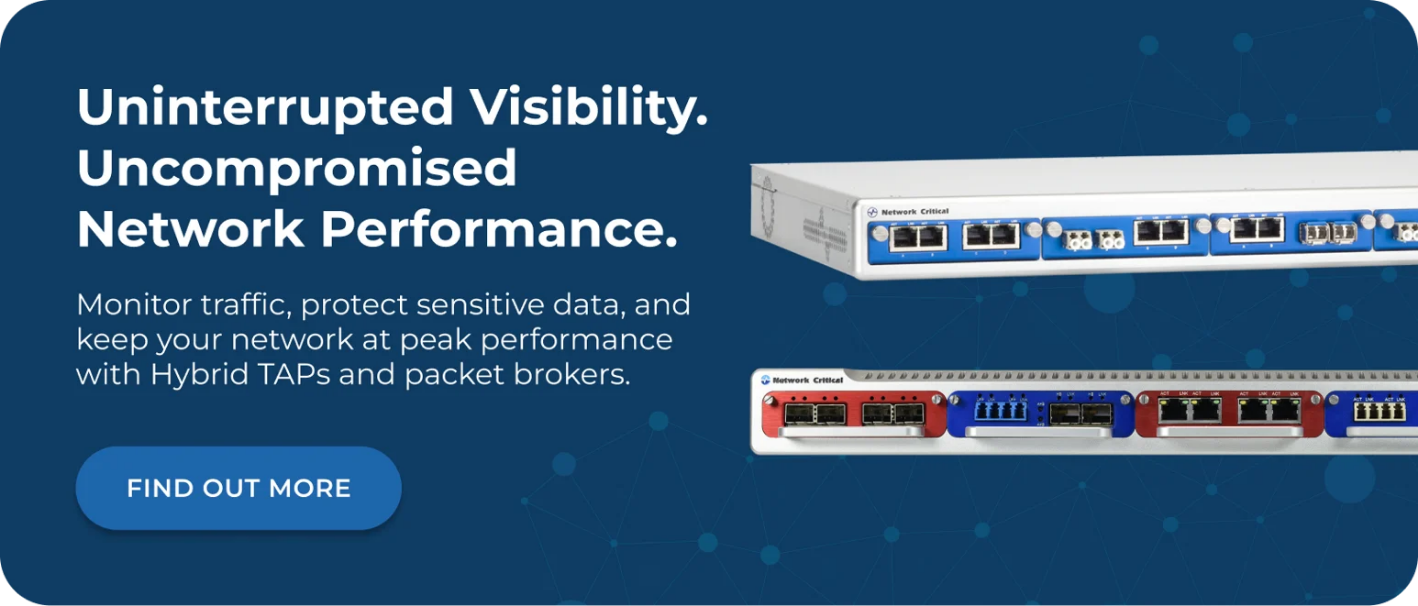
Network Critical's SmartNA-PortPlus delivers a scalable hybrid architecture. It combines TAP access and packet brokering in a single 1RU chassis. The platform scales from 48 ports to 194 ports across 1G, 10G, 25G, 40G, and 100G speeds. Non-blocking throughput runs at 1.8 Tbps at full line rate. No traffic is dropped during peak load. That eliminates the failure mode that invalidates SPAN-based monitoring under DORA audit.
For financial networks running 400G interconnects, the SmartNA-PortPlus HyperCore provides 32 QSFP-DD interfaces and up to 256 ports. Both platforms are managed through Drag-n-Vu. Its graphical drag-and-drop interface lets network teams configure and redeploy monitoring policies without specialist engineers. Typical deployments complete in under two hours.
DORA requires documented ICT risk management procedures with audit-ready evidence of monitoring continuity. Network Critical's passive fiber taps use no active electronics and require no configuration at deployment. They ship preconfigured to the desired split ratio and cannot silently fail. The tool-agnostic PCAP output feeds any SIEM, NDR, or forensic platform the institution already operates. This includes Splunk, Microsoft Sentinel, and Darktrace. Perpetual licensing eliminates per-port subscription costs that inflate 3-year total cost of ownership (TCO) under competing platforms.
Proven results:
- HSBC: Achieved zero latency on monitoring technologies across global network links, enabling real-time transaction visibility and SLA measurement
- Darktrace: SmartNA-PortPlus API integration enabled automated threat detection workflows across the full network traffic stream
- Vodafone: Delivered 100% accurate traffic visibility on key links across a multi-generation carrier network, supporting European data regulation compliance
Gigamon – GigaVUE Platform
Gigamon is the market leader in what it calls the deep observability pipeline. It holds approximately 30% share of the network visibility segment per 650 Group data from Q1 2026. The GigaVUE-HC series provides physical access across 1G to 400G. G-TAP passive and active options support battery backup for business continuity. This is relevant to DORA's operational resilience requirements around ICT continuity planning.
GigaVUE-FM centralises management across distributed deployments. Gigamon Precryption technology provides plaintext visibility into encrypted east-west traffic. It does not require decryption at each tool. This matters for DORA's requirement to detect internal ICT incidents, not just perimeter threats. The platform integrates with AWS, Azure, and Google Cloud Platform for institutions running hybrid workloads.
Financial institutions using Gigamon report up to 50--60% reductions in tool spend through deduplication and centralised filtering. Subscription pricing has emerged as a friction point at contract renewal. The 3-year TCO for a typical Gigamon deployment runs materially higher than comparable hardware-perpetual-licence platforms. Deployment typically requires specialist engineers rather than network administrator self-service.
Keysight (Ixia) – Vision 400 Series
Keysight's Network Visibility business unit is built on the Ixia acquisition. It delivers the Vision 400 Series packet broker alongside a full TAP portfolio. The IFC Centralised Manager provides centralised management across physical and virtual visibility infrastructure. The Vision 400 Series received the Frost & Sullivan 2024 Global New Product Innovation Award. It supports speeds from 10G to 400G.
Keysight's test equipment heritage means the Vision platform is built to hardware-accelerated zero-loss standards. This aligns directly with DORA's requirement for continuous, evidence-grade ICT monitoring. The IFC Centralised Manager provides a single control plane across physical and virtual deployments. CloudLens extends visibility to Azure Virtual Network TAP traffic mirroring for hybrid financial environments.
Keysight maintains extensive product inventory for fast fulfilment. This is a practical advantage for institutions facing imminent DORA audit timelines. The Vision platform's SSL/TLS decryption and dynamic filter compiler manage overlapping filter rules without manual conflict resolution. Exact port density figures at 400G in single-chassis configurations are not confirmed in public specifications. Confirmed maximum throughput from product pages is up to 400G.
NetScout – nGenius Packet Flow Switches
NetScout has produced DORA-specific compliance documentation. It positions the nGenius platform directly against the regulation's ICT risk management and incident reporting requirements. The nGenius Packet Flow Switch (PFS) 7000 Series operates from 1G to 400G. It scales to 12.8 Tbps aggregate throughput via self-organising mesh architecture. The platform provides aggregation, filtering, load balancing, replication, and header stripping as standard.
nGeniusONE provides application and network performance management analytics alongside the packet flow switching layer. Omnis CyberStream and Omnis Cyber Intelligence leverage deep packet inspection (DPI) and network traffic analysis. They support DORA's threat detection obligations. NETSCOUT HD Fiber TAPs feed the PFS 7000 with passive access to physical links. The PowerSafe external bypass TAP integrates directly with the PFS 7000 for inline security tool deployment.
NetScout's all-in-one platform approach combines visibility infrastructure with analytics in a single vendor relationship. This simplifies DORA third-party ICT supplier governance. The platform's primary orientation is analytics and performance management rather than pure-play packet brokering. Organisations with existing tool portfolios should confirm interoperability before committing to the analytics stack.
Garland Technology – PacketMAX and Breakout TAP Series
Garland Technology operates as a pure-play visibility specialist. Its focus is exclusively on network TAPs, packet brokers, and bypass solutions. The Breakout TAP range covers passive fibre and copper TAPs from 10Mbps through 400G. It carries Garland's Cisco Compatible certification with documented zero packet loss standards. All products are manufactured in the USA. This supports supply-chain auditability for institutions subject to DORA's third-party ICT risk provisions.
The PacketMAX Series packet brokers provide aggregation, filtering, and load balancing for enterprise and data centre deployments. EdgeLens Inline Bypass TAP provides automatic failover for inline security tools. Switchover times are sub-microsecond, verified under full-duplex 100G load. Garland's Mira Encrypted Traffic Orchestration (ETO) integration supports TLS 1.0 through 1.3 and SSHv2 decryption within the bypass architecture. This addresses encrypted traffic blind spots that create DORA reporting gaps.
Garland operates within the mid-market segment (under 200 ports). It has documented depth in OT and industrial environments as well as enterprise data centres. For 400G scale-out to hundreds of ports, evaluate whether the Garland portfolio matches your target port count.
Profitap – X2 and X3-Series Network Packet Brokers
Profitap is a European-headquartered specialist in network TAPs and packet brokers, based in Eindhoven, the Netherlands. The X2-6400G and X2-12800G packet brokers provide nanosecond-precision timestamping. They synchronise via IEEE 1588 Precision Time Protocol (PTP). This creates the sequenced evidence trail DORA requires when correlating ICT incidents across distributed financial systems.
The X3-Series adds advanced processing including TLS decryption, data masking, deduplication, and NetFlow generation. Data masking allows packet payload scrubbing before traffic reaches monitoring tools. This supports DORA's data governance and minimisation obligations for institutions handling personal financial data. The NPB-CM centralised management platform runs within Profitap Supervisor. It provides a single dashboard across physical X-Series brokers and virtual TAPs.
Profitap's timestamping precision suits latency-sensitive financial environments. High-frequency trading infrastructure and sub-microsecond timing analysis are documented use cases. Maximum throughput on the X2-12800G is listed at 12.8 Tbps aggregate across the chassis. Profitap presents this as aggregate backplane capacity across multiple processing blades, not a single-port maximum.
How to Choose the Right Network Visibility Platform for DORA
Confirm Zero Packet Loss Under Load
DORA requires documented evidence of ICT monitoring continuity. A platform that drops packets under peak load invalidates that evidence. Verify zero packet loss claims under full-duplex load at your actual link speeds. Do not rely on theoretical lab conditions. SPAN ports are disqualified by design: they oversubscribe during traffic spikes and do so without triggering any alert. Any platform you evaluate should demonstrate lossless capture during your busiest production window.
Match Throughput Headroom to Your Network Roadmap
Core banking interconnects and trading co-location environments are transitioning from 100G to 400G. Your visibility platform should support your current link speeds with clear headroom for the next refresh cycle. Avoid platforms that require a forklift upgrade when you add 400G links. Modular scale-out designs extend existing platforms without replacing installed infrastructure. This reduces both capital disruption and change-management risk.
Consider:
- Current maximum link speed across all monitored segments
- Planned infrastructure upgrades within your DORA three-year ICT risk planning window
- Whether the platform scales through additional modules or requires chassis replacement
Evaluate Total Cost of Ownership, Not Just Capital Expenditure
DORA compliance does not end at initial deployment. It requires ongoing monitoring continuity and documented audit readiness. Factor in:
- Subscription versus perpetual licensing over a three-year horizon
- Specialist engineer dependency for routine configuration changes
- Per-port licence exposure as your monitoring footprint expands
Platforms running on perpetual hardware licences avoid the recurring OpEx escalation that subscription-based platforms introduce at contract renewal. Network-admin self-service configuration removes specialist-engineer dependency. Network packet brokers built around graphical management interfaces deliver both.
Assess Tool-Agnostic Output Compatibility
DORA does not specify which monitoring or security tools financial institutions must use. It requires that those tools receive complete, accurate traffic data. Confirm your visibility platform delivers standard PCAP output compatible with your existing SIEM, NDR, and forensic tools before committing. Proprietary output formats or platform-locked analytics create single-vendor dependency. This conflicts with DORA's third-party ICT risk governance requirements.
Review Deployment Timelines Against Enforcement Exposure
DORA enforcement is active. Financial institutions under regulatory review cannot afford multi-month deployment timelines. Evaluate how quickly each platform can be installed and producing audit-ready output. Platforms with graphical drag-and-drop configuration and pre-configured passive TAPs reduce deployment time significantly. Those requiring specialist-engineer commissioning take considerably longer.
Consider Encrypted Traffic Handling
Over 80% of network traffic is encrypted. DORA's incident detection requirements apply to encrypted flows as well as plaintext traffic. Understand whether your chosen platform provides native decryption or integrates with a third-party decryption appliance. Confirm whether it passes encrypted traffic directly to your inline security tools. Confirm the decryption approach complies with your institution's data handling obligations under GDPR alongside DORA.
Frequently Asked Questions
What is DORA and why does it affect network visibility infrastructure?
DORA -- the Digital Operational Resilience Act -- is an EU regulation that became enforceable on 17 January 2025. It applies to financial institutions and their critical ICT service providers operating in the EU. The regulation requires documented ICT risk management, continuous monitoring, incident reporting, and resilience testing. Network visibility infrastructure -- TAPs and packet brokers -- is the physical layer for continuous, complete packet capture. This is what DORA's monitoring requirements depend on. Without it, financial institutions cannot produce the audit-grade evidence DORA auditors require.
What is the difference between a network TAP and a packet broker for DORA compliance?
A network TAP creates a passive copy of live traffic from a specific link without affecting network performance. A packet broker sits between TAPs and monitoring tools. It aggregates traffic from multiple capture points, applies filters, and distributes the right traffic to each tool. DORA compliance typically requires both. TAPs provide lossless access at each monitored link. A packet broker manages traffic distribution to your SIEM, NDR, and forensic recording tools. Organisations with more than a handful of monitored links almost always need a packet broker to avoid overwhelming individual tools.
Why is SPAN not suitable for DORA-compliant monitoring?
SPAN ports mirror traffic from a switch port to a monitoring destination. They drop packets when the switch CPU is under load. That is precisely when incident traffic is most likely to occur. SPAN operates on a best-effort basis with no alert when packets are dropped. DORA requires evidence-grade, continuous monitoring with verifiable capture completeness. Dropped packets mean incomplete forensic evidence, compromised incident timelines, and a compliance record that cannot withstand regulatory scrutiny.
How much does DORA-compliant network visibility infrastructure cost?
Hardware TAP and packet broker platforms vary widely by throughput scale and vendor. Entry-level configurations for smaller financial institutions can be deployed for a fraction of the cost of enterprise-scale 400G platforms. The more significant cost variable is the licensing model. Subscription-based platforms accumulate substantial OpEx over a three-year DORA planning horizon. Perpetual-licence platforms provide predictable CapEx. Maintenance, specialist-engineer dependency, and tool-ingestion costs all compound the headline hardware price. Modelled comparisons show 40--60% lower 3-year TCO for perpetual-licence hybrid platforms versus leading subscription-based alternatives.
Do network TAPs work with existing SIEM and NDR tools?
Yes -- hardware TAPs and tool-agnostic packet brokers deliver standard PCAP output. This is compatible with all major SIEM, NDR, and forensic platforms. These include Splunk, Microsoft Sentinel, Darktrace, ExtraHop, Corelight, Wireshark, and Endace. The key requirement is that your packet broker delivers traffic in the format your tools expect. Proprietary wrapping that forces tool replacement should be treated as a red flag. Confirm tool compatibility before procurement. This is especially important if your institution has invested in a specific NDR or forensic platform for DORA incident reporting.
Which financial institutions need DORA-compliant network visibility?
DORA applies to 20 categories of financial entity operating in the EU. These include banks, investment firms, payment institutions, insurance companies, crypto-asset service providers, and critical ICT third-party service providers. Institutions headquartered outside the EU but providing financial services within it are also subject to the regulation. Any organisation in scope that does not maintain continuous, evidence-grade ICT monitoring is exposed to regulatory enforcement action.
Build Your DORA Visibility Architecture With Network Critical
DORA compliance depends on a visibility layer that never drops packets and never silently fails. It must produce audit-ready evidence for every monitoring tool in your stack. The platform you choose today will underpin your ICT risk management documentation for the next three years and beyond.
Network Critical combines TAP access and packet brokering in a single hybrid chassis. The 100gb smartna portplus scales from 48 to 194 ports across 1G to 100G at 1.8 Tbps throughput. Zero packet loss and perpetual licensing are standard. No per-port subscriptions, no renewal surprises. The 3-year TCO runs 40--60% lower than leading subscription-based alternatives. Drag-n-Vu reduces configuration time so network teams self-serve without specialist-engineer dependency.
For audit-ready DORA monitoring infrastructure that fits your budget and deploys in hours, speak to the Network Critical team.