Top 6 Network TAPs for Retail and Payment Networks
Retail and payment networks carry some of the most targeted data in commerce. Card transactions cross store LANs, payment gateways, data centres and cloud on-ramps every second. Each hop is a point where attackers can hide and where assessors expect evidence.
PCI DSS v4.0.1 requires all traffic to be monitored at the perimeter of the cardholder data environment (CDE). It sets the same expectation for critical points inside it. SPAN ports struggle to meet that standard during peak trading, when packet loss is most likely.
As retailers and processors plan 2027 refresh cycles, hardware TAPs and packet brokers have become core compliance infrastructure. The right platform copies every packet, protects inline security tools and masks card data before analysis. This guide compares six vendors on the capabilities that matter most for retail and payment visibility.
Network TAPs for Retail and Payment Networks at a Glance
|
Vendor |
Key Feature / Strength |
Max Throughput |
|---|---|---|
|
Hybrid TAP and packet broker with payload masking and perpetual licensing |
Up to 400G |
|
|
GigaSMART masking within a broad deep observability platform |
Up to 400G |
|
|
High-density passive Flex Taps and zero-loss Vision packet brokers |
Up to 400G |
|
|
Pattern-based card number masking and on-box packet storage |
Up to 400G |
|
|
Passive fibre TAPs and PacketMAX deduplication with no subscriptions |
Up to 400G |
|
|
Modular fibre TAPs and X3-Series data masking |
Up to 400G |
1. Network Critical
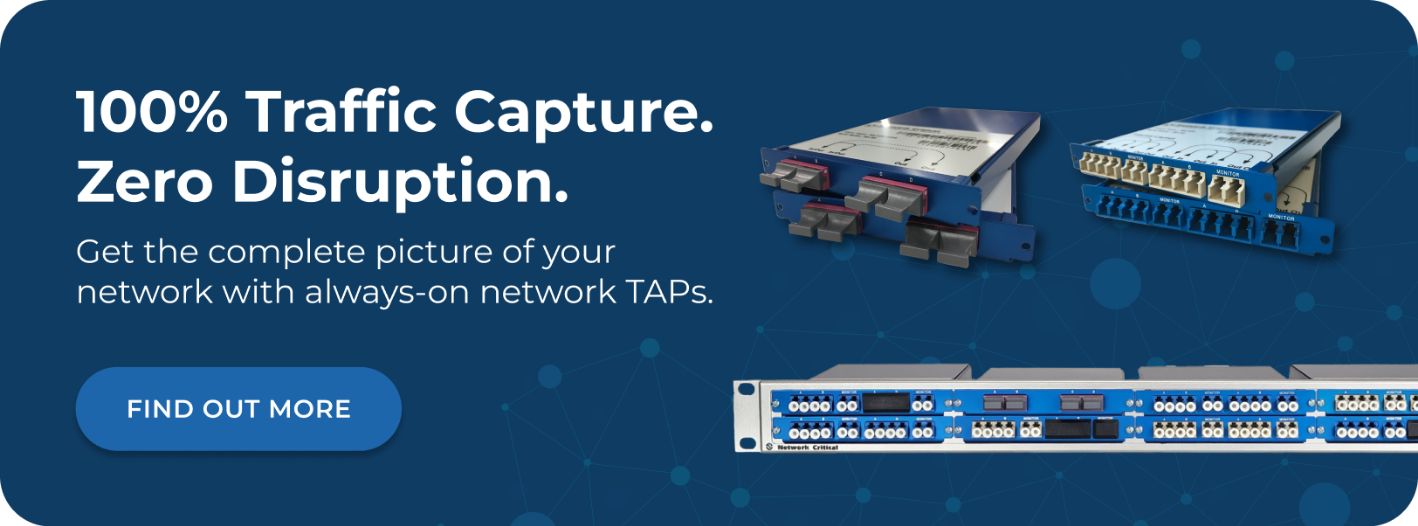
Network Critical: Passive Fiber Optical TAPs, SmartNA-XL, Bypass TAPs, SmartNA-PortPlus Network Critical builds TAPs and packet brokers that cover every layer of a retail payment estate. Its Passive Fiber Optical TAPs need zero power and support 1G to 100G links. Up to 16 TAPs fit in a single 1RU, which suits crowded comms rooms and payment hubs. With no active electronics, a power failure never interrupts card authorisation traffic. The SmartNA-XL is a modular hybrid TAP and packet broker with five slots in 1RU. It combines passive, active and bypass TAP modules across 1G, 10G and 40G links. Payload masking and packet slicing remove cardholder data before traffic reaches analysis tools. Header stripping and de-tunnelling prepare traffic for IDS, NDR and SIEM platforms. Bypass TAP modules keep inline firewalls and IPS appliances in path without adding a single point of failure. If a security tool goes offline, production traffic keeps flowing between tills and the payment gateway. For data centre aggregation, the SmartNA-PortPlus scales from 48 to 194 ports at 1.8 Tbps line rate. RADIUS and TACACS+ support provides the accountability trail that assessors look for. The SmartNA-PortPlus HyperCore extends capacity to 400G with 32 QSFP-DD interfaces. Drag-n-Vu software provides drag-and-drop configuration, with typical deployments completed in under two hours. Best for: Retailers and payment processors needing fail-safe, compliant visibility from store edge to 400G core without subscription licensing. Proven results:
- HSBC: Passive fibre TAPs delivered zero-latency monitoring across a global banking network, from the UK to Hong Kong
- Bourne Leisure: SmartNA-XL aggregated eight 1Gbps links into one 10Gbps security tool, cutting tool costs eightfold
- Darktrace: SmartNA-PortPlus API integration lets Darktrace control filtering and port mapping automatically, without human intervention
2. Gigamon
Gigamon: GigaVUE TA400, GigaSMART Masking Gigamon holds 51 per cent of the deep observability segment, according to 650 Group figures for Q1 2026. Its GigaVUE TA400 node supports 400G QSFP-DD interfaces with up to 12.8Tb of visibility capacity. That headroom suits large retailers consolidating payment, e-commerce and store traffic into central data centres. Gigamon reports more than 4,000 customer organisations, including 83 of the Fortune 100. GigaSMART Masking overwrites specific packet fields with a fixed pattern before traffic reaches tools. Gigamon states that masked data is never seen, processed or stored by connected security platforms. The feature also protects engineers and outsourced monitoring teams from accidental exposure to sensitive data. This supports the data-handling controls that financial services regulators expect. Precryption technology adds visibility into TLS-encrypted traffic, which matters for card-not-present and API payment flows. Gigamon's platform spans physical, virtual and cloud environments under a single management layer. Licensing is subscription-based, so buyers should model costs across a full three-year term. Deployment and tuning typically involve specialist engineers rather than network admin self-service.
3. Keysight
Keysight: Flex Tap, Vision E400S Keysight's network visibility portfolio grew from the Ixia acquisition. Its Flex Tap range provides fully passive fibre TAPs supporting 1G to 400G. Up to 36 taps fit in a 1U chassis, with split ratios from 50/50 to 90/10. Single-mode, multimode, MTP and BiDi options cover the mixed cabling common in retail data centres. The Vision E400S packet broker delivers 9.2 Tbps of non-blocking, line-rate forwarding in 1RU. It offers 16 QSFP-DD ports and supports up to 16 interfaces at 400G. Keysight cites independent Tolly Group validation of its zero-packet-loss architecture. Header masking hides source and destination MAC or IP addresses before traffic reaches tools. Timestamping supports NTP, 1588 PTP and 1PPS sources, which helps forensic teams sequence transaction events. The Vision 400 series earned a Frost and Sullivan 2024 Global New Product Innovation Award. A drag-and-drop interface removes much of the CLI work from broker configuration. Pricing aligns with Keysight's premium enterprise positioning, and visibility sits inside a much broader test and measurement business.
4. APCON
APCON: IntellaView, HyperEngine, IntellaStore IV APCON's IntellaView platform uses modular blades that process traffic from 1G to 400G. Customers add blades as the estate grows rather than replacing the chassis. The HyperEngine blade processes 100G traffic in real time and detects more than 1,600 applications and 400 protocols. HyperEngine's pattern-matching engine can mask matched data such as credit card numbers. APCON positions this capability directly for PCI and HIPAA compliance. Deep packet inspection also identifies sensitive data for masking before it reaches tools. Deduplication removes repeated packets to improve tool accuracy and storage efficiency. IntellaView Enterprise adds scheduled health checks and centralised licence management across switches and blades. IntellaStore IV combines tapping, filtering and packet storage, with up to 32TB on board. In February 2026, APCON added on-box ThreatGuard IDS to IntellaStore IV. A 60-day ThreatGuard trial is bundled with the appliance, giving buyers a try-before-buy route. Retailers that want security analysis running on the visibility layer may find this model useful. APCON is a smaller private company, and pricing is quote-based through partners.
5. Garland Technology
Garland Technology: Passive Fiber TAPs, PacketMAX Advanced Features Garland Technology is a US-based TAP specialist with a broad passive fibre range. Its OM5 MTP-12 passive TAPs support links up to 400G, while OM4 models cover 40G and 100G. The TAPs are non-powered, so live devices keep their link if power is lost. Garland states the TAPs pass physical layer errors and deliver full-duplex visibility. The PacketMAX Advanced Features line adds FPGA-based deduplication, which helps in SPAN-heavy store and branch environments. It also supports programmable packet slicing at Layer 2, 3 or 4. Timestamping at 5ns resolution supports event correlation across payment systems. Garland also offers inline bypass TAPs and packet brokers for security tool deployments. Garland states that it charges no subscriptions or hidden fees after purchase. Its products are manufactured in the USA, which appeals to buyers with sourcing requirements. Payload masking is not listed on the PacketMAX Advanced Features product page. Buyers that need card data masking should confirm support with Garland directly.
6. Profitap
Profitap: Fiber TAPs, X3-Series Packet Brokers, IOTA Profitap is a Netherlands-based vendor with strong European field coverage. Its fibre TAPs monitor 1G to 400G links, including MTP models for 400GBASE-SR8. The MOD-TAP chassis mixes modules of different speeds in one high-density unit. All fibre TAPs are passive and require no power, so they add no point of failure. Profitap tests each unit before and after assembly. The X3-Series packet brokers remove sensitive data from packets in real time. Masked fields are replaced with a constant value before traffic reaches tools. X2 and X3 Series brokers also support packet slicing. Profitap's published guidance links data masking to PCI DSS and credit card protection. The IOTA line combines capture, storage and analysis in one appliance. That can simplify troubleshooting at remote store or branch sites with no local analyst. Profitap also offers vTAP and Cloud TAP options for virtual and cloud workloads. North American coverage depends largely on channel partners rather than direct field teams.
How to Choose Network TAPs for Retail and Payment Networks
Retail estates mix store edges, payment hubs and high-speed data centres. Use these criteria to match visibility hardware to that reality in 2027.
Map Your Cardholder Data Environment First
Start with your PCI DSS scope. Requirement 11.5.1 expects all traffic monitored at the CDE perimeter and at critical points inside it. List every link between tills, store routers, payment gateways and data centre zones. Your TAP count, speeds and media types follow directly from that map.
Protect Inline Tools Without Risking Checkout Uptime
Inline firewalls and IPS appliances sit directly in the payment path. If one fails without bypass protection, transactions stop. Choose bypass TAPs with automatic failover for every inline tool. Passive fibre TAPs add no power dependency to links carrying card authorisations.
Keep Cardholder Data Away From Your Tools
Monitoring tools, outsourced SOCs and engineers rarely need to see primary account numbers. Masking at the visibility layer reduces how many systems handle cardholder data. Check for:
- Payload masking that overwrites card numbers before traffic leaves the broker
- Packet slicing that keeps headers while discarding sensitive payload
- Role-based access with TACACS+ or RADIUS authentication for audit trails
- Deduplication that cuts SIEM ingestion and storage costs Hybrid TAPs combine access and masking in one chassis, which reduces the number of devices you manage.
Plan for Peak Trading and Estate Growth
Black Friday and seasonal peaks expose SPAN packet loss at the worst possible moment. Size platforms with at least 50 per cent headroom above current peak traffic. Modular platforms let you add store links or 100G data centre ports without forklift upgrades. Network packet brokers that aggregate many lower-speed links into fewer tool ports also reduce tool spend.
Model Three-Year Cost Across the Estate
Retail estates multiply every licensing decision across hundreds of sites. Compare perpetual licensing against subscription models over a three-year term. Factor in deployment hours per site, because GUI-led configuration lowers partner and staff costs. Ask each vendor for per-port fees, renewal terms and support response times in writing.
Confirm Tool Integration and Vendor Neutrality
Your visibility layer should feed whichever SIEM, NDR or capture platform you choose. Look for standard PCAP output and RESTful APIs rather than proprietary analytics lock-in. This keeps your options open when security tools change during 2027 and beyond.
Frequently Asked Questions
Does PCI DSS Require Network TAPs?
PCI DSS does not name network TAPs, but it does require complete traffic monitoring. Requirement 11.5.1 calls for all traffic to be monitored at the CDE perimeter and critical internal points. TAPs give IDS and IPS tools that complete feed without relying on switch resources. SPAN ports can drop packets under load, leaving gaps an assessor may question.
What Is the Difference Between a Network TAP and a SPAN Port for Payment Monitoring?
A network TAP copies every packet in hardware, while a SPAN port relies on spare switch capacity. SPAN sessions can drop packets during peak trading, and they fail silently. Most switches also support only two to four concurrent SPAN sessions. Our guide to network TAPs vs SPAN covers the trade-offs in more detail.
Can Card Numbers Be Masked Before Monitoring Tools See Them?
Yes, many packet brokers mask sensitive fields before forwarding traffic to tools. Payload masking overwrites matched data, such as card numbers, with a fixed value. Packet slicing removes payload entirely while keeping headers for performance analysis. Both approaches limit how many tools and analysts are exposed to cardholder data.
How Many Network TAPs Does a Retail Estate Need?
You need one TAP for each monitored link at the edge of, or inside, your CDE. Smaller stores often need only one or two TAPs on WAN and payment uplinks. Data centres and payment hubs need many more, usually feeding a central packet broker. A visibility assessment against your PCI DSS network diagram gives an accurate count.
How Much Do Network TAPs Cost for Retail Networks?
Network TAP costs depend on link speed, port density and the vendor's licensing model. Passive fibre TAPs are usually a one-off purchase with no ongoing licence. Packet broker costs vary more, because some vendors charge subscriptions or per-port fees. Compare three-year total cost of ownership rather than list price before shortlisting.
Secure Your Payment Network Visibility With Network Critical in 2027
Retail and payment networks cannot afford blind spots, dropped packets or exposed card data. The visibility layer you choose in 2027 will shape audit outcomes and incident response for years. Network Critical combines fail-safe network TAPs, hybrid TAP and broker chassis, and payload masking in one portfolio. Combining TAP and broker functions in one unit saves rack space, power and cooling at payment hubs. Standard PCAP output feeds whichever SIEM, NDR or capture tool your team already runs. Perpetual licensing delivers 40 to 60 per cent lower three-year TCO than subscription-led incumbents. Drag-n-Vu configuration means typical deployments complete in under two hours. To map your cardholder data environment and request a free network audit, speak to the Network Critical team.