Top 5 Passive Network TAPs for Telecom Networks in 2026
Telecom networks carry some of the most demanding traffic volumes on the planet. Service providers, Mobile Network Operators (MNOs), and national carriers need monitoring access that captures every packet at line rate. This applies equally to 5G rollouts and DWDM backbone infrastructure. It must be always on and introduce zero performance impact. Passive fiber optical TAPs deliver exactly that.
A passive fiber TAP requires no power and has no IP address. It creates a perfect optical copy of traffic on the live link. SPAN ports, by contrast, drop packets under load and compete with switching functions for CPU resources. Selecting the right TAP platform matters. Your monitoring tools, security appliances, and compliance workflows all depend on the traffic access layer being accurate and reliable.
This guide compares five verified vendors active in telecom passive fiber TAP deployments in 2026. It covers product range, density, speed support, and key differentiators to help your team make an informed selection.
Passive Fiber TAP Platforms for Telecom: A Quick Overview
| Vendor | Key Strength | Max Speed |
|---|---|---|
|
Up to 16 TAPs per 1RU, hybrid TAP and packet broker in single chassis |
Up to 100G |
|
|
Up to 36 TAPs per 1U (VHD chassis), Flex Tap II updated April 2026 |
Up to 400G |
|
|
16 to 24 modules per 1U, USA-manufactured, OT partner ecosystem |
Up to 400G |
|
|
MOD-TAP modular chassis up to 24 TAP modules, 10-year warranty |
Up to 400G |
|
|
OptoSlim 1/3RU stackable form factor, verified Vodafone supplier |
Up to 400G |
Network Critical – Passive Fiber Optical TAPs
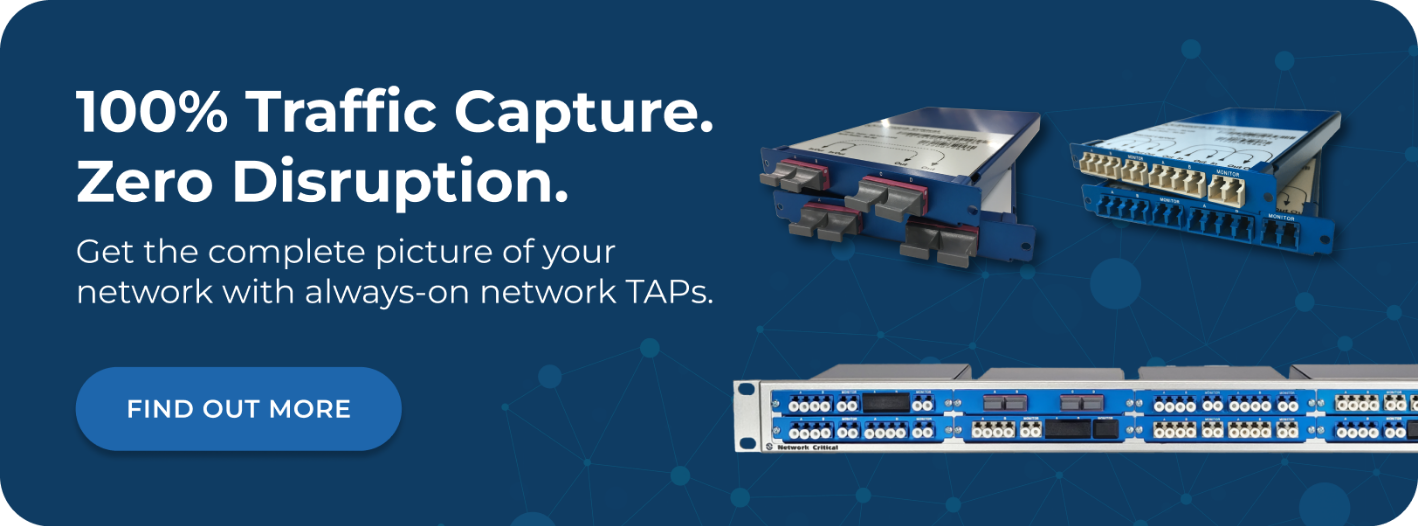
Network Critical designs and manufactures passive fiber optic TAPs for permanent, zero-power monitoring access in telecom infrastructure. Each TAP operates at the physical layer. It splits the optical signal on the live link. Monitoring tools receive a full traffic copy with no impact on throughput, latency, or packet integrity.
The passive fiber TAP range supports single-mode and multi-mode fiber across 1G to 100G link speeds. Up to 16 TAPs deploy in a single 1RU chassis, providing high-density access across backbone and aggregation layers. TAPs require no power and carry no IP or MAC address. This eliminates them as an attack surface in lawful intercept and compliance-driven telecom environments. Split ratios are available across 50/50 and asymmetric configurations to accommodate varying optical power budgets on long-haul DWDM links.
Network Critical differentiates in telecom deployments by combining network TAPs with a hybrid packet broker in a single chassis. The SmartNA-XL aggregates traffic from multiple copper and fiber TAP points into high-speed monitoring tool ports at 1G to 40G. This removes the need for a separate packet broker SKU. It reduces rack space, cabling complexity, and total cost in aggregation-layer deployments. All products carry a perpetual hardware licence with no subscription fees.
Proven results:
- Vodafone: Achieved 100% accurate traffic visibility on key links, enabling QoS monitoring across a multi-generation European mobile network
- BP: Deployed passive fiber TAPs to enable centralised monitoring of critical OT systems across refinery buildings
- HSBC: Achieved zero latency on monitoring technologies using passive fiber TAPs alongside the SmartNA platform
Keysight Technologies – Flex Tap and Flex Tap II
Keysight Technologies offers the Flex Tap family: a modular, 100% passive fiber TAP line. It covers 1G to 400G across single-mode and multi-mode fiber. The original Flex Tap VHD chassis deploys up to 36 LC TAP modules in a single 1U 19-inch rack. This is the highest published density in the vendor set reviewed here. The updated Flex Tap II, with a data sheet issued in April 2026, supports up to 24 modules per 1U. It suits mixed-speed environments where different fiber types and link speeds coexist in the same chassis.
Split ratios range from 50/50 to 90/10, with both LC and MTP/MPO connector options across the range. The Flex Tap Secure+ variant adds an optical diode on monitor ports. This physically prevents light injection from the monitoring infrastructure back into the live link. It is particularly relevant for lawful intercept deployments where monitoring infrastructure must be provably isolated from the operational network.
Keysight holds large inventory quantities for rapid shipment. This is a practical advantage where monitoring gaps need to close quickly after network changes. The Flex Tap line is validated using Keysight's own test and measurement equipment. It carries an S&P 500-backed supply chain with strong service-provider credentials. Pricing is at a premium compared to mid-market alternatives.
Garland Technology – Passive Fiber Network TAPs
Garland Technology produces a passive fiber TAP portfolio covering 1G, 10G, 25G, 40G, 100G, and 400G link speeds. Both single-mode and multi-mode fiber are supported. The Passive Fiber Modular Chassis accommodates 16 to 24 TAP modules in a 1U enclosure. This is 24 LC modules or 16 MTP/MPO modules per chassis, depending on connector type. Single-mode TAPs use OS1/OS2 media for long-range connectivity. Multi-mode options support OM3 and OM4 for short-range data centre and campus links.
All TAPs are manufactured in the USA, which matters for data-sovereignty requirements in US federal or regulated carrier deployments. The product line includes hardware Data Diode TAPs, providing physical unidirectional enforcement from the monitored link to the security tool. This is a distinct capability not replicated by most passive TAP vendors. It suits air-gapped segments and critical telecom backhaul infrastructure.
Garland maintains a published technical resource library covering split ratio selection, loss budget calculation, and OT-specific guidance. Garland's partner ecosystem includes integrations with Nozomi Networks and TXOne. The packet broker feature set is less advanced than vendors offering a hybrid TAP plus broker in a single chassis.
Profitap – MOD-TAP and Fiber TAP Range
Profitap is a Netherlands-based vendor. Its passive fiber TAP range covers fixed installation, modular, and portable form factors for 1G to 400G fiber links. The MOD-TAP is the flagship modular chassis. It supports up to 24 TAP modules in a single enclosure, mixing fiber types and speeds in one unit. The F8L high-density TAP packs eight LC links into a 1/3U unit. Three stacked units deliver up to 24 LC-linked monitoring points per rack unit. The MTP Fiber TAP range addresses 40G, 100G, and 400G networks via MPO connectors, covering 40GBASE-SR4, 100GBASE-SR4, and 400GBASE-SR8 standards.
Portable variants – the F1PL and SC equivalents – support field deployment without returning to a data centre for equipment. This is useful for field engineers monitoring remote aggregation sites or temporary tapping during planned network changes. All fiber TAPs include an optical data diode on monitor ports, isolating monitoring devices from the operational network. Tamper-evident security seals cover screw heads, making unnoticed physical access impossible.
Passive fiber TAPs across the Profitap range carry a 10-year warranty, which is the longest in this comparison. European (Netherlands, Germany, Nordics) field coverage is strong via a certified reseller model. North American coverage is primarily channel-dependent, which can affect deployment lead times outside Europe.
Cubro Network Visibility – OptoSlim TAP Series
Cubro Network Visibility is an Austrian vendor with verified telecom deployments including Vodafone and Orange Slovensko. The OptoSlim TAP Series uses a 1/3RU stackable form factor. Three units occupy a single 1U rack space. This achieves a high link density per rack unit while maintaining individual customisability per unit. The range covers 10 Mbps through 400G across single-mode (1310/1550 nm) and multi-mode (850/1300 nm) fiber. BiDi TAP variants address bidirectional links where TX and RX signals share a single fiber.
Each Cubro TAP is individually inspected under a precision microscope after assembly. Insertion loss is measured and documented for every unit shipped. This per-unit quality verification process provides traceable insertion loss data, which simplifies loss budget calculations during network planning. TAPs do not introduce delay and are fully transparent to Layer 1 and Layer 2 errors. Link continuity is maintained under hardware failure.
Cubro's Vitrum Management Suite provides centralised management across deployed packet brokers and TAPs, with a network topology visualisation interface. The Packetmaster EX series extends visibility with 1G to 400G packet brokering. European and Asia-Pacific field coverage is strong. North American presence is smaller than Garland, APCON, or Keysight for direct enterprise support.
How to Choose a Passive Fiber TAP for Telecom Networks
Assess Your Speed and Fiber Type Requirements
Identify the link speeds across your monitoring scope before selecting a platform. Telecom core and backbone environments increasingly run 100G and 400G DWDM links, requiring TAPs validated at those speeds. Most vendors in this comparison support 1G to 400G within a single product family. Verify the specific fiber type – single-mode, multi-mode, or BiDi – matches your deployed media. MTP/MPO connectivity is essential for 40G, 100G, and 400G structured cabling environments.
Evaluate Chassis Density Against Rack Constraints
High-density TAP chassis minimise rack footprint in constrained central office and telecom POP environments:
- Keysight Flex Tap VHD: up to 36 LC TAPs per 1U
- Garland Modular Chassis: 16 to 24 modules per 1U
- Profitap F8L stacked: up to 24 LC links per 1U
- Network Critical: up to 16 TAPs per 1RU
- Cubro OptoSlim: three 1/3RU units per 1U
Match the density option to your available rack space and the number of links you need to monitor.
Confirm Split Ratio Flexibility and Optical Loss Budget
Every passive fiber TAP introduces insertion loss on the live link. Your loss budget determines whether a given split ratio is deployable on a specific link. It is the difference between available optical power and the minimum required at the receiver. Asymmetric split ratios (70/30 or 80/20) preserve more signal on the live link. A 50/50 split provides equal power to the monitoring port. Keysight, Garland, and Cubro all publish detailed loss data per unit. Verify this against your link's optical power margin before deployment.
Consider Whether You Need TAP Plus Aggregation in a Single Device
A passive TAP delivers one copy of traffic from one link to one monitoring port. If traffic from multiple tap points feeds a shared monitoring tool, you will need aggregation capability alongside the TAP. The SmartNA-XL from Network Critical combines TAP access and aggregation in a single chassis. This eliminates a separate packet broker SKU. For deployments scaling to higher speeds, the network packet brokers portfolio extends this approach to 100G and beyond.
Factor in Total Cost of Ownership
Subscription-free hardware platforms reduce long-term operating cost in environments where monitoring infrastructure runs for five to ten years. Keysight and premium enterprise vendors typically carry higher 3-year TCO than mid-market alternatives. Network Critical offers perpetual hardware licensing with no per-port subscription fees. This produces predictable cost modelling and removes renewal exposure as your port count grows.
Verify Supplier Field Presence for Your Region
Direct field engineering support for pre-installation audits and post-deployment troubleshooting directly affects how quickly you can close monitoring gaps. Network Critical provides direct UK and US presence with 24/7 support. Garland's field coverage is strongest in North America. Profitap and Cubro have strong European coverage. Verify that your primary deployment geography has direct support, not just distributor relationships.
Frequently Asked Questions
What Is a Passive Fiber TAP and How Does It Work in a Telecom Network?
A passive fiber TAP is a hardware device that sits inline on a fiber link. It uses optical splitting to deliver a copy of traffic to a monitoring port. It requires no power and carries no IP or MAC address. Operating entirely at the physical layer, it cannot drop packets or introduce latency. In telecom networks, passive fiber TAPs are deployed on backbone, aggregation, and access layer links. They provide always-on monitoring access without affecting live traffic or creating a point of failure.
What Is the Difference Between a Passive Fiber TAP and a SPAN Port?
A passive fiber TAP creates a physics-level copy of traffic with zero packet loss regardless of load. A SPAN port is a software feature on a managed switch that mirrors traffic to a destination port. It drops packets under load and competes with switching functions for CPU resources. Most switches support only two to four concurrent SPAN sessions. For telecom environments where compliance fidelity and forensic accuracy are required, passive fiber TAPs are the appropriate monitoring access layer.
How Do I Select the Right Split Ratio for a Telecom Link?
Select your split ratio based on the available optical power budget on the monitored link. An 80/20 or 70/30 split preserves the majority of optical power for the live link. This is appropriate for long-haul single-mode links with a tighter power margin. A 50/50 split gives equal power to the monitoring copy, which suits shorter-reach links with more power headroom. Request per-unit insertion loss documentation from your vendor and verify the combined loss against your link's power budget before deployment.
Do Passive Fiber TAPs Work with 400G Telecom Links?
Yes. Keysight, Garland, Profitap, and Cubro all offer verified passive fiber TAP products supporting 400G links. The connector standard matters: 400G SR8 requires MPO-16 connectors and 16 fibers, while 400G DR4 uses MPO-12 connectors. Confirm the connector and fiber standard in your deployed 400G infrastructure before selecting a TAP product. Verify the vendor's insertion loss specification at 400G is within your optical power budget.
Do I Need a Packet Broker Alongside Passive Fiber TAPs?
If you feed traffic from multiple TAP points to a single monitoring tool, or distribute traffic to multiple tools, yes. A standalone passive fiber TAP delivers one copy of traffic from one link to one port. A packet broker adds aggregation, filtering, load balancing, and distribution. The passive fiber tap combined with a packet broker provides the full visibility fabric. Network Critical's hybrid TAP and packet broker chassis combines both functions in one unit. This reduces device count and deployment complexity.
How Much Do Passive Fiber TAPs Cost?
Passive fiber TAP pricing varies considerably by vendor, density, and speed. Entry-level portable single-link TAPs typically cost less than £500. High-density modular chassis covering 16 to 24 links at 100G range from several thousand to tens of thousands of pounds. Price varies by manufacturer and connector type. Premium vendors such as Keysight carry higher price points reflecting their test and measurement heritage and inventory depth. Network Critical's perpetual licensing model avoids the ongoing subscription costs that increase 3-year TCO materially on competing platforms. Request a quote from vendors directly, as most do not publish rack-level chassis pricing.
Build Your Visibility Architecture With Network Critical
Selecting the right passive fiber TAP platform is a foundational infrastructure decision. Once monitoring tools, security appliances, and compliance workflows depend on your traffic access layer, replacing it is disruptive and costly. Getting it right means choosing a platform built on verifiable zero packet loss and adequate density for your monitoring scope. The commercial model must also remain predictable as your network grows.
Network Critical delivers passive optical TAPs for telecom and service-provider environments. Deployments at Vodafone, BP, and HSBC demonstrate the platform's reliability at scale. Perpetual hardware licensing with no subscription fees produces 40 to 60 per cent lower 3-year TCO compared to enterprise incumbents. The hybrid TAP and packet broker architecture reduces device count and deployment complexity in constrained environments.
Speak to the Network Critical team to request a free network visibility audit. Identify the right passive TAP platform for your telecom infrastructure.