Top 5 Network TAPs for Legacy Infrastructure Replacement in 2026
Replacing aging visibility infrastructure is one of the most consequential decisions a network team makes. Legacy Switch Port Analyzer (SPAN) deployments drop packets under load, consume switch resources, and create monitoring blind spots that grow more dangerous as threat surfaces expand. When the time comes to replace that infrastructure with dedicated hardware TAPs, the choice of vendor determines whether your monitoring foundation is built for the next decade — or just the next refresh cycle.
This guide compares five verified vendors delivering purpose-built network TAPs suited to legacy infrastructure replacement projects in 2026. Each entry covers current product lines, verified specifications, and the architectural considerations that matter most during a planned migration.
At a Glance: Top 5 Network TAPs for Legacy Infrastructure Replacement
| Vendor | Key Products | Max Speed | Architecture |
|---|---|---|---|
|
SmartNA-XL, SmartNA-PortPlus, Passive Fiber TAPs |
Up to 400G |
Modular, hybrid TAP/broker, scale-out |
|
|
Breakout TAPs, EdgeSafe, XtraTAP |
Up to 400G |
Purpose-built, TAP-to-tool philosophy |
|
|
Flex Tap II, Flex Tap VHD, Tough TAPs |
Up to 400G |
High-density modular, multi-speed |
|
|
MOD-TAP, ProfiShark series, Fiber TAPs |
Up to 400G |
Infrastructure + portable, 10-year warranty |
|
|
OptoSlim TAP series, BIDI TAPs |
Up to 400G |
1/3RU form factor, protocol-agnostic |
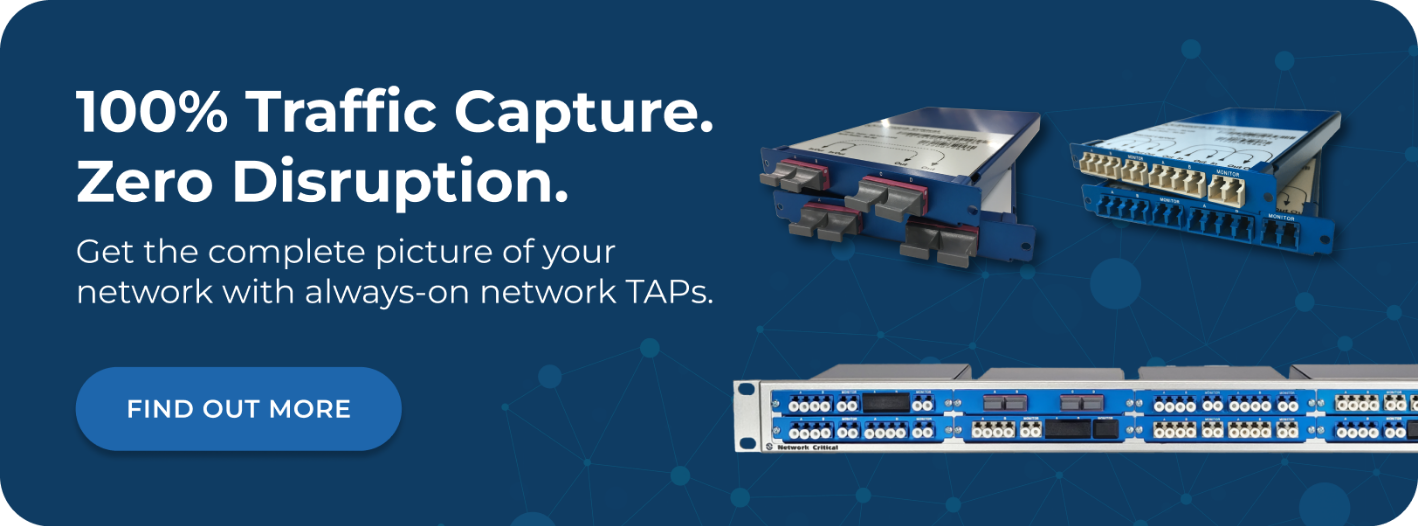
1. Network Critical — SmartNA-XL and SmartNA-PortPlus
Network Critical delivers a modular, scale-out approach to legacy infrastructure replacement that addresses two challenges simultaneously: replacing unreliable SPAN port access and consolidating the aggregation and filtering functions that organizations typically bolt on afterward.
The SmartNA-XL is a hybrid TAP and packet broker in a single 1RU chassis, supporting 1G to 40G across copper, multimode, and single-mode fiber. It combines passive fail-safe access with 4:1 aggregation, meaning four 1G links can feed a single 10G monitoring tool — a common migration requirement when existing tools were provisioned for lower-density SPAN environments. This eliminates the need to deploy separate TAP and aggregation hardware during the replacement project.
The SmartNA-PortPlus extends this architecture from 48 to 194 ports across 1G, 10G, 25G, 40G, and 100G speeds. When 400G capacity is required, the SmartNA-PortPlus HyperCore supports 32 QSFP-DD interfaces — keeping the entire visibility platform within a consistent management environment as infrastructure speeds increase. The Drag-n-Vu graphical user interface handles all filter rule computation automatically, removing the manual configuration risk that causes visibility gaps during migration windows.
Passive fiber TAPs from Network Critical require no power and introduce no active electronics to the optical path. Power loss on the TAP has zero impact on network continuity — critical for environments transitioning from SPAN ports where any access failure was previously invisible.
Proven results:
- Vodafone: Achieved 100% accurate traffic visibility on key links, supporting Quality of Service (QoS) monitoring and compliance reporting across multi-generation network infrastructure.
- BP: Enabled centralized monitoring of IT and Operational Technology (OT) systems across refinery buildings using passive fiber TAPs requiring no configuration or ongoing maintenance.
- HSBC: Deployed SmartNA TAPs and passive fiber TAPs globally, from the UK to Hong Kong, achieving zero latency on monitoring technologies for real-time financial transaction visibility.
2. Garland Technology — Breakout TAPs, EdgeSafe, and XtraTAP
Garland Technology positions itself as a pure-play TAP and packet broker vendor, and its product range reflects that focus. The portfolio covers passive fiber TAPs in both multimode and single-mode variants, active copper TAPs with fail-safe circuitry, breakout TAPs, aggregation TAPs, inline bypass TAPs, and hardware data diode TAPs.
The XtraTAP combines TAP and packet broker capabilities in a single device, reducing the number of hardware decisions required during a legacy replacement project. Breakout TAPs support passive access across 1G to 400G fiber speeds and integrate with Garland's PacketMAX aggregation platform when organizations need to consolidate multiple tapped links before distribution to monitoring tools.
Garland tests and verifies all TAPs against live network data before shipping, and the company reports a zero failure rate in field deployments. Products are manufactured in Richardson, Texas, and the company notes no mandatory transceiver requirements — which reduces procurement complexity during large-scale rollouts replacing legacy access infrastructure.
The EdgeSafe inline bypass TAP protects inline security tools during the transition period when new monitoring tools are deployed alongside existing infrastructure. For organizations running mixed IT and OT environments, Garland has deployed TAPs in critical infrastructure environments including water treatment facilities and oil refineries.
3. Keysight Technologies — Flex Tap II, Flex Tap VHD, and Tough TAPs
Keysight Technologies brings its test equipment heritage to network TAP design. The Flex Tap II is a 100% passive, fully modular fiber TAP supporting speeds from 1G to 400G in both multimode and single-mode variants. Split ratios from 50/50 to 90/10 are available, accommodating the optical budget constraints common in legacy fiber runs that were not originally specified for TAP insertion.
The Flex Tap VHD accommodates up to 36 TAPs in a 19-inch 1RU chassis — the highest density available in this product category. For organizations replacing a large number of SPAN connections across a data center or campus environment, this density reduces the rack space required to complete the migration and lowers the cost per tapped link.
Single-mode Flex Taps are multi-speed and tested from 1G to 400G across wavelengths from 1260nm to 1340nm. This means a single TAP model accommodates mixed-speed environments where legacy 1G or 10G links coexist with newer 100G infrastructure — removing the need to specify different TAP models for each link speed. For Industrial Control System (ICS) environments, the Tough TAP series supports "run to fail" fiber networks with DIN mountable housings and compatibility across IT and OT protocol types.
The iLink LA2-INLN-T integrates eight inline copper TAPs with four SFP+ monitor ports in a single unit — suited to access layer replacement projects where copper and fiber infrastructure coexist.
4. Profitap — MOD-TAP, Fiber TAPs, and ProfiShark Series
Profitap addresses legacy replacement at two levels: permanent infrastructure TAPs for fixed deployments, and portable TAPs for field engineers who need to verify visibility at any point during or after the migration.
The MOD-TAP modular chassis accepts up to 24 passive fiber TAP modules in a single 1RU housing, supporting speeds from 100 Mbps to 400G across LC, SC, Multi-Fiber Push-On/Multi-Path Push-On (MTP/MPO), and BiDi fiber types. All Profitap passive fiber TAPs carry a 10-year warranty — meaningful in environments where hardware refresh cycles are measured in decades. Passive fiber TAPs carry no Internet Protocol (IP) address, have no management interface, and are fully invisible on the network.
Copper TAPs support 10M/100M/1G/10G with the No Break fail-safe mechanism, which uses high-speed relays to keep the link operational during any power interruption. This is an important specification for replacing active SPAN configurations where the switch port was previously managing link continuity.
The ProfiShark portable TAP series — including the ProfiShark 1G and ProfiShark 10G — provides USB 3.0-powered access for field troubleshooting. Hardware timestamping with 5–8ns resolution is included across the range, which supports the forensic investigations that often accompany post-migration validation.
For Plastic Optical Fiber (POF) environments common in automotive and older industrial Ethernet segments, Profitap offers a dedicated POF-TAP that converts the signal to full-duplex 10/100 Unshielded Twisted Pair (UTP) output — enabling legacy industrial networks to feed modern monitoring tools without infrastructure replacement.
5. Cubro Network Visibility — OptoSlim TAP Series
Cubro Network Visibility is a European vendor producing carrier-grade TAPs and packet brokers for service providers and large enterprises. Founded in 2003, the company has deployed TAPs in service provider networks including Vodafone and Liberty Global.
The OptoSlim TAP series uses a 1/3RU form factor that allows three units to be mounted in a single 1RU space, achieving up to 24 LC links per rack unit. Every Cubro optical TAP is individually tested, with insertion loss measurements included in the product packaging — an important quality control step when deploying into legacy fiber runs where optical budget margins may be narrow. The OptoSlim series is compatible with speeds from 10 Mbps to 400G, covering the full range of infrastructure speeds encountered in replacement projects that span multiple generations of network equipment.
Cubro TAPs are fully protocol-agnostic and bitrate-independent, making them compatible with legacy industrial protocols running on older fiber infrastructure alongside modern standards. BIDI TAPs provide visibility into bidirectional links where TX and RX signals share a single fiber — a configuration common in carrier and campus environments where fiber conservation was prioritized during original infrastructure deployment.
The EX5-3 Network Packet Broker (NPB) complements the passive TAP range for deployments needing aggregation, providing 48 native RJ45 copper ports at 10M/100M/1G alongside four SFP+ interfaces.
How to Choose the Right Network TAP for Legacy Infrastructure Replacement
Understand Your Link Speed Range
Legacy networks frequently contain a mix of 1G copper, 10G fiber, and newer 40G or 100G segments. Specify TAPs that cover your lowest-speed legacy links and your highest-speed current or planned infrastructure. Multi-speed TAP modules — such as those in the Network Critical and Keysight ranges — eliminate the need to stock multiple TAP models per site. If your roadmap includes 400G, confirm that your chosen platform supports this before committing.
Evaluate the Aggregation Requirement
Replacing SPAN ports on a link-by-link basis without a coherent aggregation plan can result in a monitoring tool proliferation problem. Assess whether your monitoring and security tools need to receive consolidated traffic from multiple links. Hybrid TAP and packet broker platforms eliminate the separate aggregation device entirely, which reduces rack space, power draw, and configuration complexity during the migration window.
Match Form Factor to Site Constraints
Data center core deployments and remote branch sites have different space and power constraints. Consider:
- Modular chassis systems that allow incremental port addition without replacing base hardware
- High-density options for 1RU-constrained environments
- DIN rail or compact housings for OT or industrial enclosures
- Powerless passive fiber TAPs for locations where power stability is a concern
Assess the Migration Risk Profile
Every legacy replacement project carries transition risk. Fail-safe design is non-negotiable: the TAP must keep the production link operational regardless of power state or hardware condition. Copper TAPs should include fast-switching fail-to-wire circuitry. Passive fiber TAPs eliminate this risk entirely by operating without power. For inline tool deployments, network bypass TAPs provide an additional safety layer by keeping traffic flowing if an inline security appliance fails during or after migration.
Verify Fiber Compatibility Before Deployment
Older fiber runs may use connector types, split ratios, or optical modes that limit which TAPs are compatible. Calculate the optical power budget for each link before specifying a TAP — particularly for legacy single-mode runs where margin may be limited. Vendors that include individual insertion loss test results with each unit reduce the risk of budget failures during installation.
Factor in Total Cost of Ownership
The per-unit cost of a TAP is rarely the dominant cost in a legacy replacement project. Management overhead, transceiver requirements, and the cost of separate aggregation hardware can significantly exceed hardware costs over a 5–7 year deployment lifecycle. Platforms with zero mandatory transceiver requirements and single-pane management interfaces reduce operational expenditure after initial deployment.
Frequently Asked Questions
What Is the Difference Between a Network TAP and a SPAN Port?
A network TAP is a dedicated hardware device that creates a passive copy of all traffic on a link, including physical layer errors, without consuming switch resources or dropping packets under load. A SPAN port is a software-configured mirror on a switch that drops packets when the switch is under traffic load, cannot capture physical layer errors, and uses switch processing capacity. Organizations replacing SPAN-based visibility infrastructure with hardware TAPs gain guaranteed 100% packet capture that is unaffected by traffic volume.
Do I Need a Packet Broker Alongside a Network TAP?
Most organizations replacing SPAN infrastructure need both. A network TAP provides the physical access layer — a passive copy of the traffic. A packet broker sits between the TAP and your monitoring tools, aggregating traffic from multiple links, filtering by IP address, protocol, or application, and distributing relevant traffic to the right tool. Hybrid platforms that combine TAP and packet broker functions in a single chassis simplify deployment for organizations migrating from SPAN-based architectures where a single switch port was previously handling both access and distribution.
Can Passive Fiber TAPs Be Deployed in Legacy Fiber Environments?
Yes, but optical power budget calculations are required before deployment. Passive fiber TAPs split the optical signal at a fixed ratio, introducing insertion loss on the production link. Legacy fiber runs may have less optical margin than newer infrastructure, so the split ratio must be selected carefully. Vendors that provide individual insertion loss measurements with each TAP unit allow accurate budget calculations before hardware is installed.
How Long Does a Legacy TAP Replacement Project Typically Take?
Deployment time depends on the number of links, site access constraints, and whether the existing infrastructure is being replaced in phases or all at once. Individual TAP installations are typically completed during a planned maintenance window of one to four hours per site. Phased replacements — starting with highest-priority links feeding security or compliance tools — allow organizations to build TAP infrastructure incrementally without a full network freeze. Modular platforms that accept new port additions without replacing existing hardware support this approach.
What Happens to a Network TAP During a Power Failure?
Passive fiber TAPs require no power and are unaffected by power failures — the optical signal passes through regardless of TAP power state. Active copper TAPs use fail-to-wire circuitry that switches the link to a direct physical connection if power is lost, maintaining network continuity. Monitoring visibility may be reduced during a power event on active TAPs, while passive fiber TAPs maintain full monitoring output. For environments where monitoring continuity during power events is required, passive fiber TAPs or active TAPs with redundant power supplies are the appropriate specification.
Is It Necessary to Replace All SPAN Ports at Once?
No — and for most organizations, a phased approach is preferable. Start with the links feeding security tools, Intrusion Detection System (IDS) or Intrusion Prevention System (IPS) appliances, or those subject to compliance monitoring requirements. These links carry the greatest risk from SPAN-related packet loss. Once the highest-priority links are tapped, extend the replacement project to performance monitoring and general visibility links. Modular TAP platforms that grow incrementally — without requiring infrastructure replacement — support this approach while protecting the initial capital investment.
Build Your Legacy Visibility Foundation With Network Critical
Replacing legacy SPAN infrastructure is not just a hardware decision — it's a foundation-setting exercise for every security, monitoring, and compliance tool that depends on it. Getting the access layer right the first time avoids the rework costs and blind-spot risk that come from under-specified TAP deployments.
Network Critical's modular scale-out architecture lets you start with the links that matter most and expand without replacing existing hardware. The SmartNA-XL and SmartNA-PortPlus platforms combine TAP access and packet broker functionality in a single chassis — reducing the equipment footprint and management complexity of your replacement project. With 25+ years of enterprise deployments across finance, energy, telecommunications, and government sectors, Network Critical brings proven implementation experience to high-stakes migration projects.
Speak to the Network Critical team to discuss your legacy replacement project.