Top 5 Network TAPs for Teams Deploying Full Packet Capture in 2026
Full Packet Capture (FPC) is only as reliable as the infrastructure feeding it. Switch Port Analyzer (SPAN) ports drop packets under load, miss physical-layer errors, and can't sustain the fidelity that Security Operations Centers (SOCs), incident response teams, and compliance auditors depend on. Hardware Network Test Access Points (TAPs) solve this by passively copying 100% of traffic at line rate — including error frames — without touching the production link.
As networks scale to 100G and 400G and security toolchains grow in sophistication, choosing the right TAP directly determines what your capture platform actually sees. This guide compares five verified vendors offering purpose-built TAP solutions for teams where every packet counts.
At a Glance: Top 5 Network TAPs for Full Packet Capture
| Vendor | Key Products | Max Speed |
|---|---|---|
|
SmartNA-PortPlus, SmartNA-XL, passive fiber TAPs |
Up to 400G |
|
|
Flex Tap VHD, Flex Tap II, Flex Tap Secure+, Patch TAP, Tough TAP |
Up to 400G |
|
|
G-TAP M Series, G-TAP A Series 2, G-TAP BiDi |
Up to 400G |
|
|
SelectTAP, PacketMAX, passive and active TAP range |
Up to 400G |
|
|
EndaceProbe EP-94C8-G5, EndaceProbe Cloud |
Up to 100G sustained |
1. Network Critical — SmartNA-PortPlus and SmartNA-XL
Network Critical delivers a modular, scale-out approach to full packet capture that combines TAP access, aggregation, and packet brokering in a single chassis. This removes the need for separate devices at each stage of the visibility stack and simplifies architecture across large deployments.
The SmartNA-PortPlus scales from 48 to 194 ports across 1G, 10G, 25G, 40G, and 100G in a single 1RU chassis. The SmartNA-PortPlus HyperCore extends this to 400G using 32 QSFP-DD interfaces. Both platforms operate at full line rate with zero packet loss — a verified guarantee backed by hardware architecture, not software sampling.
The SmartNA-XL delivers hybrid TAP and packet broker functionality in a modular 1/10/40G chassis, suited to organizations that need media conversion, aggregation, and multi-generation link support in one unit. Passive fiber TAPs cover single-mode and multi-mode fiber from 1G to 100G with no active electronics on the optical path — power loss has zero impact on network continuity.
Drag-n-Vu software provides graphical port mapping, filtering, and load balancing through a patented rule-generation engine that eliminates the need for command-line filter management. A RESTful API enables security platforms to automate traffic routing without manual intervention — as demonstrated in the Darktrace integration, where port maps and filters update dynamically in response to threat detections.
Proven results:
- Vodafone: SmartNA-XL hybrid TAPs achieved 100% accurate traffic visibility on key links, aggregating multi-generation copper and fiber links into a unified monitoring view and reducing customer churn rates.
- BP: Passive fiber TAPs enabled centralized monitoring of IT and Operational Technology (OT) systems across refinery buildings spanning 10–12 buildings per site, with no power dependency at remote locations.
- HSBC: Achieved zero latency on monitoring technologies and deployed a global visibility network from the UK to Hong Kong within tight project timelines.
2. Keysight Technologies — Flex Tap VHD and Flex Tap II
Keysight Technologies draws on its test equipment heritage to deliver a TAP portfolio that spans the broadest range of form factors, media types, and use cases of any vendor in this comparison. Its position as the first company to offer a modular TAP means the product line has matured across more deployment scenarios than most alternatives.
The Flex Tap VHD packs up to 36 TAPs into a single 1U 19-inch chassis — the highest density available from any single vendor on this list. The Flex Tap II supports speeds from 1G to 400G in single-mode and multi-mode fiber with split ratios from 50/50 to 90/10, and accepts LC and MTP (MPO) connectors in the same chassis. This mix-and-match capability is particularly valuable in environments where legacy 1G and 10G links coexist with modern 100G infrastructure.
The Flex Tap Secure+ adds a patent-pending injection-prevention mechanism that blocks traffic from being accidentally or maliciously transmitted back onto the production network from the monitoring infrastructure — a requirement in high-security environments where tool compromise is a credible threat. The Patch TAP reduces the form factor to the size of three duplex LC connectors for direct installation into patch panels, delivering approximately 1 nanosecond lower latency than standard chassis TAPs — relevant for high-frequency trading environments. For industrial and Operational Technology (OT) environments, the Tough TAP is TAA Compliant and independently certified for operation in extreme temperatures, with DIN rail mounting support.
Keysight holds thousands of Flex Taps in stock and fulfills through a global channel partner network, making large-scale rapid deployments operationally straightforward. Vision 400 Series Network Packet Brokers pair with Flex Taps to deliver hardware-accelerated zero packet loss packet brokering, and the Vision 400 Series received Frost & Sullivan's 2024 Global New Product Innovation Award.
3. Gigamon — G-TAP M Series and G-TAP A Series 2
Gigamon designs its TAP range as the access layer for its Deep Observability Pipeline — a visibility architecture that feeds network-derived intelligence to security, monitoring, and cloud observability tools across hybrid environments. This tight integration between TAP and downstream platform is a core differentiator for organizations already operating GigaVUE infrastructure.
The G-TAP M Series is a modular family of passive fiber TAPs that requires no power source, no software, and no specialized patch cords. It covers 1G, 10G, 25G, 40G, 100G, and 400G networks, including 40G and 100G bidirectional (BiDi) links and 4×10G/25G/100G breakout configurations. The G-TAP A Series 2 adds active capabilities for 100M, 1G, and 10G copper and fiber links, with an integrated battery backup that maintains monitoring continuity during primary power failure — the Always-On architecture maintains the backup charge at 95% until needed. A G-TAP BiDi module taps up to four BiDi links per module, with up to 24 BiDi links per 1U chassis, supporting Cisco BiDi deployments commonly found in high-density data centers.
G-TAPs feed directly into GigaVUE TA Series aggregation nodes, which run GigaVUE-OS for flow mapping, filtering, and load balancing. Management is centralized through GigaVUE-FM. Gigamon serves more than 4,000 customers globally, including more than 80% of Fortune 100 enterprises, making it the most widely deployed platform in enterprise and carrier environments on this list.
4. Garland Technology — SelectTAP and PacketMAX
Garland Technology focuses exclusively on network visibility — TAPs, packet brokers, bypass solutions, and hardware data diodes — without the distraction of a broader product portfolio. This specialization shows in the depth of its passive TAP range and the strength of its OT and industrial credentials.
The SelectTAP is a high-density modular passive TAP chassis supporting speeds from 1G to 400G across single-mode (OS1/OS2) and multi-mode (OM1 through OM5) fiber, including the industry's first Optical Multi-Mode 5 (OM5) media type for extended reach in data center environments. The chassis accommodates mixed-speed modules, making it suitable for environments transitioning from 10G access links to 100G backbone without replacing existing infrastructure. The PacketMAX Advanced Aggregator pairs with SelectTAP to aggregate, load balance, filter, and distribute tapped traffic to downstream security tools — supporting deployments from basic aggregation to advanced filtering across 1G, 10G, 25G, 40G, and 100G links.
Garland TAPs are manufactured and tested in the USA using live network data, with a zero field failure rate claimed for the passive product line. For industrial environments, Garland's Military-Grade Industrial TAP and OT-specific product variants are designed for extreme operating conditions. Garland has been involved in critical infrastructure projects since 2011 and maintains active technology partnerships with OT security vendors including Dragos and Radiflow. The TAP into Technology blog provides one of the most comprehensive educational resources on network visibility of any vendor in this space.
5. Endace — EndaceProbe EP-94C8-G5
Endace occupies a distinct position in this comparison. Rather than providing the TAP access layer, Endace delivers always-on full packet capture and recording appliances that sit downstream of TAPs — making it the right choice for organizations that need forensic-grade, long-term packet storage alongside the access infrastructure.
The EndaceProbe EP-94C8-G5 sustains 100 Gbps recording with up to three petabytes of packet storage per appliance and timestamps every packet with nanosecond resolution using proprietary DAG technology. This matters for use cases where the timing relationship between packets is legally or operationally significant — financial trading compliance under Markets in Financial Instruments Directive II (MiFID II) and Regulation National Market System (RegNMS), incident forensics, and critical infrastructure event reconstruction. EndaceProbe appliances are certified for Common Criteria/NIAP NDcPP v2.2e and NIST FIPS 140-3, and are listed on the DoDIN Approved Products List (APL) — making them suitable for defense and government deployments where commercial security assurance frameworks are required.
EndaceProbe Cloud extends the same always-on capture architecture into AWS and Azure environments, providing weeks or months of packet history in hybrid cloud deployments from a unified management console. The open EndaceProbe platform hosts third-party analytics applications directly on the appliance, enabling SOC teams to run Zeek, Wireshark, and other tools against live or historical packet data without moving data off the probe. Endace integrates with a broad Fusion Partner ecosystem covering Security Information and Event Management (SIEM), Security Orchestration, Automation and Response (SOAR), and Network Detection and Response (NDR) platforms for one-click pivots from alert to packet evidence.
How to Choose the Right Network TAP for Full Packet Capture
Match Capture Infrastructure to Your Link Speeds
Your TAP must match the speed of every link you intend to monitor, without exception. A 100G TAP on a 100G link captures 100% of traffic. Anything undersized creates a guaranteed blind spot. For 400G Data Center Interconnect (DCI) links or AI/ML cluster traffic, only the SmartNA-PortPlus HyperCore and comparable 400G-capable TAPs are appropriate. For mixed-speed environments — common in organizations transitioning from 10G access to 100G backbone — modular platforms from Network Critical, Keysight, and Garland accommodate multiple speeds in the same chassis.
Decide Whether You Need a Standalone TAP or a Hybrid Platform
A standalone passive TAP provides one copy of traffic from one link to one monitoring port. If you need to send that traffic to multiple tools, aggregate multiple links, or filter by protocol, application, or IP range, you also need a packet broker. Hybrid TAP and packet broker platforms — such as the SmartNA-XL and SmartNA-PortPlus — combine both functions in a single chassis, reducing device count, rack space, power draw, and cabling complexity. For large deployments, this integration significantly lowers Total Cost of Ownership (TCO) compared to deploying separate TAPs and brokers at every monitoring point.
Assess Your Fail-Safe Requirements
Full packet capture has no value if the TAP loses the link during a power event. Passive fiber TAPs have no active electronics on the optical path and cannot affect the production link regardless of what happens to the TAP itself. Copper TAPs — including the Gigamon G-TAP A Series 2 with battery backup and Keysight Flex Taps with redundant power — maintain monitoring continuity through brief power interruptions. Define your fail-safe requirements before selecting a TAP, and verify the specific mechanism: relay-based fail-to-wire for copper, and confirmed passive optical path for fiber.
Consider Integration With Downstream Capture and Security Tools
Your TAP is only as useful as the tools it feeds. If you're deploying a dedicated packet capture appliance such as EndaceProbe, confirm that your TAP delivers traffic in the format and at the speed the appliance requires. If your capture infrastructure includes a SIEM platform or NDR solution, look for TAP and packet broker platforms with API support for automated traffic routing. This eliminates manual reconfiguration when security tools need to change what they're monitoring. Network Critical's RESTful API allows platforms like Darktrace to update port maps and filter rules in real time without human intervention.
Evaluate Compliance and Data Handling Requirements
Several regulated industries — financial services, healthcare, government, and critical infrastructure — impose specific requirements on the completeness and integrity of packet capture. Hardware TAPs capture 100% of traffic including physical-layer errors and malformed frames that SPAN ports discard, providing the complete and unaltered record that compliance frameworks including FISMA, NERC CIP, MiFID II, and HIPAA require. If your compliance obligations specify full-fidelity packet capture, that requirement should drive TAP selection ahead of cost or convenience. Network Critical's compliance-specific features — payload masking, header stripping, and packet slicing — directly support network security monitoring obligations across regulated verticals.
Plan for Scale From Day One
TAP infrastructure is a long-term investment. Replacing it when your network grows costs more than selecting a scalable platform at the outset. Evaluate how each vendor handles port expansion: do you replace existing hardware, or add capacity incrementally? Network Critical's scale-out architecture lets you add 48-port units to an existing SmartNA-PortPlus base without replacing deployed hardware or disrupting operations. Keysight's modular Flex Tap chassis accommodates mixed speeds as you add links. For organizations with evolving infrastructure, the ability to grow without a rip-and-replace cycle directly reduces long-term capital expenditure.
Frequently Asked Questions
What Is Full Packet Capture and Why Do TAPs Matter for It?
Full Packet Capture is the continuous recording of every packet traversing a network link, including headers and payload, at line rate with no packet loss. TAPs matter because they provide the only access method that guarantees 100% capture fidelity — SPAN ports drop packets under load and miss physical-layer errors, making them unsuitable for forensic, compliance, or high-accuracy security monitoring use cases.
What Is the Difference Between a Passive TAP and an Active TAP?
A passive TAP splits the optical signal on a fiber link using no power, placing no active electronics on the production path and creating no possible point of failure. An active TAP uses electronics to copy traffic on copper links, requires power, and typically includes fail-safe relays that maintain the network link if power is lost. Passive fiber TAPs are preferred for full packet capture on high-speed links where latency and reliability are the primary concerns.
Do I Need a Packet Broker as Well as a TAP for Full Packet Capture?
If you're feeding traffic from a single TAP to a single capture appliance, a standalone TAP is sufficient. If you need to aggregate traffic from multiple TAP points, distribute copies to more than one tool, or filter traffic before it reaches your capture platform, you need a packet broker. Network packet brokers handle aggregation, filtering, and load balancing between the TAP layer and your monitoring tools — and hybrid platforms combine both functions in a single chassis.
Can TAPs Capture Encrypted Traffic?
TAPs capture all traffic passing through a link — encrypted and unencrypted — without distinction. The TAP itself does not decrypt traffic; decryption happens downstream in packet brokers, dedicated decryption appliances, or analysis platforms. For full packet capture deployments where encrypted traffic inspection is required, look for packet broker platforms with integrated Transport Layer Security (TLS) decryption, such as Keysight's Vision 400 Series.
How Long Can Full Packet Capture Data Be Retained?
Retention depends on your capture platform's storage capacity and your link throughput. Security incident response investigations typically require 30–90 days of full packet history. Regulatory frameworks in financial services and healthcare may mandate longer periods. Always-on platforms such as EndaceProbe EP-94C8-G5 support up to three petabytes of storage per appliance, enabling extended retention at 100 Gbps sustained recording rates. Define your retention requirement before selecting hardware, as storage capacity varies significantly across platforms.
What Is the Difference Between a Network TAP and a SPAN Port?
A TAP is a hardware device that passively copies 100% of traffic on a link without affecting network performance or production traffic. A SPAN port is a software feature on a managed switch that mirrors traffic to a monitoring port, but can drop packets under load, consumes switch CPU resources, and cannot capture physical-layer errors. For full packet capture, TAPs are the correct choice — SPAN ports are adequate only for lightweight, best-effort monitoring where occasional packet loss is acceptable.
Build Your Full Packet Capture Architecture With Network Critical
Reliable full packet capture starts with reliable access to traffic. The wrong TAP infrastructure means blind spots in your security coverage, missed packets in your compliance records, and monitoring tools that consistently underperform because they're not seeing everything on the wire.
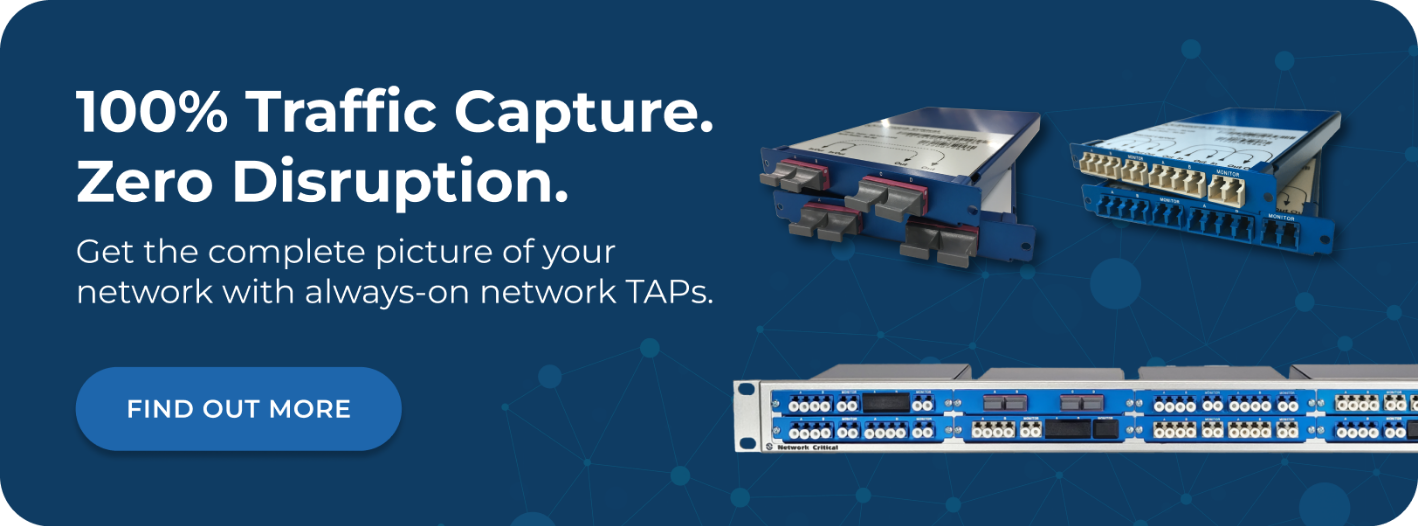
Network Critical's modular scale-out architecture combines network TAPs and packet broker functionality in a single chassis — delivering 100% packet capture at speeds from 1G to 400G, with the flexibility to grow incrementally as your network expands. With proven deployments at HSBC, Vodafone, BP, and Airbus, and a RESTful API for automated security tool integration, Network Critical provides a visibility foundation you can build on with confidence.
Speak to the Network Critical team to discuss your full packet capture requirements.