Top 5 Network Packet Brokers for High-Throughput Environments in 2026
As data center traffic scales toward 100G and 400G, legacy monitoring approaches no longer hold up. Switch Port Analyzer (SPAN) ports drop packets under load, and security tools left without filtered, deduped feeds quickly become bottlenecks. Network Packet Brokers (NPBs) solve this by sitting between your TAPs and monitoring tools — aggregating, filtering, load balancing, and distributing exactly the right traffic to exactly the right tools, at wire speed.
Choosing the wrong NPB at scale is costly. Missed packets mean blind spots. Under-specified hardware means overloaded tools and degraded detection. This guide compares five verified NPB vendors operating at 100G and 400G, covering architecture, throughput, key features, and real-world deployment outcomes.
At a Glance: High-Throughput NPB Comparison
| Vendor | Key Strength | Max Supported Speed |
|---|---|---|
|
Scale-out architecture, hybrid TAP/broker in one chassis |
Up to 400G |
|
|
Deep Observability Pipeline, GigaSMART traffic intelligence |
Up to 100G (HC Series) |
|
|
FPGA-accelerated zero packet loss, all QSFP-DD speed permutations |
Up to 400G |
|
|
Modular chassis, Layer 7 application filtering, DPI |
Up to 400G |
|
|
Nanosecond timestamping, advanced tunneling protocol support |
Up to 400G |
1. Network Critical — SmartNA-PortPlus and SmartNA-PortPlus HyperCore
Network Critical's SmartNA-PortPlus delivers scalable network packet brokering from 48 ports up to 194 ports across 1G, 10G, 25G, 40G, and 100G speeds in a single 1RU chassis. When 400G capacity is required, the SmartNA-PortPlus HyperCore extends the platform to 25.6 Tbps aggregate throughput using 32 QSFP-DD interfaces — with support for 400G, 200G, 100G, 50G, 40G, 25G, and 10G in a single unit.
The platform's scale-out architecture lets organizations start with a single 48-port base unit and add capacity incrementally. There's no need to replace existing hardware as traffic grows — expansion units join the base unit as a single managed system. This design protects capital investment and simplifies change management across environments spanning 10 Mbps to 400 Gbps.
Configuration and management are handled by Drag-n-Vu — a graphical management interface that automates filter rule generation in the background. Engineers use drag-and-drop port mapping rather than command-line rule sets, significantly reducing misconfiguration risk. The RESTful API enables full machine-to-machine automation, including the dynamic filter and port map updates used by AI-driven security tools like Darktrace.
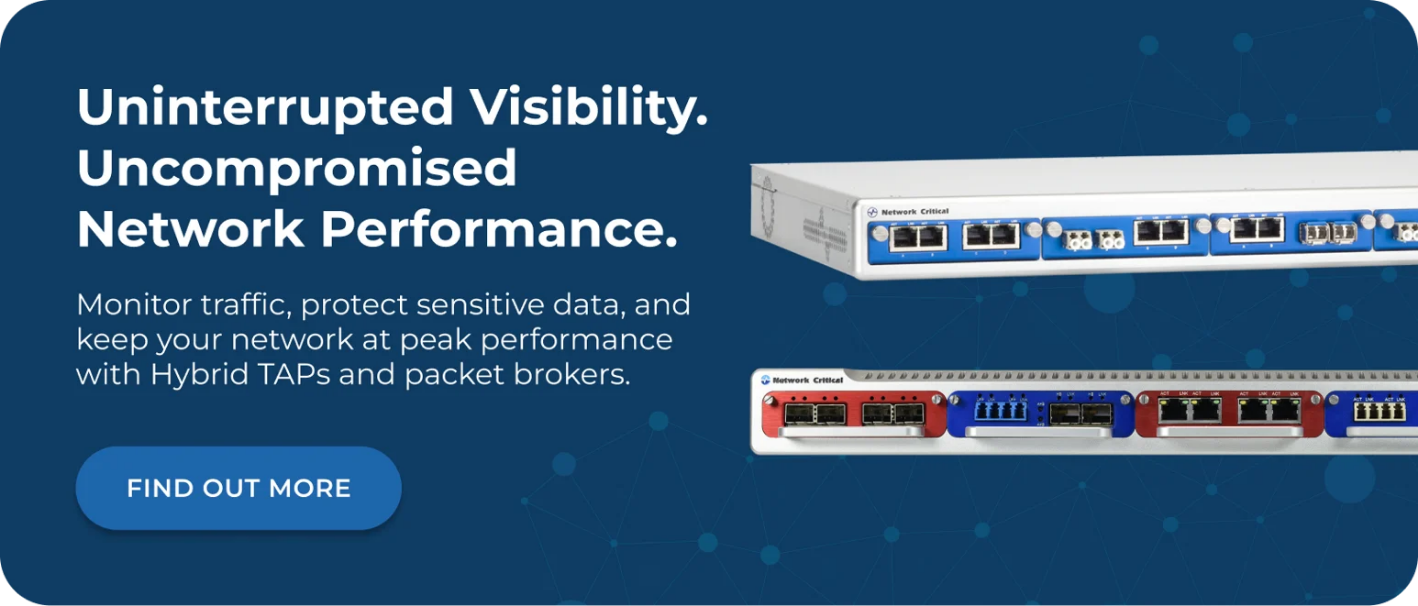
Network Critical also offers hybrid network TAPs with integrated packet broker functionality in a single chassis — simplifying deployment for teams that would otherwise need separate TAP and NPB infrastructure.
Proven results:
- Vodafone: Reduced customer churn rates and achieved 100% accurate traffic visibility on key links using the SmartNA-XL hybrid TAP/packet broker
- BP: Enabled centralized monitoring of critical IT and Operational Technology (OT) systems across refinery buildings using passive fiber TAPs
- HSBC: Achieved zero latency on monitoring technologies for real-time financial updates across a global infrastructure spanning the UK to Hong Kong
2. Gigamon — GigaVUE HC Series
Gigamon's GigaVUE HC Series is the packet brokering backbone of the company's Deep Observability Pipeline — a platform that feeds real-time network-derived intelligence to security and monitoring tools across physical, virtual, and cloud environments. The HC Series spans four models: the GigaVUE-HCT for edge and mobile deployments, the compact GigaVUE-HC1 and HC1-Plus for small-to-medium enterprise, and the GigaVUE-HC3 — a 3RU modular chassis optimized for 40G and 100G connectivity in large enterprise and service provider networks.
All HC Series appliances run GigaVUE-OS and support end-to-end orchestration through GigaVUE-FM. GigaSMART — Gigamon's traffic intelligence engine — provides advanced capabilities including application filtering, Secure Sockets Layer (SSL) and Transport Layer Security (TLS) decryption, metadata generation, and subscriber-aware processing for mobile network environments. The platform supports clustering across appliances for unified management at scale.
Gigamon's strongest differentiation is its integration depth. The platform connects directly to major Security Information and Event Management (SIEM) platforms, Network Detection and Response (NDR) tools, and cloud-native observability stacks, making it a natural fit for large enterprises with complex, multi-vendor tool environments.
Specifications not publicly detailed at the chassis level for aggregate throughput — throughput varies by module configuration and chassis model.
3. Keysight Technologies — Vision 400 Series
Keysight Technologies' Vision 400 Series — comprising the Vision 400, Vision E400S, and Vision E400P — is a family of 400G Network Packet Brokers (NPBs) built on FPGA-based hardware acceleration. The Vision 400 received the 2024 Global New Product Innovation Award from Frost & Sullivan. All models fit within a 1RU chassis and support every QSFP-DD speed permutation: 1x400G, 2x200G, up to 4x100G, up to 8x50G, up to 8x25G, and up to 8x10G per port via fan-out cables — enabling interoperability with legacy and current-generation infrastructure simultaneously.
The Vision E400P provides up to 32 QSFP-DD ports with high density flexibility reaching 256x10G/25G/50G, 64x40G, 128x100G, 64x200G, or 32x400G ports including fan-outs. Hardware acceleration ensures line-rate performance with zero packet loss across all features and filter configurations — an architecture point Keysight positions as a direct advantage over software-defined alternatives that can drop packets under load.
PacketStack capabilities — including header stripping, timestamping, tunneled IP filtering, data masking, and tunnel creation/termination — operate at full line rate on every port without consuming FPGA resources. Keysight Visibility Orchestrator (KVO) enables Intent-Based Visibility (IBV) for automated, policy-driven traffic steering. A patented dynamic filter compiler resolves overlapping filter rules automatically, eliminating blind spots during configuration changes.
4. APCON — IntellaView
APCON's IntellaView is a modular chassis-based NPB platform spanning 3RU to 9RU form factors. The platform uses interchangeable blades — including the 36-port multi-function blade (36x 40G/100G QSFP28) and 52-port multi-function blade (48x SFP+ at 1G/10G/25G plus 4x QSFP28 at 40G/100G) — allowing precise configuration for specific throughput and feature requirements. The 9RU IntellaView system supports up to 28.8 Tbps Protocol Header Stripping throughput and 3.2 Tbps Packet Deduplication processing.
The IntellaView HyperEngine is APCON's advanced packet processing blade. It enables real-time Deep Packet Inspection (DPI) processing across 100G feeds, supports up to 400G total throughput via four concurrent packet processing service engines, and automatically detects over 1,600 applications and 400 protocols at line rate. Application Filtering, Traffic Shaping, Pattern Matching, NetFlow Generation, and Deduplication are all available as selectable services on the HyperEngine.
APCON uses a separated control plane and data plane architecture. Traffic continues to pass through line cards even if both controllers fail — a design that supports high-availability deployments without requiring manual intervention during controller failover. TITAN centralized management provides multi-switch visibility for large network deployments.
5. Cubro Network Visibility — G5plus (EXA32100A / EXA64100)
Cubro Network Visibility's G5plus family of Network Packet Brokers is designed for service provider and large enterprise environments requiring advanced tunneling protocol support and precision timestamping. The EXA32100A and EXA64100 platforms support connections up to 400Gbps and carry built-in high-performance ARM CPUs for demanding packet processing workloads including Deduplication, Regex Search filtering, and NetFlow generation — tasks that would otherwise require external processing hardware.
Cubro's standout differentiator at high throughput is 8-byte timestamping with 1 nanosecond resolution on every arriving packet, including Time of Day precision. This exceeds the 6-byte timestamping common in competing platforms and is particularly relevant for financial services trading compliance, latency monitoring, and forensic analysis workflows where sub-microsecond timing accuracy is required.
Tunneling protocol support covers MPLS, MPLS over UDP, GRE, NVGRE, VXLAN, CFP, ERSPAN, and GTP — making Cubro a strong choice for service providers managing overlay networks or enterprises running complex virtualized infrastructure. The G5plus architecture uses high-performance silicon that provides flexibility to support next-generation protocols without hardware replacement.
How to Choose the Right Network Packet Broker for High-Throughput Environments
Define Your Throughput Ceiling — Today and in Three Years
Your current peak throughput is not your planning figure. Size for the traffic levels you expect to sustain under 80% utilization in year three, not year one. If your core links are at 100G today but your refresh cycle lands in 24 months, a 400G-capable platform bought now avoids a mid-cycle replacement. Confirm that the vendor's claimed throughput figures reflect line-rate performance with features enabled — not backplane capacity with all filtering disabled.
Evaluate Scalability Without Infrastructure Replacement
Some platforms require chassis replacement as port requirements grow. Others — like modular scale-out architectures — allow expansion units to be added and managed as a single system. For high-throughput environments where downtime is costly and CAPEX cycles are long, incremental expansion without rearchitecting is a significant operational advantage. Ask each vendor: what happens when you need 50% more ports in two years?
Match Feature Depth to Your Tool Stack
Not every high-throughput NPB delivers the same feature set at line rate. Confirm that the capabilities you need — deduplication, header stripping, SSL/TLS decryption, load balancing, packet slicing — operate without performance degradation at your target speed. Hardware-accelerated platforms tend to maintain line-rate performance across features; software-based processing can introduce latency or packet loss under load. If you're running AI-driven security tools, also confirm REST API support for automated filter and port map updates.
Consider Your Deployment Model
Modular chassis platforms suit environments where mix-and-match port speeds and blade-level feature assignment are priorities. Fixed 1RU platforms suit top-of-rack aggregation or data center edge deployments where density in a compact footprint matters more than configurability. Hybrid platforms combining TAP access and packet broker functions in a single chassis reduce cabling complexity and simplify management in space-constrained deployments.
Validate Compliance and Data Handling Requirements
Regulated industries — financial services, healthcare, government — often require packet-level data handling features beyond basic filtering. Look for payload masking, packet slicing to strip sensitive data before it reaches tools, and audit trail capabilities via TACACS+ or RADIUS authentication. Nanosecond-precision timestamping matters for trading compliance and latency SLA validation. Confirm that any claimed compliance feature operates at your required throughput without becoming a processing bottleneck.
Assess Management and Integration Overhead
High-throughput environments typically involve multiple monitoring tools, frequent traffic policy changes, and pressure to minimize configuration errors. Graphical management interfaces with automated rule generation reduce the risk of misconfiguration significantly compared to manual CLI-based rule sets. Factor in integration with your existing Network Management System (NMS) via SNMP and REST API support when comparing platforms — particularly if you're planning to automate visibility policy changes as part of a broader security orchestration workflow.
Frequently Asked Questions
What Is a Network Packet Broker?
A Network Packet Broker (NPB) is a hardware device that aggregates, filters, and distributes network traffic from TAPs or SPAN ports to monitoring and security tools. NPBs ensure each tool receives only the traffic relevant to its function, preventing oversubscription and improving detection accuracy. They support features including deduplication, load balancing, packet slicing, header stripping, and protocol-aware filtering across speeds from 1G to 400G.
What Is the Difference Between a Network TAP and a Network Packet Broker?
A network TAP creates a passive, full-duplex copy of traffic on a live link without impacting the production network. A network packet broker sits downstream of TAPs, receiving aggregated traffic and intelligently distributing filtered, optimized subsets to individual monitoring tools. TAPs provide the access layer; NPBs provide the traffic management layer. Most enterprise deployments at scale use both in combination — TAPs feeding one or more NPBs, which in turn feed security, performance, and compliance tools.
Do I Need a Network Packet Broker for 100G or 400G Environments?
Yes — at 100G and 400G, the volume and complexity of traffic makes direct tool connections impractical. A single 100G link can generate up to 45 Terabytes (TB) of packet data per hour. Without an NPB to filter, deduplicate, and distribute traffic, monitoring tools are quickly overwhelmed. NPBs also handle speed mismatches, allowing legacy 10G or 25G tools to receive relevant subsets of traffic from 100G or 400G links without replacement.
What Is the Difference Between Hardware-Accelerated and Software-Based NPBs?
Hardware-accelerated NPBs use Field-Programmable Gate Arrays (FPGAs) or purpose-built Application-Specific Integrated Circuits (ASICs) to process traffic at full line rate, maintaining zero packet loss even with multiple features active. Software-based NPBs process packets in a general-purpose CPU, which can introduce latency and packet drop under high load. For mission-critical visibility at 100G and above, hardware acceleration is strongly recommended to guarantee consistent performance.
How Does an NPB Support Regulatory Compliance?
NPBs support compliance through data handling features including payload masking (removing sensitive data from packets before they reach tools), packet slicing (truncating packets to strip confidential payload), protocol header stripping, and precise timestamping for audit trails. Features like TACACS+ and RADIUS authentication provide role-based access control and accountability logging. For industries subject to frameworks such as Payment Card Industry Data Security Standard (PCI DSS), Health Insurance Portability and Accountability Act (HIPAA), or financial trading regulations, these capabilities are often mandatory components of a compliant monitoring architecture.
Can an NPB Integrate With AI-Driven Security Tools?
Yes — modern NPBs expose REST APIs that allow AI-driven security platforms to dynamically control traffic filtering and port mapping without human intervention. When a security tool detects an anomaly and needs to observe a specific traffic subset, it can issue API calls to the NPB to adjust filters in real time. This machine-to-machine integration removes the latency of manual reconfiguration and allows security tools to fully use their autonomous response capabilities.
Build Your Visibility Architecture With Network Critical
Choosing the right NPB for a high-throughput environment isn't just a hardware decision — it's an architecture decision that affects monitoring accuracy, tool ROI, and operational overhead for years. The platform you select today needs to scale cleanly, integrate with the tools you have and the tools you'll add, and maintain zero packet loss under real-world traffic conditions.
Network Critical's SmartNA-PortPlus and SmartNA-PortPlus HyperCore deliver that through a scale-out architecture that grows incrementally without infrastructure replacement, a hybrid TAP and packet broker design that simplifies deployment, and proven enterprise results across financial services, telecommunications, energy, and aerospace sectors. Drag-n-Vu management and REST API integration reduce configuration risk and support automation-first security workflows.
To discuss your high-throughput visibility requirements and get a free network audit, speak to the Network Critical team today.