Packet Broker vs SIEM: Understanding the Difference and How They Work Together
Security teams often ask whether they need a network packet broker or a Security Information and Event Management (SIEM) platform, as if the two compete for the same role. They don't. A network packet broker operates at the traffic layer, managing how raw packets reach your monitoring and security tools. A SIEM operates at the intelligence layer, correlating events and logs to surface threats. One feeds data; the other analyzes it.
Understanding where each tool sits in your security architecture matters more than choosing between them. Organizations that treat these as either/or decisions often end up with a SIEM receiving incomplete or unmanaged traffic data, which limits its effectiveness from the start. This article explains what each tool does, where each fits, and why deploying them together produces better security outcomes than either tool in isolation.
What Is a Network Packet Broker?
A network packet broker is a hardware device that sits between your network access layer and your monitoring and security tools. It collects raw traffic from network TAPs and Switch Port Analyzer (SPAN) ports, applies intelligent processing rules, and distributes the right packets to the right tools at the right time.
The broker name captures the core function accurately. Just as a financial broker routes transactions between parties, a network packet broker routes traffic between your network and the tools that need to see it. Without this intermediary, tools receive either too much traffic (overloading them), too little (creating blind spots), or duplicate data that distorts analysis.
Core Functions of a Network Packet Broker
Network packet brokers perform several processing functions that make downstream tools more effective:
- Traffic aggregation: Combines feeds from multiple TAPs and SPAN ports into consolidated streams, reducing the number of connections each tool needs to manage
- Intelligent filtering: Applies rules based on IP address, protocol, port, Virtual Local Area Network (VLAN) tag, or application layer criteria to route only relevant traffic to each tool
- Load balancing: Distributes traffic evenly across multiple instances of the same tool, preventing any single appliance from becoming a bottleneck
- Packet deduplication: Removes duplicate copies of the same packet before forwarding, so tools don't process the same data twice
- Header stripping and payload masking: Removes unnecessary metadata or masks sensitive fields before traffic reaches tools
- Traffic replication: Sends identical copies of selected traffic to multiple tools simultaneously without impacting network performance
These capabilities mean your Intrusion Detection System (IDS), Network Performance Monitor (NPM), forensic capture appliance, and other tools each receive a clean, targeted feed rather than competing for access to raw, unfiltered traffic.
Where Network Packet Brokers Sit in the Architecture
Packet brokers operate at the access and distribution layers of your visibility architecture. They sit logically between the network infrastructure and your tool farm, collecting traffic out-of-band through TAPs so they never sit inline with live traffic. This means they introduce no latency and create no point of failure on the production network.
The relationship is straightforward: network TAPs copy traffic passively from network links; the packet broker receives, processes, and distributes those copies to whichever tools need them. The production network continues operating normally regardless of what happens on the monitoring side.
What Is a SIEM?
A Security Information and Event Management (SIEM) platform is a software system that collects log and event data from across your IT environment, normalizes it into a common format, and applies correlation rules and analytics to identify suspicious patterns that warrant investigation.
SIEMs ingest data from a wide range of sources: firewalls, servers, endpoints, applications, cloud services, identity platforms, and network devices. They store this data, apply detection logic, generate alerts, and provide security operations teams with a centralized console for investigation and response.
Core Functions of a SIEM
Modern SIEM platforms deliver several interconnected capabilities:
- Log aggregation: Collects event logs from hundreds of sources across on-premises and cloud environments in a single repository
- Event correlation: Links related events across different systems to identify attack sequences that individual logs wouldn't reveal on their own
- Alerting and prioritization: Generates alerts when correlated events match threat signatures or behavioral baselines, ranked by severity
- Threat detection: Applies rule-based detection, behavioral analytics, and increasingly machine learning to surface anomalies and known attack patterns
- Compliance reporting: Produces audit trails and reports required by frameworks such as Payment Card Industry Data Security Standard (PCI DSS), Health Insurance Portability and Accountability Act (HIPAA), and General Data Protection Regulation (GDPR)
- Incident investigation: Provides security analysts with historical log data, timelines, and search tools to reconstruct attack sequences during incident response
What a SIEM Does Not Do
Understanding SIEM limitations is as important as understanding its capabilities. A SIEM works with the data it receives. It cannot create visibility where none exists, and it cannot improve the quality of data that reaches it. If your network feeds incomplete or poorly managed traffic data into upstream tools, those gaps propagate directly into your SIEM.
SIEMs also do not capture raw packet data by default. They work with logs and events, which are summaries of activity rather than complete traffic records. For deep packet inspection, full session reconstruction, or payload analysis, separate tools are required. The SIEM correlates findings from those tools; it doesn't replace them.
The Fundamental Difference: Infrastructure vs. Intelligence
The clearest way to understand the packet broker vs. SIEM distinction is to separate infrastructure from intelligence. A network packet broker is visibility infrastructure. A SIEM is security intelligence. Both are necessary, but they operate at different layers and serve different purposes.
Infrastructure Layer: What the Packet Broker Provides
The packet broker ensures complete, reliable, well-managed traffic reaches your security tools. It answers the question: does the right data get to the right tool at the right time? If the answer is no, every tool downstream, including the SIEM, operates with an incomplete picture.
Key infrastructure responsibilities the packet broker handles:
- Capture completeness: Ensuring 100% of traffic on monitored links is copied and made available, with zero packet loss
- Traffic management: Aggregating, filtering, and distributing traffic so each tool receives what it needs without being overwhelmed
- Tool protection: Preventing tools from receiving traffic volumes they can't process at line rate
- Operational flexibility: Allowing tools to be added, replaced, or reconfigured without touching the live network
Intelligence Layer: What the SIEM Provides
The SIEM answers a different question: what does the data mean? Once traffic reaches IDS sensors, flow analyzers, and other tools, those tools generate events. The SIEM collects those events and applies context, correlation, and analytic logic to turn raw findings into actionable intelligence.
Key intelligence responsibilities the SIEM handles:
- Threat correlation: Connecting events from an IDS alert, a firewall log, and an authentication failure to identify a coordinated attack
- Behavioral baselines: Learning normal patterns across users, systems, and network segments to detect deviations that indicate compromise
- Alert triage: Prioritizing findings so analysts investigate the most critical issues first
- Historical context: Providing the timeline and log history analysts need during incident investigation
Why the Distinction Matters
Security teams sometimes invest heavily in SIEM platforms while underinvesting in the visibility infrastructure that feeds them. The result is a capable analytics engine working with incomplete input data. An IDS that misses traffic because of SPAN port limitations generates fewer events. Fewer events mean the SIEM has less to correlate. Threats that would have triggered correlation rules go undetected because the foundational data was never captured.
Getting the infrastructure layer right is a prerequisite for getting value from the intelligence layer. A well-deployed packet broker improves every security tool it feeds, including the SIEM.
How Packet Brokers and SIEMs Work Together
Packet brokers and SIEMs are complementary by design. The packet broker sits upstream of the tools that feed the SIEM. Better traffic management from the packet broker means better-quality inputs for those tools, which produces better-quality events for the SIEM to correlate.
The Data Flow from Network to SIEM
Tracing the data flow clarifies the relationship between these tools:
- Traffic capture: Network TAPs on critical links copy all passing packets without disrupting the live network
- Traffic brokering: The network packet broker aggregates feeds, deduplicates packets, filters by policy, and distributes targeted streams to monitoring tools
- Tool processing: IDS sensors, flow analyzers, network detection and response (NDR) platforms, and other tools process the traffic they receive and generate alerts, flows, and events
- SIEM ingestion: The SIEM collects these events alongside logs from firewalls, endpoints, cloud services, and other sources
- Correlation and alerting: The SIEM applies detection logic, correlates events across sources, and surfaces prioritized alerts for analyst investigation
Each stage depends on the quality of the stage before it. Gaps at the traffic capture or brokering stage create blind spots that persist through every downstream layer.
Specific Ways the Packet Broker Improves SIEM Effectiveness
When a packet broker is deployed upstream of the tools feeding your SIEM, several measurable improvements follow:
- Reduced false negatives: Complete traffic capture means IDS sensors don't miss events due to SPAN port oversubscription or packet loss, reducing the likelihood of undetected threats
- Cleaner event data: Deduplication at the broker level means IDS sensors and flow analyzers don't process the same packet twice, preventing duplicate alerts in the SIEM
- Better tool coverage: Load balancing across tool instances means no single sensor is overwhelmed during traffic spikes, maintaining consistent detection coverage
- Targeted tool feeds: Filtering at the broker level lets you send only relevant traffic to each tool, reducing noise and improving the signal-to-noise ratio in SIEM alerts
- Encrypted traffic visibility: When combined with SSL/TLS decryption tools, the packet broker routes decrypted traffic to inspection tools before re-encryption, providing the SIEM with events from traffic that would otherwise be invisible
SIEM Feeds That Benefit from Packet Broker Infrastructure
Multiple security tools feed events into a typical SIEM deployment, and packet broker infrastructure improves nearly all of them:
- IDS/Intrusion Prevention System (IPS) sensors: Receive complete, deduplicated, filtered traffic, improving detection accuracy and reducing alert fatigue
- NDR platforms: Receive full-fidelity traffic for behavioral analysis, improving anomaly detection without missing traffic at volume
- NetFlow and IPFIX generators: Produce flow data from complete traffic feeds rather than sampled or partial views
- Packet capture appliances: Record complete sessions for forensic investigation, giving analysts the full context behind SIEM alerts
- Application Performance Management (APM) tools: Provide performance context that helps analysts distinguish security events from performance issues
Common Deployment Scenarios
Understanding how these tools combine in practice helps clarify the architecture decisions involved. The right deployment model depends on network scale, existing tool investments, and the security outcomes you're trying to achieve.
Scenario 1: Data Center Security Operations
In a data center environment, a network packet broker aggregates east-west and north-south traffic from multiple TAP points and distributes targeted feeds to IDS sensors, NDR platforms, and packet capture appliances. Each of these tools generates events that flow into the SIEM. The packet broker's load balancing ensures IDS coverage remains complete even as traffic volumes grow, while deduplication prevents the SIEM from being flooded with duplicate events from overlapping tap points.
Scenario 2: Multi-Site Enterprise
For organizations operating across multiple locations, packet brokers at remote sites can aggregate and filter traffic locally before forwarding selected flows to centralized monitoring tools over Generic Routing Encapsulation (GRE) tunnels. The SIEM receives consolidated events from all sites, providing enterprise-wide visibility from a single console. Without the packet broker layer, shipping raw traffic from every remote site to central tools is typically impractical at scale.
Scenario 3: Encrypted Traffic Visibility
Encrypted traffic presents a particular challenge for SIEM-fed tools. When the majority of traffic is encrypted, IDS sensors generate fewer events because they can't inspect payloads. The SIEM receives less data, reducing its correlation effectiveness. A packet broker integrated with an SSL/TLS decryption appliance routes decrypted traffic to inspection tools, generating the events the SIEM needs. Re-encrypted traffic continues to its destination, maintaining end-to-end security while providing the visibility that detection and response depends on.
Scenario 4: Compliance-Driven Monitoring
Regulatory frameworks including PCI DSS, HIPAA, and GDPR require organizations to demonstrate comprehensive monitoring of specific network segments. A network packet broker provides the access infrastructure necessary to guarantee complete traffic capture from those segments, while the SIEM provides the log retention, audit trails, and reporting capabilities compliance auditors require. Both components serve distinct compliance functions that neither can fulfill alone.
Why SIEMs Alone Are Not Enough for Network Visibility
Many organizations deploy a SIEM and assume they have comprehensive network visibility. This assumption leads to blind spots that attackers regularly exploit. A SIEM aggregates log data well, but log data is inherently incomplete compared to full packet capture.
The Limitations of Log-Only Visibility
Network devices, servers, and security tools generate logs based on what they observe and what their logging configurations capture. Several visibility gaps emerge from relying solely on logs:
- Lateral movement detection: Traffic between internal systems often isn't logged by perimeter devices, making east-west movement difficult to detect from logs alone
- Encrypted payload inspection: Logs capture connection metadata but not payload content, limiting detection of encrypted threats
- Evasion techniques: Attackers using protocol obfuscation or low-and-slow techniques may not trigger logging thresholds that would generate SIEM-visible events
- Log tampering: Sophisticated attackers may modify or suppress logs on compromised systems, creating gaps in SIEM visibility
- Flow sampling: Many network devices use sampled NetFlow rather than full flow records, meaning the SIEM sees only a fraction of actual network conversations
Full Packet Capture Complements SIEM Analysis
When a packet broker feeds a full packet capture appliance alongside IDS and NDR tools, analysts gain access to complete session records that logs can't provide. When the SIEM generates an alert, analysts can retrieve the full packet capture for that session to understand exactly what happened. This combination reduces investigation time significantly, because analysts don't need to make inferences from incomplete log data.
The packet broker makes this possible at scale. Without intelligent traffic management, storing full packet capture for all traffic becomes impractical. With broker-level filtering, you can capture everything on high-value segments while using flow data for lower-priority links, matching capture depth to risk level across the network.
Choosing the Right Network Packet Broker for Your Environment
Network packet brokers vary in scale, speed, and capability. Selecting the right platform depends on your network speeds, the number of tools you need to feed, and the processing functions your architecture requires.
Key Factors to Consider
- Network speed support: Your packet broker must support the speeds of the links it monitors. Mismatched speeds result in packet loss that defeats the purpose of the deployment
- Port count and density: Consider both the number of input ports (TAP and SPAN feeds) and output ports (tool connections) required for your architecture
- Processing features: Advanced filtering, deduplication, header stripping, and load balancing capabilities vary across platforms. Match feature requirements to your use cases
- Scalability: As networks grow, visibility requirements grow with them. Modular platforms that scale without full replacement protect your infrastructure investment
- Management interface: Complex visibility architectures require intuitive management. Look for platforms that simplify port mapping and policy configuration at scale
Matching Platform to Use Case
Entry-level environments monitoring 1G links benefit from a compact, modular approach. Organizations running 10G and 40G data centers need platforms that combine TAP and packet broker functions in a space-efficient chassis. High-speed environments operating at 100G–400G require purpose-built platforms with the throughput headroom to process traffic at full line rate without introducing bottlenecks.
Hybrid platforms that integrate TAP and packet broker functions in a single chassis provide the most space-efficient and cost-effective approach for most enterprise deployments, eliminating separate TAP infrastructure while delivering full packet broker capabilities.
Frequently Asked Questions
Does a Packet Broker Replace a SIEM?
No. A network packet broker and a SIEM serve different functions at different layers of the security architecture. The packet broker manages traffic at the infrastructure level, ensuring monitoring and security tools receive complete, well-managed data. The SIEM operates at the intelligence layer, correlating events from those tools to detect threats and support incident response. Organizations need both, and the packet broker improves the quality of data the SIEM receives.
Can a SIEM Receive Data Directly from a Packet Broker?
Not typically in a direct sense. The packet broker distributes traffic to network monitoring tools such as IDS sensors and flow generators, which then produce events and logs that the SIEM ingests. Some packet broker platforms can generate metadata and flow records that feed directly into a SIEM, but the primary function of the packet broker is managing raw traffic for inspection tools rather than generating SIEM-ready log data itself.
What Happens to SIEM Effectiveness When Packet Loss Occurs?
Packet loss at the traffic access layer creates gaps in the data that inspection tools see. An IDS that misses packets may fail to detect attack sequences that depend on seeing complete session data. The SIEM then receives fewer events from that tool, reducing its ability to correlate threats accurately. Ensuring zero packet loss at the packet broker layer is therefore directly linked to SIEM detection effectiveness.
How Does Encrypted Traffic Affect the Packet Broker and SIEM Relationship?
Encrypted traffic limits what inspection tools can see, which reduces the events they send to the SIEM. A packet broker integrated with SSL/TLS decryption infrastructure can route decrypted copies of encrypted sessions to inspection tools before the traffic continues to its destination re-encrypted. This restores visibility into encrypted flows and provides the SIEM with events from traffic that would otherwise be undetectable.
Do I Need a Packet Broker if I Already Have SPAN Ports?
SPAN ports provide limited, best-effort traffic access that is subject to packet loss under high utilization, limited to a single tool per port without duplication, and dependent on switch CPU resources. A network packet broker accepts SPAN port feeds as inputs and adds aggregation, filtering, deduplication, and multi-tool distribution capabilities on top. Most organizations use both: SPAN ports and network TAPs as inputs to the packet broker, which then manages distribution to all downstream tools.
How Network Critical Can Help
Getting the visibility infrastructure right is the foundation for effective security operations, including the performance of your SIEM. Network Critical has designed and delivered network packet broker solutions for enterprise, carrier, and government networks since 1997, helping organizations eliminate the traffic management gaps that limit security tool effectiveness.
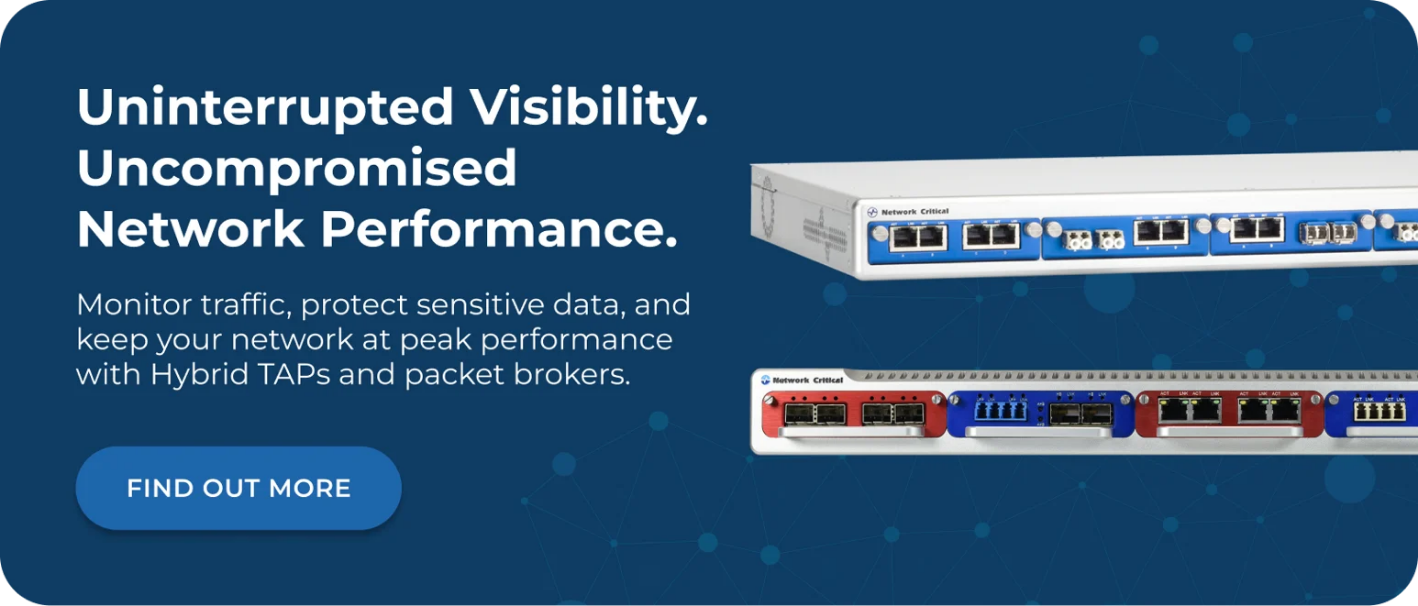
Our hybrid TAP and packet broker platforms combine network access and traffic management in a single, compact chassis. The SmartNA-PortPlus supports 1G to 100G environments with a non-blocking 1.8 Tbps architecture, modular scalability to 194 ports, and the intelligent Drag-n-Vu management interface for fast, error-free configuration. For high-speed environments requiring 400G visibility, the SmartNA-PortPlus HyperCore delivers 25.6 Tbps throughput with 32 QSFP-DD interfaces in a single 1RU chassis, ensuring your packet broker infrastructure keeps pace with network growth.
Whether you're building out visibility for a new SIEM deployment, expanding coverage across existing security tools, or addressing blind spots in an established architecture, our team can help you design a packet broker solution that delivers the complete, reliable traffic access your security stack depends on.