Top 6 Network TAPs for NIS2 Compliance in 2026
The Network and Information Security 2 (NIS2) Directive requires operators of essential services to implement proportionate technical measures. These cover network monitoring, incident detection, and audit readiness. For network teams, that means continuous, packet-accurate visibility across every critical link. Sampling, Switch Port Analyzer (SPAN) mirroring, and best-effort capture do not meet the standard. Network Test Access Points (TAPs) are the foundation of any NIS2-aligned monitoring architecture. They deliver a passive, lossless copy of live traffic to security and monitoring tools without touching the production path. This article compares six verified vendors across the hardware TAP and hybrid TAP space. It covers the specifications, use cases, and compliance strengths that matter for NIS2 deployments in 2026.
Network TAP Vendors at a Glance
| Vendor | Key Feature / Strength | Max Throughput |
|---|---|---|
|
Hybrid TAP plus packet broker, perpetual licensing, Drag-n-Vu GUI |
Up to 400G |
|
|
OT-focused TAP portfolio, hardware data diodes, no subscription fees |
Up to 100G |
|
|
Deep observability platform, GigaSMART inline intelligence, broad cloud support |
Up to 400G |
|
|
FPGA-based zero packet loss, Vision drag-and-drop GUI, 400G and 800G support |
Up to 800G |
|
|
IOTA all-in-one capture and analysis, European field presence, cloud TAP options |
Up to 100G |
|
|
On-box ThreatGuard IDS, data masking, HIPAA and PCI-DSS compliance features |
Up to 400G |
Network Critical – SmartNA-PortPlus and Passive Fiber Optical TAPs
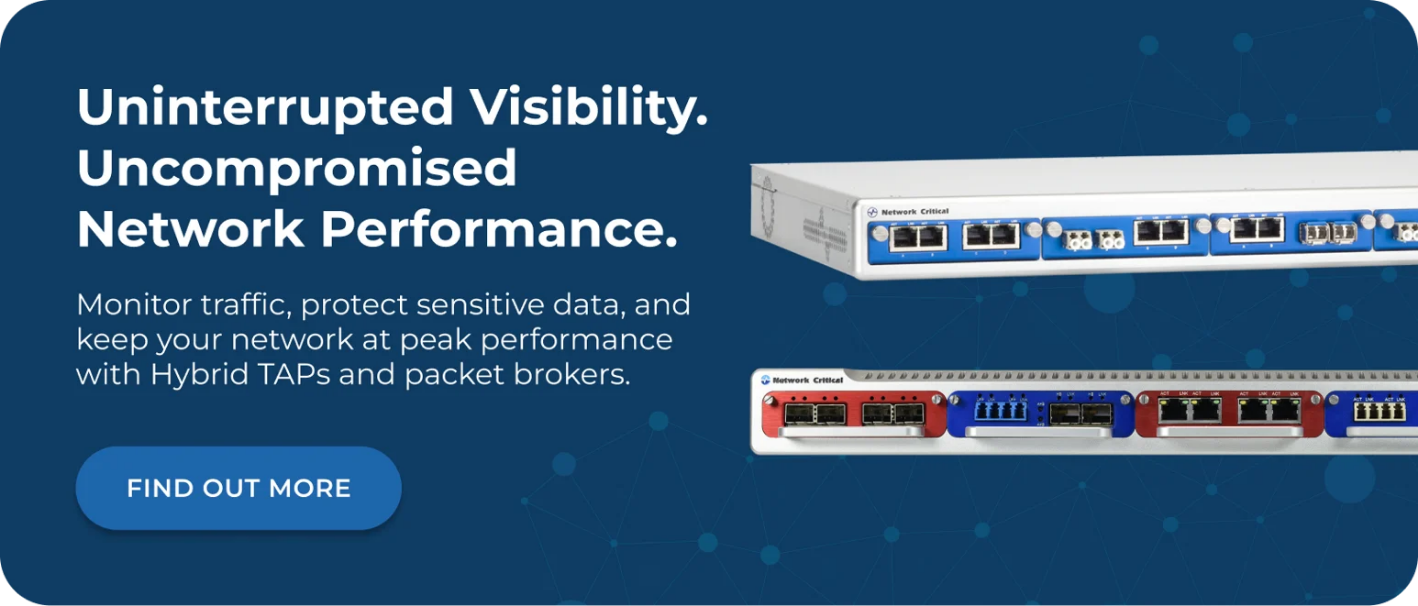
Network Critical builds network TAPs and hybrid TAP plus packet broker platforms for continuous, lossless traffic capture. They are designed for the mixed-speed environments where NIS2 Article 21 technical measures apply. The SmartNA-PortPlus delivers scalable packet brokering across 1G to 100G speeds. It scales from 48 to 194 ports with 1.8 Tbps non-blocking throughput. The SmartNA-PortPlus HyperCore extends this to 400G with 32 QSFP-DD interfaces and up to 256 ports. Both platforms support RADIUS and TACACS+ authentication, SNMPv3 integration, and session-aware load balancing. Each feature is directly relevant to the audit trail requirements NIS2 imposes.
Passive fiber optical TAPs operate with zero power draw and zero latency. They create no single point of failure on monitored links. Up to 16 TAPs fit within a single 1RU chassis. Bypass TAPs provide automatic failover for inline security tools, keeping monitoring tools online without network disruption. The Drag-n-Vu graphical interface enables fast, error-free port mapping and filtering configuration – without requiring specialist engineers. Typical deployments complete in under two hours.
Network Critical holds a perpetual hardware licensing model. There are no per-port subscription fees and no forced upgrade cycles. NIS2-obligated organizations get predictable cost structures and no visibility gaps at contract renewal.
Proven results:
- BP: Enabled centralized monitoring of critical Operational Technology (OT) systems across refinery buildings, supporting compliance with industrial cybersecurity requirements.
- HSBC: Achieved zero latency on monitoring technologies for real-time financial transaction visibility, supporting regulatory audit and incident response readiness.
- State of Maryland: Deployed SmartNA-XL to provide unified communications monitoring across government infrastructure, meeting public sector network visibility mandates.
Garland Technology – EdgeLens and Data Diode
Garland Technology is a US-based TAP specialist. Its product line covers copper and fiber TAPs, inline bypass, packet brokers, and hardware data diodes. The EdgeLens inline bypass TAP supports sub-millisecond failover for 1G to 100G links. It aggregates traffic across multiple monitoring points. Garland's hardware data diode enforces one-way traffic in air-gapped and critical infrastructure environments. This supports NIS2 Article 21's risk-proportionate security requirements in industrial and government networks. Garland states "no hidden fees, no subscriptions, no extra fees after purchase" as its commercial baseline. That aligns with compliance buyers who need predictable long-term cost structures. The company has an active OT security partner ecosystem including Nozomi Networks, TXOne, and Radiflow. It publishes consistent technical content framed around NIS2 and IEC 62443. Garland's field presence is strongest in North America, with European coverage handled via distributor partnerships.
Gigamon – GigaVUE-HC3 and GigaSMART
Gigamon leads the category it calls "deep observability." It claims 4,000-plus customer organizations, including 83 of the Fortune 100. The GigaVUE-HC3 chassis supports line-rate processing at 1G to 100G. GigaSMART modules add inline deduplication, packet slicing, header stripping, and flow sampling. GigaSMART's NetFlow/IPFIX generation and SSL/TLS decryption via Precryption technology deliver enriched, analysis-ready traffic feeds. Tool-side decryption is not required. Gigamon's platform spans on-premises, hybrid cloud, and container environments. Frost and Sullivan recognized Gigamon with its 2026 Company of the Year award in the public sector. Gartner Reference Architecture cites the platform for enterprise visibility. PeerSpot user feedback (updated March 2026) notes that filtering improvements, cluster capacity, and built-in flow visualization remain areas for development. Three-year TCO is materially higher than mid-tier alternatives. Specialist engineer deployment is typically required.
Keysight Technologies – Vision 400 and Network TAPs
Keysight Technologies built its Network Visibility business unit on the Ixia acquisition. It offers the Vision packet broker family alongside dedicated TAPs and bypass switches, managed through the IFC Centralised Manager. The Vision 400 series received the Frost and Sullivan 2024 Global New Product Innovation Award. Keysight uses FPGA-based processing to deliver zero packet loss under full duplex load. The Vision X platform supports 400G and 800G speeds. The Vision drag-and-drop GUI simplifies packet broker configuration without requiring command-line expertise. This resonates with NIS2 network teams who manage ongoing monitoring changes. Keysight's portfolio is strongest in service provider and regulated enterprise environments, where test-and-measurement credibility carries weight in compliance conversations. TAPs and packet brokers ship as separate SKUs. Organizations requiring combined access and brokering in a single footprint face higher deployment complexity and cost. Three-year TCO is positioned at a premium comparable to Gigamon.
Profitap – ProfiTAP HW-2000 and IOTA
Profitap is a Netherlands-based vendor. Its products include hardware TAPs, packet brokers, portable field capture units, and the IOTA all-in-one appliance. IOTA combines TAP, capture, storage, and analysis in a single device. IOTA suits NIS2 teams that need self-contained capture units at edge points or remote sites. It does not require a full distributed visibility fabric. Profitap also offers cloud TAP options for VMware, Kubernetes (AWS EKS), and Azure VM environments. The Supervisor platform provides centralized management across deployed Profitap devices. The company publishes consistent NIS2-framed technical content for European network teams. A strong certified-reseller network covers the Netherlands, Germany, and the Nordics. North American field coverage is more limited. For large-scale, multi-tool architectures, IOTA's integrated model limits deployment flexibility. Fabric-based approaches that feed independent SIEM, NDR, and forensics platforms offer more optionality.
APCON – IntellaStore IV and IntellaView
APCON is a packet broker specialist based in Wilsonville, Oregon. Its IntellaStore IV, launched February 2026, bundles an on-box ThreatGuard Intrusion Detection System (IDS) with the packet broker. Security applications run directly on the capture appliance. The IntellaView platform supports 400G blade capacity with data masking, packet slicing, and VLAN manipulation. Compliance positioning covers HIPAA and Payment Card Industry Data Security Standard (PCI-DSS) regulated environments. Masking and slicing capabilities help NIS2 teams meet proportionate data protection obligations under Article 21. Raw traffic is not shared to every connected tool. APCON offers a 60-day free trial of ThreatGuard bundled with IntellaStore IV. Pricing is quote-based via partners. APCON's brand recognition and field presence are smaller than Gigamon or Keysight, and its packet-broker-plus-IDS model is newer to market.
How to Choose a Network TAP for NIS2 Compliance
NIS2 does not mandate specific products. Article 21 requires proportionate technical and organizational measures for incident detection, business continuity, and supply chain security. The following criteria translate those obligations into practical purchasing decisions.
Packet Capture Fidelity
NIS2 incident reporting timelines – 24-hour early warning, 72-hour notification – depend on accurate forensic evidence. Your TAP must deliver zero packet loss at line rate, including during traffic spikes and anomaly events. Passive fiber TAPs and purpose-built hardware TAPs guarantee this. SPAN ports drop packets under load and produce incomplete evidence that can undermine both incident response and regulatory submissions. Verify zero packet loss guarantees in vendor specifications before committing.
Coverage Across Mixed-Speed Environments
Most NIS2-obligated networks carry legacy 1G and 10G links alongside 40G and 100G infrastructure. A single-vendor TAP portfolio from 10 Mbps to 100G or 400G simplifies procurement and reduces management complexity. Speed-mismatch blind spots are also avoided. Look for:
- Modular chassis designs that accept different speed modules
- Support for both copper and fiber media types
- A clear upgrade path as network speeds increase
Integration With Your Monitoring Toolchain
NIS2 Article 21 monitoring obligations are tool-agnostic. The directive does not specify which SIEM, NDR, or IDS platform you use. Your TAP and packet broker architecture should deliver standard PCAP output to any platform you choose. Options include Splunk, Microsoft Sentinel, Darktrace, and Wireshark. Vendor lock-in at the capture layer creates supply chain risk that NIS2 itself flags as a governance concern. Network packet brokers with open, tool-agnostic output give your team the flexibility to evolve the toolchain. The visibility infrastructure does not need to be replaced.
Deployment Speed and Operational Complexity
NIS2 obligated organizations cannot afford extended visibility gaps during deployment or reconfiguration. GUI-led management lets your team self-serve port mapping, filtering, and tool connections. It reduces mean time to deployment and eliminates the dependency on specialist vendor engineers for routine changes. Evaluate how quickly your team can configure a new monitoring feed or redirect traffic to a replacement tool.
Audit Trail and Authentication Support
Incident reports submitted to national Computer Security Incident Response Teams (CSIRTs) must be defensible. Platforms that support RADIUS and TACACS+ authentication, SNMPv3, and configuration logging create a defensible audit trail. Your compliance team will need it when regulators ask how traffic was captured and distributed during an incident.
Total Cost of Ownership and Licensing Model
NIS2 compliance is a multi-year obligation, not a one-time deployment. Subscription-based licensing creates budget volatility and risks visibility gaps when contracts lapse. Perpetual hardware licensing with transparent maintenance gives finance teams a predictable cost model. There is no compliance risk of a lapsed subscription leaving monitoring tools dark. Network Critical's perpetual licensing runs 40 to 60 percent lower over three years versus leading subscription-based platforms.
Frequently Asked Questions
What Is a Network TAP and Why Does It Matter for NIS2?
A network TAP is a passive hardware device that creates a lossless copy of live network traffic. It does not affect the production network. NIS2 Article 21 requires operators of essential services to implement technical measures for network monitoring and incident detection. TAPs provide the continuous, packet-accurate traffic access that security and monitoring tools require to meet those obligations. Unlike SPAN mirroring, TAPs do not drop packets under load, making them the appropriate foundation for a compliance-grade monitoring architecture.
What Is the Difference Between a Network TAP and a SPAN Port for NIS2 Monitoring?
A network TAP copies 100 percent of traffic passively and independently of switch CPU load. A SPAN port mirrors traffic through switch software and drops packets when the switch is under load. This includes the traffic spikes that accompany security incidents. For NIS2 incident reporting, where forensic completeness determines the quality of your 72-hour notification, SPAN-sourced evidence may be incomplete. TAPs produce audit-grade capture that SPAN cannot reliably replicate.
Do Network TAPs Work With Existing SIEM and NDR Tools?
Yes. Hardware network taps deliver standard PCAP traffic output that any SIEM, NDR, IDS, or packet analysis platform can consume. Packet brokers aggregate and filter that traffic before distribution, reducing tool ingestion costs and preventing tool overload. Network Critical's platform is verified to integrate with Splunk, Microsoft Sentinel, Darktrace, ExtraHop, Wireshark, and Endace, among others.
How Much Does a NIS2-Compliant Network TAP Deployment Cost?
A single passive fiber TAP starts in the low four figures. Scaled packet broker deployments with management software reach mid-six figures. The largest cost variable is licensing model. Subscription-based platforms from Gigamon and Keysight carry materially higher three-year total costs than perpetual-licensed alternatives. Network Critical's perpetual licensing runs 40 to 60 percent lower in three-year total cost of ownership versus leading subscription platforms. Accurate budgeting requires a network audit to determine port count, speed requirements, and tool distribution architecture.
Can a Single Network TAP Platform Cover Both IT and OT Networks for NIS2?
Hybrid TAP plus packet broker platforms can monitor both IT and OT environments from a single management interface. The TAP must support the appropriate media types and speed ranges for each segment. NIS2 scope includes operators in energy, transport, water, and digital infrastructure. Many of these organizations run converged IT and OT environments. Coverage from 10 Mbps OT links to 100G data center speeds removes the need for separate vendor relationships per environment.
What Should I Look for in a Network TAP Vendor for Long-Term NIS2 Readiness?
Prioritize vendors with perpetual licensing and a modular architecture that scales without forklift upgrades. Tool-agnostic output gives your team freedom to change monitoring platforms without replacing the capture infrastructure. Audit trail support – RADIUS, TACACS+, SNMPv3 configuration logging – is essential for defensible incident reports. Vendor responsiveness and direct technical support access matter for compliance obligations with 24-hour incident notification windows.
Build Your NIS2 Visibility Architecture With Network Critical
NIS2 compliance requires continuous, packet-accurate visibility across every critical network link. The monitoring architecture supporting it must be sustainable, scalable, and auditable for years to come. Network Critical delivers a complete portfolio of hybrid taps, passive fiber TAPs, and packet brokers covering 10 Mbps to 400G. It carries perpetual licensing and no subscription lock-in. Three-year total cost of ownership runs 40 to 60 percent lower than leading alternatives. Drag-n-Vu's graphical interface lets your team self-serve monitoring changes in under two hours. No specialist engineers are required, and there are no gaps in coverage. To discuss your NIS2 monitoring requirements and request a free network audit, speak to the Network Critical team.