Top 6 Network TAPs for NERC CIP Compliance in 2026
North American electric utilities face a tightening compliance environment. NERC CIP (North American Electric Reliability Corporation Critical Infrastructure Protection) standards govern bulk electric system security. They require operators to monitor, log, and protect electronic access to critical assets. Meeting those obligations demands continuous, passive traffic visibility. It must be delivered without introducing latency or disrupting control system operations.
Network TAPs are the foundational tool for that visibility. Unlike Switch Port Analyzer (SPAN) ports, they copy traffic passively at the physical layer. They deliver zero packet loss and create no single point of failure on the monitored link. For NERC CIP audits, that distinction matters: complete, unaltered traffic capture is a documented requirement across CIP-007 and CIP-010.
This article compares six vendors offering network TAPs suited to NERC CIP environments. Coverage includes passive fiber options, copper variants for legacy Operational Technology (OT) links, and bypass functionality for inline tools. It also covers hybrid chassis that combine TAP and network packet broker functions under a single management plane.
At a Glance: Network TAPs for NERC CIP Compliance
| Vendor | Product | Max Speed | TAP Type | NERC CIP Fit |
|---|---|---|---|---|
|
Network Critical |
SmartNA-XL / Passive Fiber TAPs |
40G / 100G |
Hybrid + Passive Fiber |
Strong – passive fiber, hybrid chassis, role-based access |
|
Garland Technology |
EdgeSafe Bypass TAP / P-Series Passive |
100G |
Passive Fiber + Bypass |
Strong – purpose-built OT and utility focus |
|
Gigamon |
GigaTAP / GigaPure |
100G |
Passive Fiber + Copper |
Strong – deep enterprise feature set |
|
Cubro Network Visibility |
Omnia Series |
100G |
Passive Fiber |
Good – carrier-grade build quality |
|
Profitap |
IXTAP Series |
10G |
Passive Fiber + Copper |
Good – compact, substation-suitable form factors |
|
Keysight Technologies |
TAP-HS Series |
100G |
Passive Fiber |
Strong – high-density, audit-grade capture |
Network Critical – SmartNA-XL and Passive Fiber TAPs
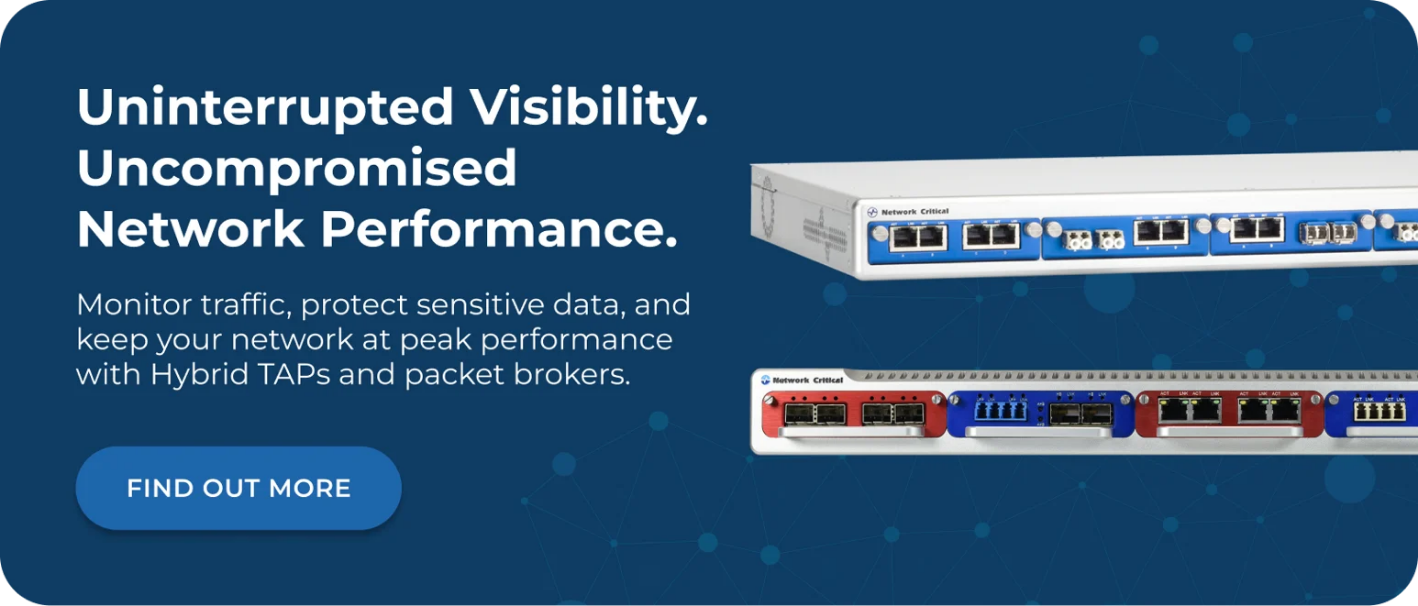
Network Critical's SmartNA-XL is a modular 1RU hybrid TAP and packet broker supporting 1G, 10G, and 40G interfaces. Its five-slot chassis accepts interchangeable modules. Utilities can scale from a handful of monitoring points to a full substation visibility architecture without replacing chassis hardware. The PacketPro engine adds Layer 2–7 filtering, payload masking, and packet slicing. All three capabilities are directly relevant to NERC CIP-007 security event monitoring requirements.
Network Critical's passive fiber TAPs require no power and introduce no electrical path into the monitored circuit. Up to 16 TAPs fit in a single Rack Unit (RU), making them practical for dense substation patch panels. The bypass TAPs protect inline security tools – intrusion detection systems and firewalls – with automatic failover. This ensures the production network continues if a tool fails.
Drag-n-Vu software provides role-based user accounts, TACACS+ authentication, SNMP v2c/v3 support, and a RESTful API. Those management controls align directly with CIP-007 and CIP-010 access management requirements. Audit logs of configuration changes are exportable for compliance evidence packages.
Network Critical holds a zero packet loss guarantee across its product range. This is a verifiable claim relevant to CIP-007-6 R4 log integrity requirements. The OT network monitoring page covers the company's broader industrial positioning.
Proven results:
- BP: Deployed passive fiber TAPs across refinery buildings for centralized monitoring of critical operational technology systems
- Airbus: Network TAPs used in aircraft test rig monitoring – a high-integrity, zero-interference deployment requirement
- A UK university used Network Critical INVIKTUS alongside TAP infrastructure for zero trust cybersecurity across campus OT networks
Best for: Utilities and grid operators needing a scalable hybrid TAPs and packet broker platform. Particularly suited to teams requiring verifiable zero packet loss and NERC CIP-aligned access controls.
Garland Technology – EdgeSafe Bypass TAP and P-Series Passive TAPs
Garland Technology has built a distinct position in OT and industrial network visibility. Its P-Series passive fiber TAPs support 1G to 100G links with no power draw and no network impact. This is the standard requirement for OT monitoring under NERC CIP or IEC 62443. The EdgeSafe inline bypass TAP adds sub-millisecond failover for inline security appliances, maintaining network continuity during tool maintenance or failure.
Garland's OT-specific documentation addresses NERC CIP use cases directly. It includes guidance on placing TAPs inside the Electronic Security Perimeter (ESP). The vendor also produces application notes covering integration with Dragos, Claroty, and other industrial security platforms. These cover bulk electric system environments specifically.
Copper TAP options address legacy 10/100/1000BASE-T links common in older substation automation systems. Garland's form factors range from desktop units for small substations to rack-mounted chassis for control center environments.
Best for: Utilities seeking a pure-play TAP specialist with explicit NERC CIP documentation and strong OT ecosystem integrations.
Gigamon – GigaTAP and GigaPure
Gigamon's GigaTAP line covers copper and fiber variants from 1G to 100G. The GigaPure passive optical TAPs require no power. They're designed for environments where network modifications must be minimized – a standard constraint inside Electronic Security Perimeters. Gigamon integrates its TAP portfolio with the GigaVUE fabric manager for centralized policy management across large TAP and monitoring deployments.
The GigaVUE-HC platform adds advanced traffic intelligence: deduplication, SSL/TLS decryption, and application filtering. This extends compliance monitoring coverage beyond raw packet capture. Role-based access, SNMP alerting, and full audit trails are available across the product line.
Gigamon's compliance documentation includes NERC CIP alignment notes and reference architectures for bulk electric system deployments. Enterprise support tiers include professional services with compliance-specific engagement options. Pricing sits at a significant premium over mid-tier vendors, which can affect deployment scale inside constrained utility capital budgets.
Best for: Large investor-owned utilities with budget and internal expertise to deploy a full Gigamon visibility fabric across multiple sites.
Cubro Network Visibility – Omnia Series
Cubro Network Visibility's Omnia passive fiber TAPs support 1G and 10G optical links in a compact 1RU form factor. The devices are fanless, drawing no power and generating no heat in the tap itself. These properties suit substation environments with restricted HVAC and power budgets. Cubro's European manufacturing base and carrier-grade build standards make the hardware well-suited to demanding physical environments.
The Omnia series integrates with Cubro's EXA packet broker platform for environments that need traffic aggregation alongside passive access. Management is handled via REST API or the Cubro NMS platform. Specifications for TACACS+ authentication are not publicly detailed. Buyers in NERC CIP environments should verify access control capabilities against CIP-007 requirements directly with the vendor.
Best for: European utilities or North American operators with a preference for compact, carrier-grade passive TAPs at the 1G–10G tier.
Profitap – IXTAP Series
Profitap's IXTAP series targets industrial and field-deployed network monitoring. The compact form factor suits remote substation environments where rack space is limited or unavailable. Some units are desktop or DIN-rail mountable. Passive fiber and copper options cover legacy Supervisory Control and Data Acquisition (SCADA) links. Energy management system interfaces are also supported.
Profitap does not publish detailed NERC CIP-specific documentation. The IXTAP's passive, zero-power design does meet the physical access monitoring requirement for Electronic Security Perimeter links. Integration with third-party Security Information and Event Management (SIEM) tools and SCADA security platforms is supported via standard PCAP output.
Throughput tops out at 10G across most IXTAP models. That covers the majority of substation and control room links, but is a constraint for higher-speed data center interconnects.
Best for: Utilities with space-constrained field sites, remote substations, or legacy copper links at 1G and below.
Keysight Technologies – Network TAP HS Series
Keysight Technologies' Network TAP HS Series delivers high-density passive fiber monitoring with up to 36 TAP points per Rack Unit. That is the highest available density in the market. Aggregate throughput reaches 100G with zero packet loss. The hardware supports breakout configurations for bidirectional capture. This simplifies forensic evidence collection for CIP-007 log reviews.
Keysight's network visibility products are positioned within a broader test and measurement portfolio. Enterprise support is available. The sales and support motion is weighted toward lab and test environments rather than OT deployments. NERC CIP-specific documentation is limited compared to OT-specialist vendors.
Management integrates with Keysight's Network Packet Broker platforms for customers needing traffic aggregation and filtering downstream of the TAP layer. Role-based access and SNMP alerting are standard.
Best for: Utilities needing maximum TAP density in a constrained rack footprint, or organizations with existing Keysight test infrastructure.
How to Choose a Network TAP for NERC CIP Compliance
Passive vs. Hybrid Architectures
Passive fiber TAPs require no power and introduce no active component into the monitored path. This makes them the preferred architecture for Electronic Security Perimeter monitoring. Hybrid TAP and network packet broker platforms add traffic aggregation and filtering downstream. This reduces the number of monitoring tools needed and simplifies CIP-007 evidence collection. Where budgets allow, combining passive TAPs with a hybrid TAP and packet broker chassis provides the most complete audit trail.
Interface Type Coverage
NERC CIP environments span multiple decades of infrastructure. Substation automation systems may use copper at 10/100Mbps. Control center interconnects may run 10G fiber. Newer advanced metering infrastructure gateways use 1G or 10G Ethernet. Your TAP selection must cover every interface type inside the Electronic Security Perimeter. A single uncaptured path is a compliance gap.
Access Control and Audit Logging
CIP-007-6 R5 requires documented, enforced user access controls on all network devices inside the Electronic Security Perimeter. TAPs and associated management platforms must support role-based accounts, authentication via TACACS+ or RADIUS, and exportable configuration change logs. Verify these capabilities against the standard before procurement.
Zero Packet Loss Verification
NERC CIP log integrity requirements depend on complete, unaltered packet capture. Verify that your TAP vendor provides a documented, testable zero packet loss guarantee – not just a marketing claim. Passive fiber TAPs are inherently lossless; active and copper TAPs should carry explicit specifications.
Vendor OT Experience
TAP vendors with explicit OT experience are better positioned to support NERC CIP implementation. Look for documented deployments in utilities, oil and gas, or industrial environments. Published reference architectures, compliance application notes, and integration guides for your existing security tools are all strong signals.
Scalability Across the CIP Asset Inventory
Most utilities monitor dozens or hundreds of Electronic Security Perimeter boundaries. A modular, scalable TAP architecture reduces procurement complexity and management overhead as the CIP asset inventory grows. Avoid one-off hardware choices that require multiple management platforms across your tap infrastructure.
Frequently Asked Questions
What NERC CIP Standards Require Network Traffic Monitoring?
CIP-007-6 (Systems Security Management) requires controls over ports and services, security patching, and security event monitoring. This includes logging of traffic on Electronic Security Perimeter boundaries. CIP-010-4 (Configuration Change Management and Vulnerability Assessments) requires documented baselines and change detection. Network TAPs provide the passive, continuous traffic access layer that feeds security event monitoring systems and supports change detection evidence.
Do Network TAPs Affect the Monitored Network's Availability?
Passive fiber TAPs have no active components in the signal path. They cannot introduce latency, packet loss, or failure modes into the monitored link. Copper TAPs include a relay that defaults to pass-through on power loss. These properties make passive TAPs the preferred choice for Electronic Security Perimeter monitoring. Any network impact could affect bulk electric system operations.
Can a SPAN Port Replace a Network TAP for NERC CIP Evidence Collection?
No. SPAN ports are managed by the switch, subject to oversubscription, and can drop packets under load. For NERC CIP audit purposes, SPAN-sourced logs carry a documented risk of incompleteness. Passive network TAPs deliver hardware-guaranteed, unmodified copies of every frame on the link. That is the evidence standard auditors expect for CIP-007 log integrity.
What Is the Difference Between a Passive TAP and a Bypass TAP in NERC CIP Environments?
A passive TAP copies traffic for monitoring without any active component in the production path. A bypass TAP sits inline and protects active security tools such as intrusion detection systems. It reroutes traffic around those tools if they fail. NERC CIP environments typically use both. Passive TAPs provide monitoring access; bypass TAPs protect inline inspection tools at the Electronic Security Perimeter.
How Many TAPs Does a Typical NERC CIP Deployment Require?
It depends on the number of Electronic Security Perimeter boundaries and the interface count at each boundary. A single substation may have four to ten monitored links. A large control center or data center may require dozens. Network Critical's modular SmartNA-XL chassis and passive fiber TAPs offer up to 16 TAPs per rack unit. They help manage scale without proportionally increasing rack space or management complexity.
What Management Features Should a NERC CIP TAP Platform Include?
At minimum, your platform needs: role-based user access, TACACS+ or RADIUS authentication, and exportable configuration change logs. SNMP alerting for link state changes and a documented zero packet loss method are also required. These controls map directly to CIP-007-6 R5 access management requirements. Drag-n-Vu provides all of these features across the Network Critical product range. Its graphical interface simplifies configuration evidence capture for auditors.
Meet NERC CIP Monitoring Requirements With Network Critical
North American utilities operating under NERC CIP cannot afford monitoring gaps at Electronic Security Perimeter boundaries. The right network TAP delivers complete, unaltered, zero-packet-loss traffic capture – passively, continuously, and without impact to the production network.
Network Critical's hybrid TAP and network packet broker platform provides that foundation. It comes with the access controls, audit logging, and scalable architecture that NERC CIP compliance demands. Speak to the Network Critical team to discuss your compliance monitoring architecture.