The Best Gigamon Alternatives for Enterprise Networks in 2026
Gigamon commands roughly 51 percent of the deep-observability segment. For many enterprises, its platform delivers real value. But subscription pricing and deployment complexity have pushed network teams to evaluate alternatives. Three-year Total Cost of Ownership (TCO) routinely reaches $680,000 or more. Whether your contract is approaching renewal or you're building a new visibility architecture, the market in 2026 offers credible options. Network Test Access Points (TAPs), network packet brokers, and hybrid visibility platforms are all covered. This article compares seven verified vendors on cost, scalability, deployment simplicity, and tool integration.
Enterprise Network Visibility Platforms at a Glance
| Vendor | Key Strength | Max Throughput |
|---|---|---|
|
Network Critical – SmartNA-PortPlus HyperCore |
Hybrid TAP + packet broker, perpetual licensing, Drag-n-Vu GUI |
Up to 400G |
|
Keysight Technologies – Vision 400 |
FPGA-based zero-packet-loss, drag-and-drop GUI |
Up to 400G |
|
Arista Networks – DANZ Monitoring Fabric |
Software-defined packet broker, CloudVision integration |
Up to 100G |
|
NetScout – nGeniusONE / InfiniStream |
Full-stack NPM, DDoS, and NDR platform |
– |
|
APCON – IntellaStore IV / IntellaView |
On-box ThreatGuard IDS, compliance-led positioning |
Up to 400G |
|
Garland Technology – EdgeLens / TAP series |
OT specialization, hardware data diodes, no subscription fees |
Up to 100G |
|
Profitap – IOTA / ProfiShark |
All-in-one capture and analysis, European field strength |
– |
Network Critical
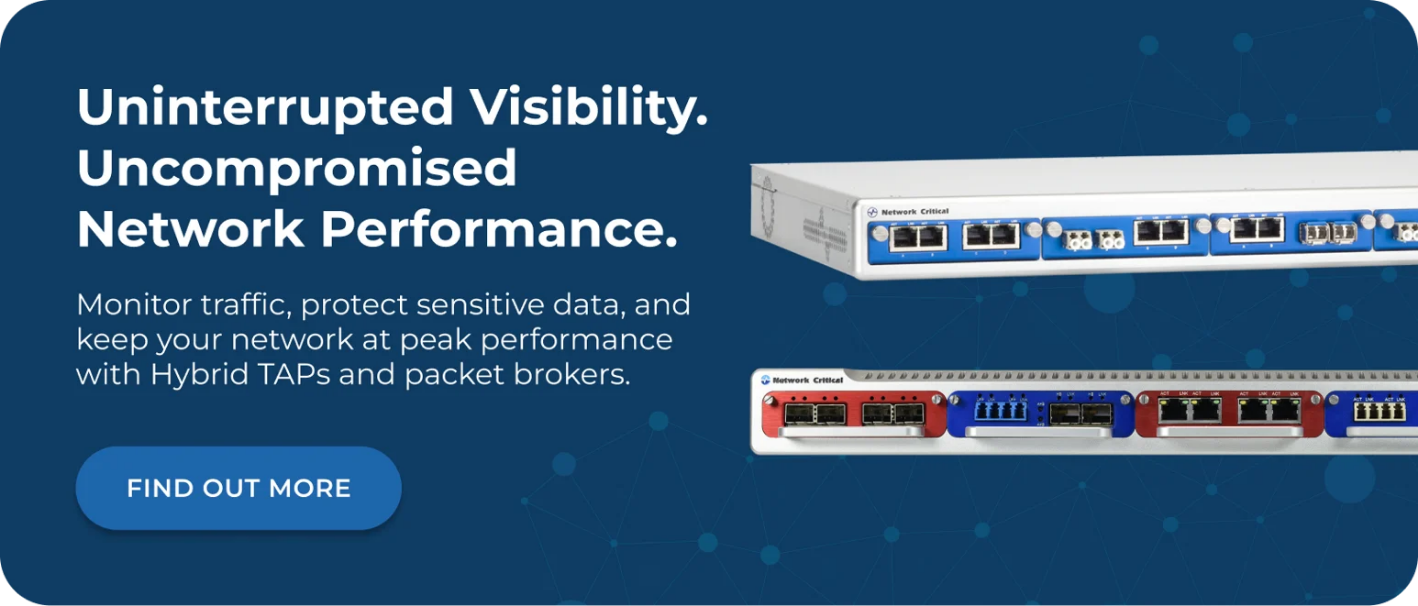
Network Critical's SmartNA-PortPlus is a scalable hybrid packet broker supporting 1G to 100G across 48 to 194 ports. It delivers 1.8 Tbps non-blocking throughput with aggregation, filtering, and session-aware load balancing. The SmartNA-PortPlus HyperCore extends this to 400G via 32 QSFP-DD interfaces. That targets service-provider and data center environments where incumbent platforms demand substantially higher investment.
The platform combines network TAPs and network packet brokers in a single hybrid chassis. This removes the separate-SKU complexity common to Gigamon deployments. Drag-n-Vu provides a graphical interface for port mapping and traffic configuration. Typical deployments complete in under two hours. Network admins self-serve day-to-day changes without vendor engineer involvement.
The cost difference against Gigamon is material. NWC's modelled 3-year TCO sits at approximately $325,000. A comparable Gigamon deployment benchmarks at $680,000 – a 52 percent saving. Network Critical uses perpetual hardware licensing with no per-port subscription fees. This eliminates annual price volatility that drives many Gigamon customers to evaluate alternatives at contract renewal.
Network Critical's architecture is tool-agnostic. It delivers standard PCAP output to any Security Information and Event Management (SIEM) or Network Detection and Response (NDR) platform. Packet analysis tools are equally supported. Verified integrations include Splunk, Darktrace, ExtraHop, Wireshark, and Endace. The SmartNA-XL covers 1G to 40G deployments for environments not yet at 100G scale.
Proven results:
- Vodafone: Achieved 100% accurate traffic visibility on key links, reducing subscriber churn through continuous Quality of Service (QoS) monitoring across a multi-generation European mobile network
- HSBC: Achieved zero latency on monitoring technologies, enabling real-time financial transaction visibility with no impact on live traffic
- Darktrace: Integrated SmartNA-PortPlus via API to automate traffic filtering and port mapping for AI-driven threat detection workflows
Keysight Technologies
Keysight's network visibility business was built on the Ixia acquisition. It covers the Vision series packet broker family alongside TAPs, bypass switches, and the IFC Centralised Manager. The Vision 400 received the Frost & Sullivan 2024 Global New Product Innovation Award. It uses an FPGA-based architecture validated by The Tolly Group for zero-packet-loss performance. Keysight offers 400G and 800G capability, making it a credible option in large service-provider environments.
Keysight's drag-and-drop Graphical User Interface (GUI) for packet broker configuration removes CLI complexity. This positions it close to Network Critical on ease of use. The Application Fusion Program enables partner integrations. Forescout was named inaugural Network Visibility Tech Partner of the Year in January 2026. Pricing is aligned with premium positioning. Three-year TCO benchmarks place Keysight alongside Gigamon for enterprise-scale deployments. Network visibility is one business unit within a broader portfolio spanning wireless, automotive, and EDA.
Arista Networks
Arista Networks' DANZ Monitoring Fabric is a software-defined packet broker derived from the Big Switch Networks acquisition. DMF is built on merchant-silicon switches and integrates with Arista's CloudVision platform. It is strongest in accounts where Arista is already the incumbent switching vendor. The architecture supports thousands of ports from 1G to 100G and delivers a Monitoring-as-a-Service narrative. This suits enterprises running shared NetOps, SecOps, and CloudOps teams from a shared fabric.
DMF includes a hands-on online lab environment for evaluation without physical hardware shipment. However, DMF requires Arista switching or approved merchant-silicon hardware. Organizations seeking vendor-neutral visibility across multi-vendor environments will encounter limitations. Demand generation relies heavily on the Arista switching install base rather than standalone DMF discovery.
NetScout
NetScout sells a full-stack platform spanning network performance monitoring, Network Detection and Response (NDR), DDoS defense, and threat intelligence. Its core products include nGeniusONE, Omnis CyberStream (NDR), Arbor (DDoS), and ATLAS (threat intelligence). A January 2026 nGeniusONE update added real-time Deep Packet Inspection (DPI) over Ethernet and Wi-Fi 7. It also introduced Secure Sockets Layer/Transport Layer Security (SSL/TLS) certificate expiry monitoring. NetScout received the Security Today 2025 CyberSecured Award for Omnis CyberStream.
NetScout's proposition is a unified platform covering monitoring, detection, and defense from a single vendor. This suits organizations wanting to consolidate tools under one contract. Buyers seeking open integrations with independently chosen SIEM and NDR platforms, however, face platform lock-in. The product portfolio – nGeniusONE, Omnis CyberStream, Arbor, InfiniStream, vSTREAM, KlearSight – carries significant operational complexity. Pricing is enterprise-grade and quote-based.
APCON
APCON is a Wilsonville, Oregon-based packet broker specialist. Its February 2026 IntellaStore IV launch introduced on-box ThreatGuard Intrusion Detection System (IDS) via the APCON Intelligent Processor (AIp). This allows customers to run security applications directly on the packet broker without a separate appliance. The IntellaView platform supports 400G blade configurations and targets compliance-led deployments. Data masking and packet slicing capabilities address HIPAA and PCI-DSS requirements.
APCON includes a bundled 60-day free trial of ThreatGuard with IntellaStore IV. This try-before-buy mechanic is unusual at this market segment. APCON's global brand footprint is smaller than Gigamon or Keysight. Specifications are available on request via the partner channel rather than through a fully public pricing model. US-centric field coverage may be a consideration for European buyers with data sovereignty requirements.
Garland Technology
Garland Technology is a US-based TAP specialist with deliberate positioning in Operational Technology (OT) and industrial network visibility. Its product line covers TAPs, packet brokers, hardware data diodes, and inline bypass. An active OT security partner ecosystem includes Nozomi Networks, TXOne, Dispel, EmberOT, and Radiflow. Garland states no hidden fees, no subscriptions, and no extra fees after purchase. That's a direct commercial match for enterprises that want predictable visibility infrastructure costs.
The hardware data diode product line is a distinctive category for critical infrastructure environments. It suits environments where unidirectional data flow is a compliance or operational requirement. Garland maintains a consistent events presence at TechNet Augusta, S4, BSides ICS/OT, and InfoSecurity Europe. It publishes regular educational content on TAP versus Switch Port Analyzer (SPAN) deployments and IEC 62443 compliance. Advanced packet broker features and GUI-led configuration are narrower compared to dedicated packet broker platforms.
Profitap
Profitap is a Netherlands-based vendor covering TAPs, packet brokers, portable field troubleshooters, and the IOTA product line. IOTA combines TAP, capture, storage, and packet analysis in a single appliance. No other vendor in this comparison set packages capture and analysis together in the same device. Profitap also offers the Supervisor centralised management layer for visibility fabric coordination.
Profitap runs a creator-amplified content strategy featuring named packet-analysis personalities. It maintains strong European field presence across the Netherlands, Germany, and Nordics through a certified-reseller model. IOTA suits forensics-led deployments and troubleshooting workflows where self-contained capture is the primary requirement. Organizations scaling to service-provider throughput or feeding multiple security tools may find the all-in-one architecture limits deployment flexibility. North American field coverage depends on channel distribution.
How to Choose the Right Gigamon Alternative for Your Network
Total Cost of Ownership and Licensing Model
The most common trigger for evaluating Gigamon alternatives is contract renewal. Before comparing products, model the 3-year TCO across CapEx, subscription or maintenance fees, and engineer time for ongoing configuration. Vendors using perpetual hardware licensing eliminate the annual price volatility that makes Gigamon renewals unpredictable. If your team spends significant hours on vendor-led configuration changes, deployment simplicity compounds the saving over time.
Throughput and Speed Requirements
Identify your current and near-term speed ceiling before selecting a platform. Most enterprise data centers operate at 10G to 100G today, with 400G deployments growing in service-provider environments. Verify that the vendor's published throughput figure is non-blocking at full line rate. Network packet brokers at 100G and above should carry independent test validation, not just manufacturer claims.
Hybrid TAP and Packet Broker Architecture
Separate TAP and packet broker SKUs introduce integration overhead, additional rack space, and two support relationships. A hybrid chassis that handles both functions simplifies deployment and reduces failure points. It's particularly valuable in OT and space-constrained edge environments. Key questions to ask vendors:
- Does the platform support TAP functions and packet broker functions in the same chassis?
- Can you scale port count without replacing the base unit?
- Is failsafe TAP operation maintained if the chassis loses power?
Tool Integration and Vendor Neutrality
Your packet broker should feed any monitoring or security tool you choose without per-integration licensing. Closed platforms that lock you into vendor-specific analytics constrain your ability to adopt best-of-breed SIEM, NDR, or packet analysis tools. Confirm that the platform delivers standard PCAP output and integrates via open APIs. This matters most if you're running Splunk, Darktrace, ExtraHop, or a purpose-built capture platform alongside your visibility infrastructure.
Deployment Complexity and Ongoing Management
Enterprise visibility platforms are often deployed by network architects but maintained day-to-day by administrators. If routine port mapping or filter changes require vendor engineer involvement, you're paying for an unnecessary dependency. Graphical, drag-and-drop network TAP and packet broker interfaces reduce configuration errors. They also cut Mean Time To Resolution (MTTR) during maintenance windows. Ask vendors for a live demo of the management interface before committing.
Compliance and Data Handling
If your network must meet PCI-DSS, HIPAA, NIS2, or IEC 62443, confirm the platform supports your compliance data handling needs. Relevant capabilities include packet slicing, data masking, header stripping, and audit-ready access controls. Some frameworks specify physical network monitoring as the required method. This rules out software-only or cloud-native alternatives regardless of their other features.
Frequently Asked Questions
What Is the Main Difference Between Gigamon and Its Alternatives?
Gigamon is the market category leader in deep observability, with approximately 51 percent segment share. It has deep integration with cloud and encrypted traffic workflows. Its alternatives offer comparable packet-level visibility at lower cost, simpler deployment, or with more flexible licensing. The primary practical differences are 3-year TCO, licensing model, and deployment approach. Network Critical and Garland Technology run 40 to 60 percent lower on 3-year TCO than Gigamon. Gigamon uses subscription licensing; Network Critical uses perpetual hardware licensing. Gigamon typically requires specialist engineers for configuration; some alternatives support network admin self-service.
How Much Does a Gigamon Alternative Cost Compared to Gigamon?
Gigamon's 3-year TCO benchmarks at approximately $680,000 for a representative enterprise deployment. That figure comprises $500,000 in CapEx plus $60,000 per year in subscription fees. Comparable Network Critical deployments have been modelled at approximately $325,000 over the same period – a 52 percent saving. Garland Technology also uses a no-subscription model. APCON and Keysight are quote-based and priced at a premium tier. Request a side-by-side quote with equivalent port configurations before deciding.
Do I Need a Packet Broker If I Already Have Network TAPs?
A network TAP creates a passive copy of live traffic without affecting the production network. A packet broker sits between the TAPs and your monitoring tools. It aggregates, filters, and distributes traffic to the right tool at the right speed. TAPs alone are sufficient for simple, single-tool deployments. Once you're running more than two or three monitoring tools, a network packet broker becomes essential. Feeding traffic from multiple TAP points to a shared SIEM without one leads to tool overload and missed events.
What Is the Difference Between a Network TAP and a SPAN Port?
A network TAP physically copies traffic at the cable or fiber level. It delivers a complete, lossless copy to your monitoring tools without any dependency on the switch's CPU. A Switch Port Analyzer (SPAN) port mirrors traffic via switch software and shares CPU resources with switching functions. Under high load, SPAN drops packets silently, without triggering an alarm. For compliance-grade capture or forensic investigation, a dedicated network TAP is the reliable choice.
Can I Replace Gigamon With a Smaller Vendor Without Losing Visibility Coverage?
Yes, in most enterprise deployments. The core packet broker function – aggregating, filtering, and distributing traffic to monitoring tools – doesn't require Gigamon's scale. For environments under 194 ports at 100G, vendors including Network Critical, APCON, and Garland cover most enterprise use cases. Where Gigamon retains a clear advantage is in hybrid cloud and container visibility. Large analyst-driven RFPs requiring Gartner or Forrester validation also favor Gigamon. Evaluate whether those capabilities are in scope before deciding.
How Long Does It Take to Deploy a Network Packet Broker?
Deployment time depends on the platform and the complexity of your traffic map. Enterprise incumbents typically require specialist engineers and multi-day deployment engagements. Platforms with graphical management interfaces designed for network administrator self-service deploy significantly faster. Network Critical's Drag-n-Vu interface enables deployment completion in under two hours for standard configurations. Network admins manage ongoing changes without vendor involvement.
Build Your Visibility Architecture Without the Subscription Lock-In
Choosing the right Gigamon alternative is not simply a product decision – it's a commercial and operational one. Subscription pricing, specialist-engineer dependency, and closed platform architectures create long-term costs that compound well beyond the initial purchase.
Network Critical offers the same packet-level visibility as Gigamon at 40 to 60 percent lower 3-year TCO. It uses perpetual licensing and a hybrid TAP-plus-broker chassis that eliminates separate-SKU complexity. Your team can operate the management interface without vendor support. The platform scales from 10 Mbps to 400 Gbps in a single vendor portfolio. It delivers tool-agnostic PCAP output to any SIEM, NDR, or analysis platform you choose. Speak to the Network Critical team to request a free network audit.