The Best Keysight Alternatives for Network Visibility in 2026
Keysight's Vision packet broker family has earned its place in service-provider and enterprise data centers. The hardware is capable, the FPGA architecture delivers zero packet loss, and the drag-and-drop GUI reduces configuration time. But Keysight's Network Visibility business sits two units deep inside a $1.6B test-and-measurement corporation. Buyers who need visibility-specific focus, simpler procurement, or a lower three-year TCO have strong reasons to look elsewhere. This article compares six vendors across key criteria: throughput, deployment complexity, scalability, licensing model, and tool integration.
Network Visibility Platform Comparison
| Vendor | Key Feature / Strength | Max Throughput |
|---|---|---|
|
Network Critical – SmartNA-PortPlus |
Hybrid TAP plus broker in single chassis, Drag-n-Vu GUI, perpetual licensing |
Up to 400G |
|
Keysight Technologies – Vision Series |
FPGA zero-packet-loss, drag-and-drop GUI, Frost & Sullivan award |
Up to 400G |
|
Gigamon – GigaVUE HC Series |
Deep observability pipeline, 51% market share, AI traffic intelligence |
Up to 400G |
|
Garland Technology – EdgeLens / PacketMAX |
OT specialisation, no-subscription model, hardware data diodes |
Up to 100G |
|
APCON – IntellaView / IntellaStore IV |
On-box ThreatGuard IDS, 400G blade support, data masking |
Up to 400G |
|
Profitap – IOTA / XTAP Series |
All-in-one capture and analysis, vTAP and cloud TAP support |
Up to 100G |
Network Critical – SmartNA-PortPlus
Network Critical delivers the SmartNA-PortPlus, a scalable network packet broker. It covers 1G to 100G across 48 to 194 ports in a 1RU chassis. Line-rate throughput reaches 1.8 Tbps with non-blocking architecture and dual hot-swap power supplies. Full support for aggregation, filtering, load balancing, and deduplication is included across all configurations. For 400G deployments, the SmartNA-PortPlus HyperCore provides 32 QSFP-DD interfaces, 25.6 Tbps throughput, and up to 256 ports.
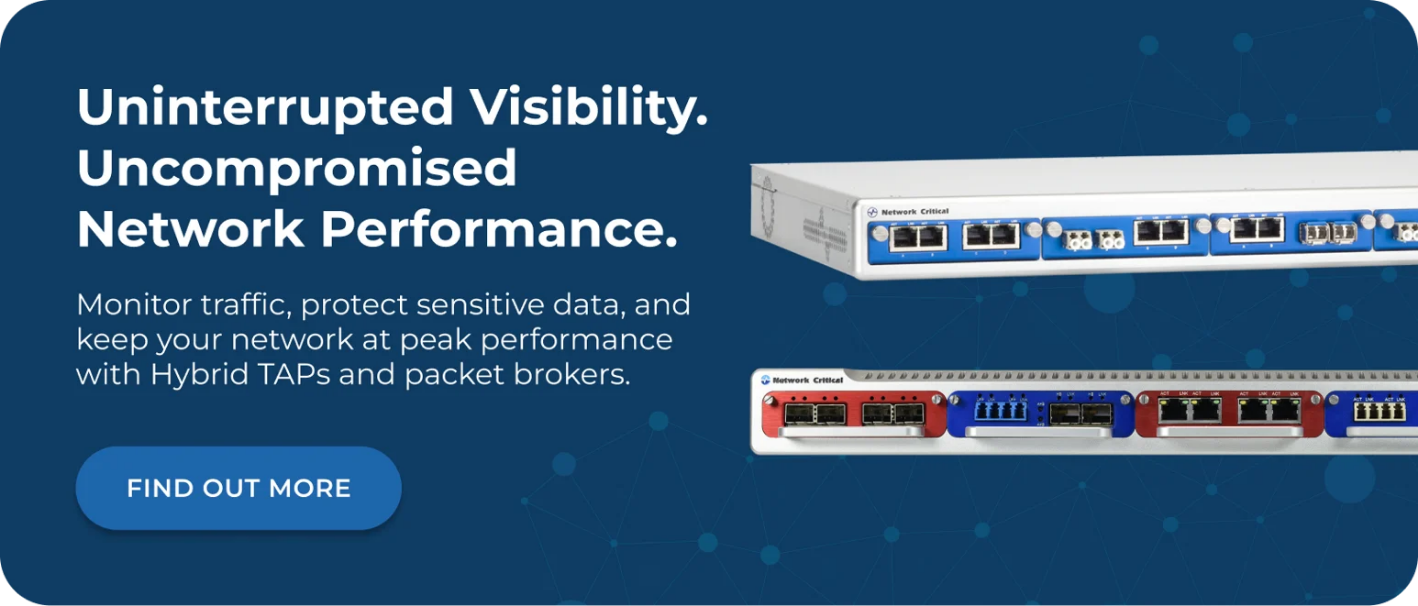
The platform combines network TAP and packet broker functionality in a single hybrid chassis. This removes the separate-SKU complexity common with incumbent vendors. Drag-n-Vu software provides drag-and-drop graphical configuration with API integration, enabling network admins to self-serve without specialist engineers. Typical deployments complete in under two hours. The perpetual licensing model carries no per-port fees and no subscription renewals. Three-year TCO runs 40 to 60 percent lower than Gigamon and Keysight equivalents.
The tool-agnostic architecture outputs standard PCAP to any SIEM, NDR, or capture platform, including Splunk, Microsoft Sentinel, Darktrace, and Wireshark. Industries served include finance, telecommunications, government, and industrial and operational technology environments.
Proven results:
- Vodafone: Achieved 100% accurate traffic visibility on key links, directly supporting a QoS improvement program that reduced customer churn.
- HSBC: Deployed passive fiber TAPs alongside SmartNA to achieve zero latency on monitoring technologies for real-time financial updates.
- BP: Enabled centralized monitoring of critical operational technology systems across refinery buildings using passive fiber optical TAPs.
Keysight Technologies – Vision Series
Keysight Technologies offers the Vision ONE, Vision 400, and Vision X packet brokers. The portfolio also includes TAPs and bypass switches, all managed through the IFC Centralized Manager. The Vision 400 series received the Frost & Sullivan 2024 Global New Product Innovation Award. The platform's FPGA-based architecture delivers verified zero packet loss, validated by The Tolly Group. Drag-and-drop GUI configuration reduces dependency on CLI-heavy workflows.
Keysight supports 400G and 800G throughput, with strong service-provider credentials. The Application Fusion Program launched in early 2026 brings Forescout and other partners into a structured visibility ecosystem. Financial stability is substantial: Q1 FY2026 revenue reached $1.6B.
The key consideration for buyers evaluating Keysight is organizational focus. Network Visibility sits as one business line inside a broader test-and-measurement corporation. Visibility-specific support and thought leadership compete for internal attention with wireless, automotive, and EDA product lines. Pricing aligns with a premium positioning that places Keysight's three-year TCO alongside Gigamon at the top of the market.
Gigamon – GigaVUE HC Series
Gigamon is the category leader in deep observability. The company holds 51 percent of the segment per 650 Group as of Q1 2026. The GigaVUE HC Series covers 1G through 400G, managed via GigaVUE-FM with AI Traffic Intelligence and Copilot capabilities. Gigamon's Precryption technology addresses encrypted traffic visibility. The platform spans hybrid cloud, container, and on-premises environments.
The scale is substantial: 4,000-plus organizations deployed and 83 of the Fortune 100 covered. Gigamon also holds sustained Frost & Sullivan recognition, including a 2026 Company of the Year award for the Public Sector. The Q1 2026 reframing around AI and GenAI workload visibility extends the platform story beyond traditional packet brokering.
The practical constraint for many organizations is cost. A representative three-year model places Gigamon at $500K CapEx plus $60K per year in subscription fees, totaling $680K. Subscription pricing and the specialist-engineer dependency required for deployment and ongoing management are recurring friction points in the renewal cycle. PeerSpot feedback updated in March 2026 also cites filtering improvements needed and the absence of built-in traffic flow visualization.
Garland Technology – EdgeLens and PacketMAX
Garland Technology is a US-based TAP specialist with an explicit OT and industrial positioning. The EdgeLens inline bypass TAP series supports 1G to 100G with sub-microsecond failover. The PacketMAX Advanced Features Broker adds aggregation, filtering, and load balancing for environments that need traffic management alongside access. Garland also offers a hardware data diode product line. This is a distinctive capability for critical infrastructure buyers with strict unidirectional data requirements.
The commercial model carries no hidden fees, no subscriptions, and no additional costs after purchase. "Manufactured in the USA" is prominently stated. The OT security partner ecosystem includes Nozomi Networks, TXOne, Dispel, EmberOT, and Radiflow, with joint roadshows and integrations. Dedicated regional sales coverage includes named DOD and Federal Civilian roles.
The tradeoff is product scope. Garland's advanced packet broker capabilities are narrower than those of the major incumbents. Configuration workflows are more traditional and CLI-adjacent compared to GUI-led alternatives. European and Asia-Pacific coverage depends on distributor relationships rather than owned field teams.
APCON – IntellaView and IntellaStore IV
APCON is a Wilsonville-based packet broker specialist. The early 2026 story centers on IntellaStore IV, which added on-box ThreatGuard intrusion detection via the APCON Intelligent Processor. The IntellaView platform supports 400G blade configurations. The product line includes compliance-led features: HIPAA and PCI-DSS positioning, data masking, and packet slicing. IntellaStore IV ships with a 60-day free trial of ThreatGuard. The IntellaFlex chassis family rounds out the portfolio with flexible port configurations for varied deployment sizes.
APCON's distinctive angle is running customer-owned security applications directly on the packet broker hardware. This reduces the number of separate appliances required in a monitoring stack. Pricing is quote-based through the partner channel.
Considerations for buyers include APCON's primarily US-centric presence, which limits local support options for European and Asia-Pacific deployments. The on-box IDS model launched in Q1 2026. Large-scale customer validation at Gigamon-level deployments has not yet been publicly documented.
Profitap – IOTA and XTAP Series
Profitap is a Netherlands-based vendor covering network TAPs, packet brokers, and portable field troubleshooters through the ProfiShark line. The IOTA product combines TAP, capture, storage, and analysis in a single appliance. No other vendor in this comparison offers an equivalent all-in-one category proposition. The XTAP Series covers fiber and copper TAP deployments. The Supervisor management layer provides centralized visibility across distributed Profitap deployments.
Profitap also offers virtual TAP support for VMware environments. Cloud TAP capabilities cover Kubernetes, AWS EKS, and Azure VM workloads. A creator-led content strategy featuring David Bombal and other packet analysis personalities drives strong engineer-level awareness relative to company size.
For buyers focused on packet capture and forensic analysis in a contained environment, IOTA's all-in-one design simplifies the architecture. The tradeoff is deployment flexibility. The integrated approach limits scalability for organizations that need to distribute capture and analysis across a larger fabric. US presence is limited compared to Garland, APCON, and NetScout. Service-provider-scale deployments at 400G are outside IOTA's designed scope.
How to Choose the Right Keysight Alternative for Your Network
Throughput and Speed Requirements
Match the platform to your current and planned link speeds before evaluating any other criteria. If your environment runs 100G today with 400G on the roadmap, shortlist platforms that handle both without a chassis swap. The SmartNA-PortPlus HyperCore and the Keysight Vision 400 both cover this range. If your deployment is 1G to 10G dominant, the cost-efficiency calculation shifts toward platforms with strong low-speed density.
Scalability and Port Expansion
Consider how the platform scales before you outgrow it. Modular scale-out architectures reduce the cost and disruption of capacity expansion. Additional units connect to a base chassis and operate as a single managed system.
- Platforms that require a full chassis replacement to add ports have a higher total lifecycle cost.
- Verify whether filtering, load balancing, and traffic mapping features remain available across all expansion units, not only on the base.
- Confirm whether scale-out adds cost through per-port licensing or only through hardware.
The 100gb SmartNA PortPlus scales from 48 to 194 ports without per-port licensing, keeping expansion predictable.
Deployment Complexity and Operational Overhead
Specialist-engineer dependency drives OpEx beyond the initial hardware cost. Platforms requiring vendor-led configuration for routine changes add ongoing cost and extend Mean Time To Repair (MTTR) during maintenance windows. GUI-led platforms – where network admins self-serve day-to-day configuration – materially reduce this overhead. Evaluate the realistic configuration workflow, not just the feature list, before committing.
Tool Integration and Vendor Neutrality
Verify the platform outputs standard PCAP to existing tools and to any tools you plan to add. Closed or proprietary output formats create tool lock-in that becomes expensive when NDR, SIEM, or forensics platforms change. Platforms built around tool-agnostic architecture give you more flexibility as your monitoring stack evolves. This means feeding Splunk, Wireshark, Darktrace, ExtraHop, or any capture platform via standard output.
Licensing Model and Three-Year TCO
Subscription-based pricing compounds over time. A $500K CapEx platform with $60K per year in subscription fees totals $680K over three years. A perpetual hardware licensing model at comparable capability carries no per-port fees and no mandatory subscription renewals. It can run 40 to 60 percent lower over the same period. Build the TCO model before the RFP stage, not after, so the comparison is accurate when the renewal conversation arrives.
Support Model and Vendor Focus
Evaluate whether visibility is the vendor's primary business or one line among many. Vendors whose entire product focus is network visibility typically provide faster issue resolution and more relevant pre-sales support. Confirm support availability, response SLAs, and whether pre-sales network audits are available. For EMEA deployments, verify whether the vendor has owned field presence or relies on distributor support.
Frequently Asked Questions
What Is the Difference Between a Network TAP and a Packet Broker?
A network TAP creates a passive physical copy of live traffic without affecting the production network. A packet broker sits between TAPs and monitoring tools, aggregating, filtering, and distributing that traffic to the correct tools. In most enterprise deployments, TAPs provide the access layer and packet brokers manage the traffic distribution. Organizations running more than a handful of monitoring tools typically need both.
Why Do Organizations Look for Keysight Alternatives?
The most common reasons are cost and organizational focus. Keysight's three-year TCO sits at the premium end of the market, comparable to Gigamon. Network Visibility also competes for internal attention with Keysight's larger wireless and test-and-measurement business lines. Buyers looking for visibility-specific support, simpler procurement, or a perpetual licensing model frequently evaluate alternatives after a contract renewal. For mid-market and industrial deployments, alternatives with hybrid TAP plus broker architectures often offer better fit at lower cost.
What Should I Look for in a Network Packet Broker?
The core criteria are throughput headroom, filtering depth, scalability without chassis replacement, and compatibility with your existing monitoring tools. Beyond specs, evaluate the configuration interface. GUI-led platforms reduce specialist-engineer dependency and lower ongoing OpEx. Confirm the licensing model: perpetual licensing with predictable maintenance fees is easier to budget than per-port subscription models.
How Much Does a Network Packet Broker Cost?
Entry-level packet brokers for 1G to 10G environments start in the low tens of thousands. Mid-market platforms supporting 1G to 100G typically range from $50K to $250K depending on port count and feature licensing. Enterprise platforms at 400G and above, including subscription fees where applicable, can exceed $500K over a three-year period. Perpetual licensing models with no per-port subscription fees typically deliver a lower total lifecycle cost than premium subscription-based platforms.
Do I Need a Bypass TAP for Inline Security Tools?
If your network uses inline security appliances, a bypass switch protects availability if those appliances fail or go offline. Inline appliances include Next-Generation Firewalls (NGFWs), Intrusion Prevention Systems (IPSs), and SSL inspection devices. Without bypass protection, a failed inline appliance breaks the network path it monitors. Bypass TAPs automatically redirect traffic around the failed device, maintaining network continuity while the appliance is restored.
Is a Keysight Alternative Suitable for OT Environments?
Yes, provided the platform is selected carefully. Operational Technology (OT) deployments have specific constraints. These include limited rack space, power restrictions, sensitivity to network disruption, and compliance requirements under IEC 62443 and NIS2. Hybrid TAP plus broker platforms in a single chassis reduce the footprint and deployment risk in constrained OT environments. Passive fiber optical TAPs require no power and introduce no single point of failure. They're well suited to OT monitoring where network disruption is unacceptable.
Build Your Visibility Architecture With Network Critical
Choosing the right packet broker or TAP platform requires balancing throughput, TCO, deployment complexity, and tool compatibility. Network Critical's hybrid TAP plus broker architecture combines network TAPs and packet broker functionality in a single chassis. This addresses the deployment constraints that drive organizations away from separate-SKU incumbents.
The perpetual licensing model and Drag-n-Vu GUI deliver three-year TCO 40 to 60 percent lower than Gigamon and Keysight equivalents. Specialist-engineer dependency is eliminated. Deployments typically complete in under two hours. To explore how Network Critical fits your environment, speak to the Network Critical team and request a free network audit.