Top 7 Network TAPs for Smart Grid and Substation Automation in 2026
Smart grid modernisation is pushing more Operational Technology (OT) traffic through substation automation systems. These systems run on IEC 61850, SCADA, and protection relay networks. Utilities are converging IT and OT to support remote monitoring and faster fault response. That convergence expands the attack surface at the point where downtime matters most. The risks include cascading grid failures, safety incidents, and penalties under NERC CIP and IEC 62443. Continuous, non-intrusive visibility into substation traffic is now a baseline requirement. SPAN ports cannot guarantee full packet capture under load. Any monitoring approach that risks disrupting protection relay traffic is a non-starter for OT engineers. This guide compares seven vendors offering network TAPs and visibility platforms for smart grid and substation automation. It covers fail-safe design, environmental fit, and compliance alignment.
Smart Grid and Substation Network TAP Vendors at a Glance
|
Vendor |
Key Feature / Strength |
Max Throughput |
|---|---|---|
|
Hybrid TAP and packet broker chassis with DC input suited to substation battery systems |
Up to 400G |
|
|
Hardware Data Diode and TAP portfolio built for critical infrastructure |
Up to 400G |
|
|
DIN rail industrial TAPs with built-in Data Diode isolation |
Up to 100G |
|
|
Deep Observability Pipeline spanning hybrid IT and OT environments |
Up to 400G |
|
|
Dedicated IT and OT visibility solutions for utility grids |
Up to 100G |
|
|
Application-aware packet broker with on-box compliance controls |
Up to 400G |
|
|
FPGA-based zero packet loss packet brokering |
Up to 400G |
1. Network Critical
Network Critical – SmartNA-XL, Passive Fiber Optical TAPs, Drag-n-Vu
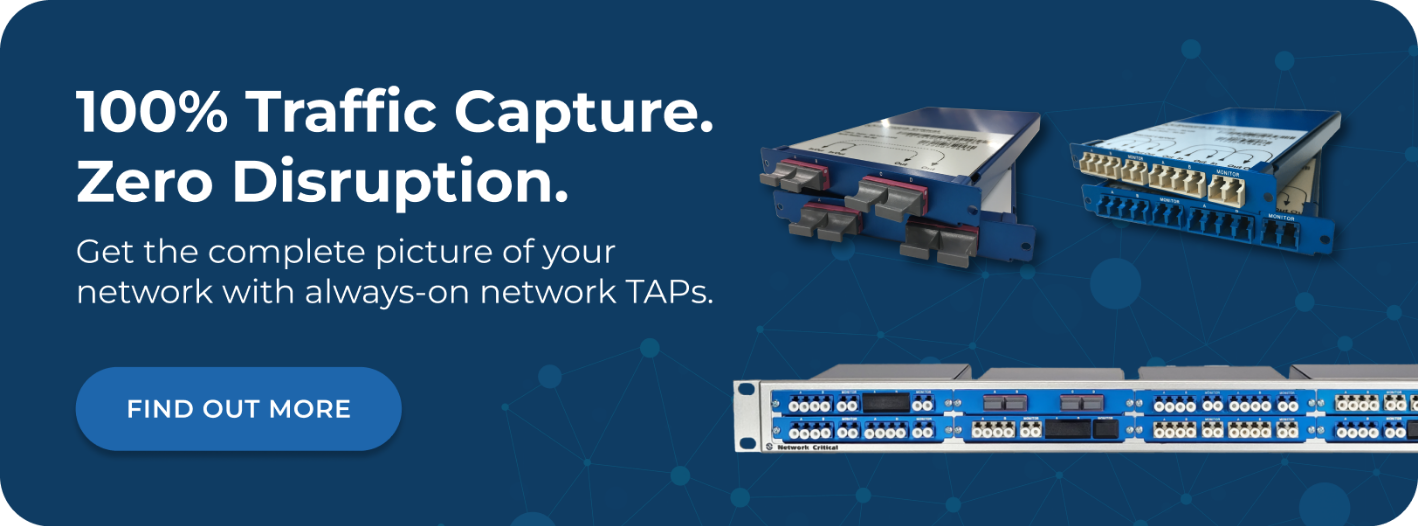
Network Critical builds its substation case on a hybrid architecture. It combines TAP access and packet brokering in a single chassis. The SmartNA-XL covers 1G to 40G links in a 5-slot 1RU unit. It mixes passive, bypass, and optical TAP modules in one chassis. This suits the mixed copper and fibre links common in substation control cabinets. For long links between substations and control centres, Passive Fiber Optical TAPs require no power. They contain no active electronics, so they cannot introduce a new point of failure.
Both platforms run on Drag-n-Vu software. It lets network administrators configure filtering and port mapping without CLI expertise. That matters in substation environments, where OT engineers specialise in SCADA and protection relays, not network visibility. The SmartNA-PortPlus base unit also accepts DC input from negative 40 to negative 72 volts. This range covers the negative 48-volt DC station batteries common in substation control houses. The hybrid TAP and packet broker design reduces rack space and cabling. That matters in control houses where every enclosure slot is contested.
Proven results:
- BP: Passive fiber TAPs enabled centralised monitoring of IT and OT systems across remote, distributed energy sites, without impacting live production traffic
- Darktrace: SmartNA-PortPlus API integration lets the Darktrace tool automatically adapt traffic filtering as anomalies emerge, a pattern directly applicable to substation SOC threat detection
2. Garland Technology
Garland Technology – Hardware Data Diode, EdgeLens Bypass TAP, Aggregator TAPs
Garland Technology has supplied critical infrastructure operators since 2011. Its product line spans TAPs, aggregators, and hardware data diodes. The EdgeLens series provides inline bypass protection with sub-microsecond failover for 1G to 100G links. This keeps inline security tools from becoming a single point of failure. The Hardware Data Diode line enforces unidirectional traffic flow at the physical layer. This suits OT segments that must send monitoring data out without accepting any traffic back in. Garland's partnership with Darktrace/OT extends visibility to Purdue Model Level 1 devices, including programmable logic controllers and remote terminal units. A separate partnership with Radiflow targets deviation detection across industrial plants. Garland positions itself as a critical infrastructure specialist, citing oil rigs and energy substations as target environments. Specifications for its data diode and TAP ranges are published on the Garland website. Its field presence outside North America relies more on distributors than owned sales.
3. Profitap
Profitap – C1D-100 Industrial Copper TAP, ProfiShark, Industrial Fiber TAPs
Profitap is a Netherlands-based vendor with a dedicated industrial Ethernet product line. Its C1D-100 copper TAP and related models support DIN rail mounting. They also support 20 to 30 volt DC powering, matching typical substation control cabinet conditions. Copper TAPs use physical isolation to act as a data diode. Fibre models use an optical data diode, preventing light insertion from monitor ports back into the network. The ProfiShark portable series adds field troubleshooting, streaming captured traffic over USB 3.0. It supports protocol analysis on industrial protocols including PROFINET and Modbus. Profitap's certified-reseller model gives it strong presence across the Netherlands, Germany, and the Nordics. North American coverage is comparatively limited. Its industrial line targets the lower-speed links typical of protection and control networks, rather than high-throughput substation backbones.
4. Gigamon
Gigamon – GigaVUE HC Series, GigaVUE TA Series, Deep Observability Pipeline
Gigamon holds an estimated 51 percent share of the deep observability segment. That is the largest share of any vendor in this comparison. Its GigaVUE HC and TA Series appliances feed the Gigamon Deep Observability Pipeline. This spans physical, virtual, and hybrid cloud environments. Gigamon markets a unidirectional tap capability designed to stop other traffic mixing into OT and IoT monitoring data. The company has published case material describing device visibility gains at a water utility. That sector sits adjacent to electrical grid operations. Deployment typically needs specialist engineers rather than network administrator self-service. Three-year total cost of ownership runs materially higher than mid-market alternatives. A modelled example totals roughly 680,000 US dollars, against 325,000 US dollars for a comparable hybrid deployment. Gigamon's scale and Frost and Sullivan Public Sector recognition suit large, multi-site utility programmes with dedicated visibility teams.
5. NetScout
NetScout – nGenius Packet Flow Switch, nGeniusONE, Omnis Cyber Intelligence
NetScout maintains a dedicated IT and OT solutions page for the utility industry. It positions its platform around visibility and security for complex grids. The nGenius Packet Flow Switch series aggregates, filters, and replicates traffic from copper and fibre TAPs, up to 100G. Its differentiator is tight integration with the nGeniusONE service assurance platform. Packet access infrastructure feeds directly into SLA monitoring and root cause analysis, without separate data hand-offs. Omnis Cyber Intelligence adds deep packet inspection for real-time threat detection on the same traffic feed. NetScout also offers virtual TAPs for hybrid cloud extensions of utility monitoring. The platform suits utilities wanting one vendor across performance monitoring, DDoS defence, and OT security visibility. That breadth brings the complexity of a full-stack platform, rather than a focused visibility point solution.
6. APCON
APCON – IntellaView, IntellaStore IV, HyperEngine
APCON is a Wilsonville, Oregon-based packet broker specialist. Its modular chassis range spans 1RU to 9RU. The HyperEngine processing module handles real-time processing of 100G traffic. It automatically detects more than 1,600 applications and 400 protocols. That awareness lets operators route specific substation protocol traffic to the right analysis tools. It avoids the need for a separate inline inspection appliance. The February 2026 IntellaStore IV added on-box intrusion detection through ThreatGuard, running on the APCON Intelligent Processor. Compliance features include data masking, packet slicing, and audit trails suited to regulated environments. Centralised management spans all chassis from one interface. This helps utilities managing monitored links across many distributed substation sites. APCON's presence outside North America, and its analyst footprint, remain smaller than the larger incumbents here.
7. Keysight
Keysight – Vision 400 Series, Vision Edge 400S, IFC Centralised Manager
Keysight's Network Visibility business unit grew out of the Ixia acquisition. It applies the company's test and measurement heritage to packet brokering. The Vision Edge 400S supports up to 152 ports of 10G to 50G in a single chassis. It also adds 40G, 100G, 200G, and 400G interfaces. An FPGA-based architecture targets zero packet loss under line-rate conditions. This was independently validated by The Tolly Group. A dynamic filter compiler removes manual REGEX configuration from filter rule management. Keysight launched a new OT motion through a Forescout partnership in January 2026. This is an early-stage push compared with the more established OT specialists here. Visibility sits as one business line inside a much larger Keysight portfolio. That portfolio spans wireless, automotive, and aerospace test equipment, which can mean visibility support competes for attention.
Selecting the Right Network TAP for Smart Grid and Substation Environments
Fail-Safe and Non-Intrusive Design
Production safety in substation automation is non-negotiable. Any approach that risks disrupting protection relay or SCADA traffic should be disqualified immediately. Passive TAPs contain no active electronics on the traffic path. This means they cannot introduce a new failure point. If you deploy an active or bypass TAP, confirm fail-safe behaviour is enforced at the hardware level. Software configuration alone is not a sufficient guarantee.
Environmental Fit and DC Power Compatibility
Substation control houses expose equipment to electromagnetic interference from switchgear. Temperature swings and restrictive cabinet space add further constraints. Check operating temperature range, DIN rail mounting, and DC power input against your battery voltage. Do this before shortlisting a vendor. Many substations run 48-volt DC station batteries. Confirm your chosen platform, such as Network Critical's 10-40G packet broker SmartNA-XL, accepts that input directly.
Zone Segmentation and Regulatory Alignment
Substation networks follow the Purdue Model. Level 0 and 1 sensors and controllers sit separate from Level 3 and above business systems. NERC CIP governs North American grid reliability. IEC 62443 sets segmentation monitoring requirements more broadly. Map your zone and conduit architecture before selecting TAPs. This determines how many monitoring points you need, and which links carry auditable compliance traffic.
Integration With SCADA and OT Security Tools
Hardware TAPs are protocol-agnostic. They forward Modbus, DNP3, and IEC 61850 GOOSE traffic without modification. This applies to whichever OT network monitoring or security platform you run. Confirm your shortlisted vendors integrate cleanly with tools already in your stack. Common examples include Dragos, Claroty, Nozomi Networks, and Darktrace/OT.
Total Cost of Ownership Across Distributed Sites
A single substation deployment might cost tens of thousands of dollars. Multiply that across dozens or hundreds of sites, and the licensing model matters. Compare perpetual hardware licensing against subscription-based platforms over a 3-year horizon. Include maintenance and per-port fees in that comparison. Factor in whether your team can self-serve configuration changes. The alternative is vendor engineer callouts for every substation visit.
Frequently Asked Questions
What Is the Difference Between a Network TAP and a Data Diode?
A network TAP passively copies both directions of traffic on a link to a monitoring port. A data diode enforces traffic flow in one direction only, at the physical layer. TAPs support two-way visibility for monitoring and security tools. Data diodes suit segments that must send data out, such as sensor telemetry, without ever accepting return traffic. Some vendors combine both functions, using diode-style isolation on a TAP's monitor port.
Does NERC CIP Require Network TAPs at Substations?
NERC CIP does not name network TAPs specifically. It does require monitoring and access controls for North American bulk electric system assets. Passive hardware TAPs are a common way utilities meet that requirement without risking production traffic. They provide the non-intrusive access needed for continuous monitoring and audit evidence. This aligns with NERC CIP's electronic security perimeter requirements.
How Many Network TAPs Does a Typical Substation Need?
Most substations need one TAP per monitored conduit link. Relevant links run between protection relays, RTUs, and the substation gateway or control centre connection. A mid-sized substation with segmented protection, control, and business zones typically needs four to twelve TAP points. The exact figure depends on your zone map and which conduits carry traffic your tools need to inspect.
Can a SPAN Port Replace a Network TAP in Substation Networks?
A SPAN port cannot reliably replace a hardware network TAP for substation monitoring. SPAN ports drop packets under high traffic load. They also compete with switch management functions for CPU resources. Substation automation systems generate GOOSE and sampled value traffic in short, critical bursts. A single dropped packet can hide the evidence of a fault or intrusion. Hardware TAPs, including bypass TAPs for inline security tools, provide deterministic full capture regardless of switch load.
What DC Power Input Do Substation Network TAPs Need to Support?
Substation control houses commonly run 48-volt or 125-volt DC station battery systems, rather than mains AC. Confirm any TAP or packet broker you shortlist accepts your battery voltage directly. Some vendors support this instead through a DC-DC converter accessory. Vendors serving industrial and utility customers typically publish DC input ranges alongside AC specifications.
Do Network TAPs Work With SCADA and OT Security Platforms Like Dragos or Darktrace/OT?
Yes. Hardware network TAPs forward all traffic to connected tools without modifying or inspecting it. OT security platforms including Dragos, Claroty, Nozomi Networks, and Darktrace/OT ingest that traffic. They perform protocol-aware analysis and anomaly detection on top of it. The TAP's role is to guarantee those platforms receive a complete, unaltered copy of substation traffic.
Build Your Substation Visibility Architecture With Network Critical
Selecting the right network TAP for smart grid and substation automation means choosing hardware that will never risk production safety. It must still meet NERC CIP and IEC 62443 monitoring requirements. Network Critical's 3-year total cost of ownership runs 40 to 60 percent lower than Gigamon and Keysight. This is backed by perpetual licensing with no per-port subscription fees. The hybrid TAPs and packet brokers architecture combines access and traffic management in a single chassis. This reduces the rack space and cabling that space-constrained control houses cannot spare. Drag-n-Vu's drag-and-drop configuration means deployments typically complete in under two hours. That keeps a specialist network engineer free for higher-priority work. To discuss your smart grid or substation monitoring requirements, speak to the Network Critical team. A free network audit is available on request.