Top 6 Network TAPs for Remote Oil and Gas Sites in 2026
Oil, gas and energy operators run some of the most dispersed networks in industry. Upstream drilling platforms, midstream pump stations and unmanned substations often sit hundreds of miles from the nearest data centre. Many have no mains power, no rack space and no resident IT staff. Security and monitoring tools at head office are only as good as the traffic reaching them from these remote points. A TAP that needs rack power or a specialist engineer on-site defeats the purpose at a wellhead. This guide compares six vendors offering network TAPs and packet brokers suited to that constraint. The focus is passive, low-power, ruggedised hardware built to keep working when nobody is watching it. Weigh power draw and environmental tolerance as heavily as throughput.
At a Glance: Network TAPs for Remote Oil, Gas and Energy Sites
|
Vendor |
Key Feature / Strength |
Max Throughput |
|---|---|---|
|
Zero-power passive fibre TAPs; portable single-slot chassis for field deployment |
Up to 400G |
|
|
DIN rail OT TAP rated to -40°F to 185°F with wired DC power |
Up to 100G |
|
|
Portable ProfiShark units and DIN rail 24V DC fibre TAPs |
Up to 100G |
|
|
Copper Tough Taps with fail-to-wire access and PoE passthrough for extreme temperatures |
Up to 800G |
|
|
Compact half-width chassis for edge and tactical sites |
Up to 400G |
|
|
Compact aggregation and capture appliance for remote locations |
Up to 400G |
Network Critical
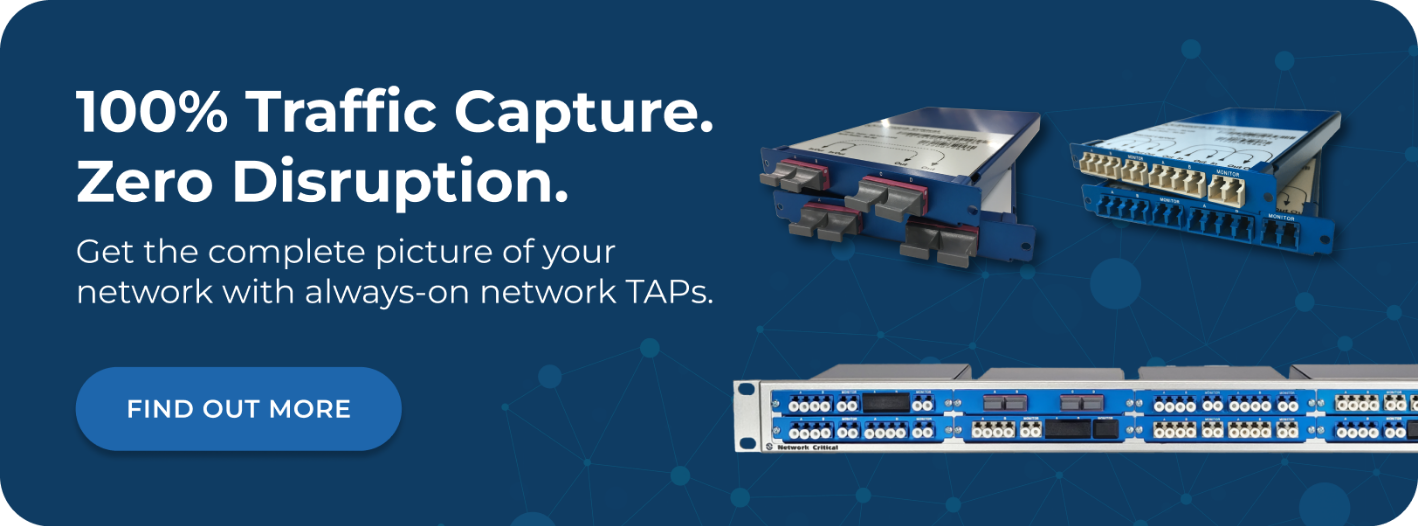
Network Critical has supplied passive access hardware to oil and gas operators for over 25 years. Deployments span refinery and pipeline environments. For remote sites, the Passive Fiber Optical TAPs are the starting point. They carry no active electronics and draw no power from the monitored link. Units ship preconfigured to the required split ratio. Field engineers plug in the network and tool connectors, with no further setup needed. Up to 16 TAPs fit into a single 1RU enclosure. That density matters where rack space at a wellhead is scarce.
For sites needing a small local chassis, the 1G SmartNA is also available in a one-slot portable configuration. It ships with external power supplies for temporary or single-link monitoring points. Drag-n-Vu software lets a network engineer reconfigure any connected SmartNA unit remotely. There is no need to revisit the site for routine changes. The wider SmartNA range also offers a hybrid TAP-plus-broker architecture. Access and traffic distribution share one chassis, reducing the footprint at constrained sites.
Network Critical's architecture outputs standard PCAP to any connected security or monitoring platform. There is no per-port licensing and no subscription requirement. For a multi-site rollout, this keeps the cost model predictable as more locations come online.
Proven results:
- BP: Passive Fiber Optical TAPs enabled centralised IT and OT monitoring across refinery buildings, with zero impact on production
- Darktrace: SmartNA-PortPlus with API integration fed full-fidelity traffic to Darktrace, avoiding the packet loss tool oversubscription causes
Garland Technology
Garland Technology sells a TAP purpose-built for OT field environments. Their OT Network TAP is rated from -40°F to 185°F. It mounts directly to a DIN rail. A durable metal chassis and wired DC power keep the unit stable under vibration. This matters at compressor stations and pump platforms. The product line also includes hardware data diodes for unidirectional data transfer. Garland maintains an active partner ecosystem with OT security vendors, including Nozomi Networks and Dragos.
Garland's EdgeLens series adds inline bypass functionality for connected security tools, with sub-microsecond failover. The company runs an active partner ecosystem with Dragos for joint OT deployments. This has included live demonstrations at events such as RSA Conference's ICS Village. Garland's feature set is narrower than full packet broker platforms for advanced filtering and aggregation. There is no GUI-led configuration comparable to a drag-and-drop interface. Routine changes typically depend on CLI familiarity. Garland's field presence is strongest in North America. European coverage runs through distributors rather than owned sales teams.
Profitap
Profitap is a Netherlands-based vendor with a strong European energy customer base. Their IXTAP series provides passive fibre and copper tapping up to 10G. It comes in a compact form factor with DIN rail mounting. A 24V DC power option supports deployment inside control cabinets. Portable ProfiShark units give field engineers a lightweight troubleshooting option for temporary monitoring. The NETASSIST packet broker aggregates traffic from multiple TAP inputs where a site needs central distribution.
The ProfiShark range supports hardware timestamping to 8 nanosecond resolution. This helps correlate events across dispersed monitoring points during an investigation. A Supervisor management layer provides centralised oversight across distributed Profitap deployments. Profitap's published specifications above 10G on the field-deployable range are limited. Confirm current 40G and 100G capability directly with the vendor for higher-bandwidth links. Profitap's North American field presence is smaller than Garland's or Keysight's.
Keysight Technologies
Keysight Technologies built its Industrial Visibility line for utility and energy field deployments. The Copper Tough Taps are purpose-built 10/100/1000Mbps TAPs for extreme temperatures. They offer fail-to-wire access and Power over Ethernet passthrough. A dual-redundant power solution can supply up to 16 taps from one unit. The broader Vision packet broker family scales to 800G. This suits operators consolidating traffic from many remote points into one facility.
The Vision family uses an FPGA-based architecture independently validated by The Tolly Group for zero-packet-loss performance. A drag-and-drop interface on the IFC Centralised Manager reduces reliance on CLI configuration for routine packet broker changes. Keysight's visibility line still sits inside a much larger test-and-measurement portfolio. This can dilute OT-specific thought leadership compared to dedicated visibility vendors. Pricing sits at the premium end of the market. Three-year total cost of ownership is broadly comparable to Gigamon.
Gigamon
Gigamon is the largest vendor in this comparison by market share. Its deep observability platform spans physical, virtual and cloud environments. For edge deployments, the GigaVUE-HCT is a half-width 1RU appliance. It delivers up to 500Gbps across 68 ports at low size and power draw. The GigaVUE TA Series extends aggregation out to remote and cloud sites. It clusters back to core GigaVUE HC Series nodes for centralised management through GigaVUE-FM.
GigaSMART processing adds deduplication and packet slicing, and Precryption technology provides TLS traffic visibility without a separate inline decryption appliance. Gigamon claims over 4,000 customer organisations, giving buyers a wide base of enterprise SOC references. Gigamon's subscription pricing produces a materially higher 3-year total cost of ownership than perpetual-licence alternatives. Deployment typically requires specialist engineers rather than site personnel. That can be a constraint where remote locations have limited access to vendor support.
APCON
APCON is a Wilsonville, Oregon-based packet broker specialist. Their IntellaStore family is positioned for midsize data centres and remote locations. It combines aggregation, filtering and onboard traffic capture in one appliance. The IntellaStore IV stores up to 32TB of traffic locally. Optional ThreatGuard intrusion detection runs on the same hardware. This reduces the number of separate devices needed at a space-constrained site.
Built-in data masking limits exposure of sensitive operational data as it passes through connected monitoring tools. This is relevant for compliance-driven energy deployments. WebXR and TitanXR provide the configuration and multi-switch management interface. APCON does not publish a ruggedised or DIN rail TAP option comparable to Garland or Profitap. Extreme temperature or vibration-heavy environments fall outside its documented range. The company's US-centric presence may limit fit for European operators with data sovereignty requirements.
Choosing a Network TAP for Remote Oil, Gas and Energy Sites
Confirm Power Availability at Each Site
Many wellheads and remote substations have no mains power, or only an intermittent supply. Passive fibre TAPs need no power for the traffic path itself. This removes the constraint entirely. Where a local chassis is needed for aggregation, check the supported DC voltage range. Confirm whether battery or solar backup suits your site infrastructure.
Verify Environmental Ruggedisation
Standard data centre hardware rarely tolerates conditions at a drilling platform or compressor station. Before you specify hardware for an outdoor or unmanned enclosure, check:
- Operating temperature range across the full seasonal swing at the site
- Vibration and shock tolerance for skid-mounted or platform-based equipment
- Mounting options, including DIN rail for control cabinet installation
- Ingress protection rating if the enclosure is exposed to dust or moisture
DIN rail mounting and wired DC power reduce installation complexity in control cabinets.
Plan for Minimal Local Support
OT engineers at remote sites are rarely network visibility specialists. Choose a platform your existing field team can install without a vendor engineer travelling to site. A hybrid TAP and packet broker in one chassis cuts the number of components a local team has to manage.
Decide Where Aggregation Happens
Some architectures aggregate traffic locally before backhaul. Others send individual TAP feeds to a centralised packet broker instead. The right choice depends on backhaul bandwidth and how many tools each site feeds.
Map Compliance Requirements to Each Site Type
IEC 62443, NERC CIP and NIS2 apply differently across upstream, midstream and downstream operations. Confirm which framework governs each site type. Establish what audit evidence your visibility platform must produce. Full-fidelity capture with zero packet loss is a baseline requirement across all three frameworks.
Confirm Tool-Agnostic Output
Whichever platform you choose, verify it outputs standard PCAP or an equivalent format. Your existing SIEM, NDR and SCADA security tools should already accept it. Locking remote-site telemetry to one vendor's proprietary format creates switching costs later. This matters as OT security platforms such as Dragos, Claroty and Nozomi Networks evolve their own integration requirements.
Model Total Cost Across Many Sites
A single-site cost comparison understates the real difference between vendors. Multiply hardware, licensing, travel and support costs across every remote location you plan to instrument. Subscription-based platforms compound this difference significantly at scale. Perpetual licensing keeps per-site costs predictable over a multi-year rollout.
Frequently Asked Questions
What TAP Works Without Power at a Remote Oil and Gas Site?
A passive fibre optical TAP requires no power for the traffic path. It uses optical splitting to copy part of the light signal to a monitoring port. No active electronics are involved. This makes it the standard access method for wellheads and other unpowered locations.
Can a SPAN Port Replace a TAP at a Remote Site?
A SPAN port depends on switch availability and can drop packets under high traffic load. At an unstaffed site, nobody is present to notice a dropped session. A hardware network TAP provides deterministic, complete capture regardless of switch state or traffic volume.
Do I Need a Packet Broker at Every Remote Site?
Not necessarily. Sites with a single monitoring tool can often connect directly to a TAP. Sites feeding multiple tools generally need a local network packet broker. This manages distribution and stops any single tool being overwhelmed.
How Do TAPs Handle Extreme Temperatures at Drilling Platforms?
Ruggedised TAPs are rated for extended operating ranges, typically around -40°F to 185°F depending on the vendor. Passive optical designs have no active components to fail under thermal stress. This further improves reliability in unheated or exposed enclosures.
What Compliance Standards Apply to Remote OT Monitoring in Oil and Gas?
IEC 62443 governs industrial control system security generally. NERC CIP applies specifically to North American electric utility and pipeline infrastructure. NIS2 covers EU critical infrastructure operators. Each requires continuous, non-disruptive capture and audit-ready evidence.
Is It Cheaper to Deploy TAPs at Every Site or Aggregate Centrally?
This depends on backhaul bandwidth and the number of sites involved. Deploying a TAP at each site and aggregating locally before backhaul typically reduces bandwidth and licensing cost. Model both scenarios against your actual site count before deciding.
Can Passive TAPs Be Used Alongside Existing SCADA Equipment?
Yes. A passive fibre TAP splits the optical signal on a monitored link without touching the equipment at either end. It requires no configuration changes to SCADA controllers, PLCs, or other connected systems. This makes it suitable for brief maintenance-window installation on live production links.
Build Your Remote Site Visibility Architecture With Network Critical
Selecting visibility hardware for remote oil, gas and energy sites means choosing equipment that works without power. It must work without a technician on standby, and without disrupting production. Network Critical's passive fibre TAPs and portable SmartNA chassis are built for that environment.
The perpetual hardware licensing model produces a 3-year total cost of ownership 40 to 60 percent lower than subscription-based alternatives. That saving compounds significantly across a multi-site rollout, where the same difference repeats at every location you instrument. Drag-n-Vu lets your team configure connected hardware remotely, without a vendor engineer visiting every location. Network Critical supports oil, gas and energy operators across upstream, midstream and downstream infrastructure. Deployment experience spans refineries, pipelines and offshore facilities. To discuss your remote site visibility requirements, speak to the Network Critical team.