Network Traffic Security: Methods, Tools, and Best Practices
Organizations today face an escalating challenge in securing network traffic as cyber threats grow more sophisticated and network architectures become increasingly complex. Network traffic security encompasses the technologies, methodologies, and strategies organizations use to monitor, analyze, and protect data flowing through their networks. Without complete visibility into network traffic, security teams operate blindly, unable to detect threats, investigate incidents, or ensure compliance with data protection regulations.
Effective network traffic security requires purpose-built infrastructure that provides comprehensive visibility without compromising network performance. Network TAPs and network packet brokers form the foundation of this infrastructure, delivering copied traffic to security and monitoring tools while maintaining network integrity. This guide explores the methods organizations use to secure network traffic, the essential tools required for comprehensive protection, and the best practices that ensure effective implementation.
What Network Traffic Security Means for Your Organization
Network traffic security represents the comprehensive approach organizations take to monitor, analyze, and protect data as it moves through network infrastructure. This discipline extends beyond traditional perimeter defenses like firewalls and intrusion prevention systems to encompass complete visibility into all network communications.
The Visibility Imperative
At its core, network traffic security depends on one fundamental principle: you cannot secure what you cannot see. Organizations must first establish comprehensive visibility across their entire network infrastructure before they can effectively detect threats, investigate incidents, or respond to security events.
Modern networks operate at speeds from 10Gbps to 400Gbps, demanding visibility infrastructure that can capture traffic at line rate without packet loss. Over 96% of internet traffic now uses encryption, requiring specialized approaches to maintain visibility without compromising security. Hybrid environments spanning on-premises data centers, cloud platforms, and remote locations create multiple points where visibility gaps can emerge.
Core Components of Traffic Security Infrastructure
Network security infrastructure consists of several integrated components working together:
- Traffic access layer: Physical devices that capture copies of network data without impacting production traffic flow
- Aggregation and optimization layer: Intelligent systems that filter and distribute traffic efficiently to security tools
- Analysis layer: Security and monitoring tools that process captured traffic to identify threats and compliance violations
- Management layer: Centralized interfaces providing control across the entire infrastructure
Each component serves a specific function in the visibility workflow, and organizations must implement all components to achieve comprehensive security.
Why Complete Visibility Is Non-Negotiable
The importance of comprehensive network traffic security extends across multiple organizational priorities, from immediate threat detection to long-term regulatory compliance.
Security Operations Depend on What They Can See
Security tools can only detect and respond to threats they can observe. When monitoring gaps exist, attackers exploit those blind spots to establish footholds, move laterally through networks, and exfiltrate data without detection.
Complete network visibility enables security teams to detect unauthorized access by identifying suspicious login attempts and credential abuse across all network segments. Teams can spot command-and-control communications when compromised systems reach out to attacker infrastructure. Data exfiltration becomes visible through unusual data transfer patterns that indicate sensitive information leaving the organization.
Forensic investigation capabilities improve dramatically with the ability to trace complete attack paths through network infrastructure. Threat hunting teams can proactively search for indicators of compromise that automated tools might miss.
Research from Zscaler reveals that 80% of attacks employ encrypted channels to conceal malicious activities, making traffic visibility more critical than ever for detecting threats that hide within encrypted sessions.
Performance Management Requires Traffic Insight
Application performance directly impacts user productivity, customer satisfaction, and revenue generation. When applications slow down or fail, IT teams need real-time diagnostic capability to identify root causes quickly.
Network visibility provides the traffic-level insight necessary to distinguish between application issues, network congestion, infrastructure failures, and external service problems.
Compliance Obligations Demand Defensible Monitoring
Regulatory frameworks including GDPR, HIPAA, PCI-DSS, and SOX require organizations to demonstrate continuous monitoring and control over sensitive data. Organizations must prove they can track who accesses sensitive information, detect policy violations in real time, and maintain complete audit trails.
Compliance auditors increasingly scrutinize the completeness and reliability of network monitoring infrastructure, often rejecting visibility solutions that cannot prove 100% packet capture.
Methods for Achieving Network Traffic Security
Organizations employ several distinct approaches to gain visibility into network traffic, each with specific advantages, limitations, and appropriate use cases.
Passive Monitoring Provides Complete Reliability
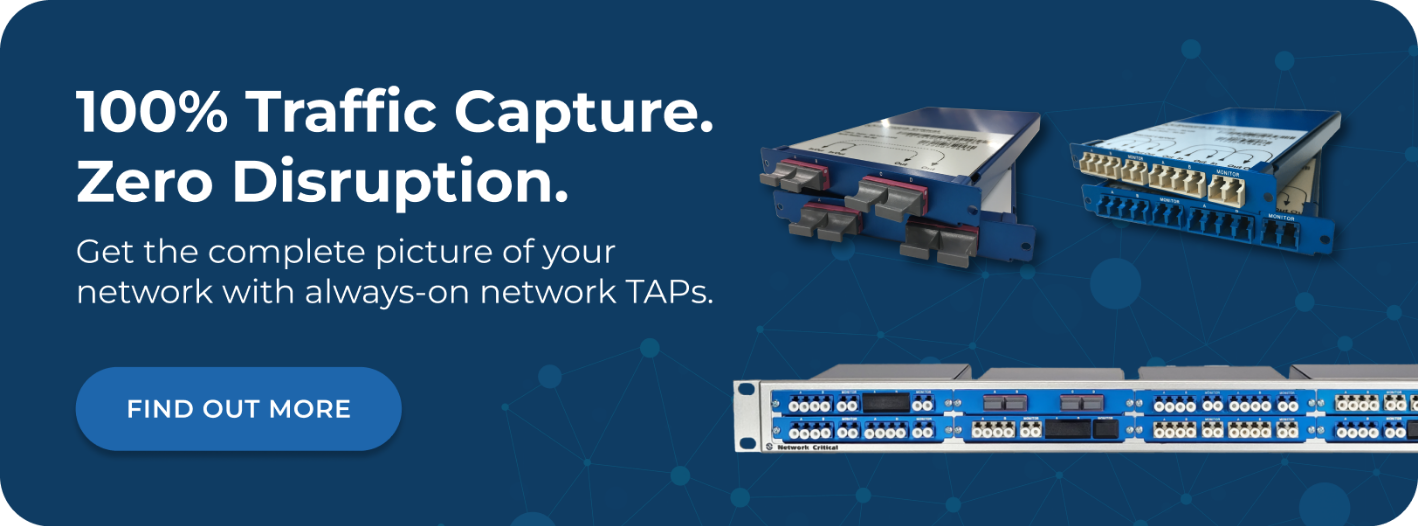
Passive monitoring represents the gold standard for network visibility, using physical hardware devices called network TAPs to create exact copies of network traffic. These devices sit between network devices and forward 100% of traffic to monitoring tools while allowing production traffic to flow uninterrupted.
Passive fiber TAPs operate without any electrical power, using optical splitters to divide light signals between the production network and monitoring infrastructure.
This approach provides several critical advantages:
- Zero packet loss: Captures every packet including errors and malformed frames
- No performance impact: Introduces no latency because packets flow through optical paths without processing
- Complete reliability: Cannot fail because they contain no active components that could malfunction
- Invisible to attackers: Operate at the physical layer with no IP or MAC address
- Standards-based operation: Work with all network protocols and speeds without requiring configuration
Organizations deploy passive TAPs for monitoring critical links where complete visibility and zero network risk are non-negotiable requirements.
Active Monitoring Adds Intelligence
Active Ethernet TAPs provide monitoring capabilities for copper networks while adding intelligence features not possible with passive devices. These TAPs actively regenerate signals, enabling advanced traffic processing before forwarding to monitoring tools.
Active TAPs support features that passive devices cannot provide:
- Traffic aggregation: Combining multiple low-speed links into a single feed for efficient tool utilization
- Port mirroring: Sending copies of traffic to multiple monitoring tools simultaneously
- Basic filtering: Applying simple filters to reduce traffic volume before sending to capacity-limited tools
- Heartbeat monitoring: Continuously verifying connectivity to inline security appliances
- Link extension: Regenerating signals allows longer cable runs than passive devices support
The SmartNA series supports 1Gb networks with modular, hot-swappable TAP modules in compact chassis.
Inline Monitoring With Automatic Bypass
Bypass TAPs address a specific challenge: how to deploy inline security appliances like intrusion prevention systems and next-generation firewalls without creating potential network failure points.
These specialized TAPs sit between network segments and inline security tools, monitoring the health of security appliances through continuous heartbeat signals. When an appliance fails or requires maintenance, the bypass TAP automatically reroutes traffic around the failed device in milliseconds.
This failover mechanism ensures:
- Network continuity: Traffic continues flowing even when security tools fail
- Safe maintenance: Security teams can upgrade or replace inline tools without scheduling downtime
- Tool redundancy: Organizations can deploy redundant security appliances with automatic failover
- Compliance assurance: Security event logs are preserved even when traffic bypasses failed tools
The SmartNA-XL supports bypass TAP modules alongside passive and active TAPs in a unified platform.
Understanding SPAN Port Limitations
Switch Port Analyzer (SPAN) ports represent the most common alternative to TAPs for network monitoring, using software configuration on network switches to copy traffic. While SPAN ports avoid hardware costs, they introduce several significant limitations:
- Packet loss under load: SPAN ports drop packets when monitored ports generate more traffic than the SPAN destination port can handle
- CPU prioritization: The switch CPU prioritizes production traffic over SPAN copying during high load periods
- Error filtering: Malformed packets and frames with CRC errors typically aren't copied to SPAN ports
- Protocol exclusions: Many switches exclude certain protocols from SPAN copying by default
- Configuration fragility: SPAN settings can be accidentally overwritten during switch configuration changes
These limitations create visibility gaps that attackers can exploit. Security tools monitoring via SPAN ports may miss the initial compromise, lateral movement, or data exfiltration that would be visible with complete packet capture from TAPs.
Essential Tools for Comprehensive Traffic Security
Comprehensive network traffic security requires multiple categories of tools working together to capture, optimize, distribute, and analyze traffic.
Network TAPs Provide Foundational Access
Network TAPs form the foundation of any complete visibility architecture, providing the physical access points where traffic gets copied for analysis. Organizations deploy different TAP types based on network media, speed requirements, and monitoring objectives.
Organizations typically deploy TAPs at these strategic locations:
- Data center access layer: Monitoring traffic entering and leaving server segments
- Core network links: Capturing traffic between major network segments to detect lateral movement
- Perimeter connections: Monitoring traffic crossing security boundaries to external networks
- Remote office links: Extending visibility to distributed locations through centralized monitoring
- Cloud connections: Capturing traffic flowing between on-premises infrastructure and cloud platforms
Packet Brokers Optimize Tool Performance
Network packet brokers sit between TAPs and security tools, intelligently processing and distributing traffic to maximize tool effectiveness. These devices solve several critical challenges that emerge as monitoring infrastructure scales.
Without packet brokers, organizations face:
- Port exhaustion: Security tools have limited monitoring ports
- Traffic overload: High-speed links overwhelm tools with limited processing capacity
- Resource waste: Tools receive irrelevant traffic that consumes capacity without providing value
- Management complexity: Reconfiguring tool connections requires physical cable changes
Packet brokers address these challenges through intelligent traffic management capabilities.
Traffic Aggregation Maximizes Monitoring Coverage
Aggregation combines traffic from multiple TAPs or network segments into consolidated feeds sent to monitoring tools. This capability allows a single security tool to monitor multiple network links efficiently.
The SmartNA-PortPlus packet broker provides scalable aggregation for networks operating at speeds from 1Gbps to 100Gbps. Organizations can aggregate traffic from dozens of 1Gbps links into a few 10Gbps feeds matched to tool capacity.
Advanced Filtering Reduces Unnecessary Load
Filtering capabilities allow packet brokers to forward only relevant traffic to each security tool based on specific criteria. This optimization dramatically reduces the processing load on security tools while ensuring they receive all traffic relevant to their function.
Packet brokers support filtering based on several criteria:
- IP addresses: Source or destination addresses or entire address ranges
- Transport protocols: TCP, UDP, ICMP, or GRE
- Application ports: Identifying specific applications
- VLAN tags: Isolating different traffic types in virtual network segments
- Application signatures: Layer 7 protocol identification for filtering by application type
Load Balancing Extends Tool Capacity
Load balancing distributes high-volume traffic across multiple monitoring tools operating in parallel. This capability allows organizations to monitor high-speed links using multiple lower-speed tools working together.
The SmartNA-PortPlus HyperCore packet broker supports intelligent load balancing across speeds up to 400Gbps. Organizations can monitor 100Gbps data center core links using multiple 10Gbps or 25Gbps security tools.
Centralized Management Simplifies Operations
As visibility infrastructure scales to dozens of TAPs and packet brokers, centralized management becomes essential for maintaining operational efficiency.
Drag-n-Vu provides an intuitive graphical interface that eliminates the complexity of manual filter configuration. The system uses drag-and-drop operations to create traffic mappings, automatically generating the complex filter rules required to implement desired traffic flows.
Effective management interfaces enable:
- Rapid deployment: Configuring traffic flows takes minutes instead of hours
- Automated rule generation: Prevents syntax errors and configuration mistakes that create security gaps
- Visual troubleshooting: Clear representation of traffic flows makes diagnosing issues straightforward
- Compliance logging: Complete records of configuration changes support compliance requirements and operational review
Best Practices for Network Traffic Security Implementation
Successful network traffic security implementation requires careful planning, appropriate architecture design, and ongoing operational discipline.
Start With a Comprehensive Visibility Assessment
Organizations should inventory all network segments requiring monitoring before designing visibility architecture. This assessment identifies critical links, sensitive data flows, compliance requirements, and existing visibility gaps.
The assessment should cover several key areas:
- Network topology: All network segments, link speeds, and traffic patterns
- Compliance scope: Which segments carry data subject to regulatory requirements
- Security priorities: Critical assets and high-risk segments requiring enhanced monitoring
- Existing tools inventory: Current security tools, their capacity limitations, and monitoring coverage
- Performance baselines: Normal traffic volumes for accurate capacity planning
Design for Scalability From the Start
Network traffic volumes grow continuously as organizations add applications, users, and services. Visibility architecture must accommodate this growth without requiring complete redesign.
Scalable visibility architecture uses:
- Modular platforms: Hybrid TAP and packet broker systems that support adding capacity through additional modules
- Stackable systems: Packet brokers that can be managed as a single logical system
- Overprovisioned capacity: Deploying packet brokers with 30–50% excess capacity to accommodate growth
- Future-speed support: Selecting platforms that support multiple speed grades for easy upgrades
Implement Defense in Depth Monitoring
Comprehensive security requires monitoring at multiple network layers and locations rather than relying on a single monitoring point:
- Perimeter monitoring: Captures all traffic entering and leaving the organization to detect external attacks
- Core network monitoring: Observes traffic between major network segments to identify lateral movement after initial compromise
- Data center monitoring: Tracks traffic to and from critical servers and databases where sensitive data resides
- Application layer monitoring: Captures traffic at the application level to detect attacks targeting specific applications
Each layer provides different security value, and comprehensive protection requires visibility at all layers working together.
Avoid Over-Reliance on SPAN Ports
While SPAN ports seem attractive for their zero hardware cost, organizations should limit their use to non-critical monitoring applications. The packet loss inherent in SPAN port operation creates visibility gaps that compromise security effectiveness:
- Security Information and Event Management (SIEM) systems require TAPs because complete event logs demand 100% packet capture
- Intrusion detection and prevention systems need TAPs because missing packets containing attack signatures allows threats to go undetected
- Network forensics tools require TAPs because investigative analysis needs complete packet captures to reconstruct attack sequences
- Compliance monitoring demands TAPs because regulatory audits often require proof of complete monitoring without packet loss
Deploy Bypass TAPs for Inline Security Tools
Organizations increasingly deploy inline security tools like intrusion prevention systems and next-generation firewalls to actively block threats. However, these inline deployments create potential network failure points unless protected by bypass TAPs.
Every inline security tool should connect through a network bypass TAP that monitors tool health, provides automatic failover, enables safe maintenance, and maintains security logging.
Plan for Encrypted Traffic Monitoring
With over 96% of internet traffic now encrypted, visibility architecture must account for monitoring encrypted sessions without compromising security.
Encrypted traffic monitoring approaches include:
- SSL/TLS decryption: Using dedicated devices to decrypt, inspect, and re-encrypt traffic
- Metadata analysis: Examining encrypted session characteristics without decrypting payload
- Endpoint visibility: Deploying agents that can observe traffic before encryption
- Cloud visibility: Using cloud security tools that can inspect traffic within cloud platforms before encryption
Document Visibility Architecture Thoroughly
Comprehensive documentation enables effective troubleshooting, compliance auditing, and knowledge transfer as security team membership changes.
Visibility architecture documentation should include:
- Physical topology diagrams: Showing all TAPs, packet brokers, security tools, and their interconnections
- Logical traffic flow diagrams: Illustrating which traffic reaches which security tools
- Configuration details: Filter rules, aggregation policies, and load balancing configurations
- Change history: All configuration changes, who made them, and why
How Network Critical Can Help
The visibility challenges discussed throughout this guide require purpose-built infrastructure designed specifically to overcome the limitations of SPAN ports and legacy monitoring approaches. Network Critical has provided network visibility solutions to enterprises worldwide since 1997, helping organizations achieve comprehensive traffic monitoring without compromising network performance.
Our network TAPs deliver guaranteed packet capture across speeds from 1Gbps to 400Gbps, supporting both passive fiber deployments that require zero power and active Ethernet solutions with advanced aggregation capabilities. The SmartNA family of modular platforms combines TAP and packet broker functionality in compact 1RU chassis, enabling you to deploy complete visibility infrastructure without dedicating entire racks to monitoring equipment.
Whether you're addressing monitoring blind spots, extending visibility into encrypted traffic, or building visibility infrastructure for hybrid cloud environments, our team can help you design an architecture that delivers complete network coverage while maximizing your security and monitoring tool investments.