Top 6 Network TAPs for IEC 62443 Compliance in 2026
IEC 62443 has become the defining cybersecurity framework for Industrial Automation and Control Systems (IACS). It mandates continuous, non-intrusive monitoring across network zones and conduits – without disrupting production systems that can't tolerate downtime. That requirement points directly to passive hardware tapping. Unlike Switch Port Analyzer (SPAN) ports, hardware network TAPs deliver 100% packet capture with zero impact on live traffic. SPAN ports drop packets under load; TAPs don't. But not all TAPs are built for industrial environments. Compliance demands fail-safe design, extended temperature tolerance, and support for industrial protocols. It also requires the physical separation that IEC 62443's zone model demands. This guide compares six vendors offering solutions built – or well-suited – for these conditions.
At a Glance: Top Network TAPs for IEC 62443 Compliance
| Vendor | Key Strength | Max Speed |
|---|---|---|
|
Modular hybrid TAP/broker, fail-safe, scale-out architecture |
Up to 400G |
|
|
Dedicated OT/ICS product lines, TAA-compliant options |
Up to 100G |
|
|
DIN rail, 24V DC, industrial protocol support |
Up to 100G |
|
|
Carrier-grade individual certification, 10Mbps–400G range |
Up to 400G |
|
|
Modular platform with bypass and aggregation options |
Up to 400G |
|
|
Application-aware processing, modular chassis system |
Up to 400G |
1. Network Critical
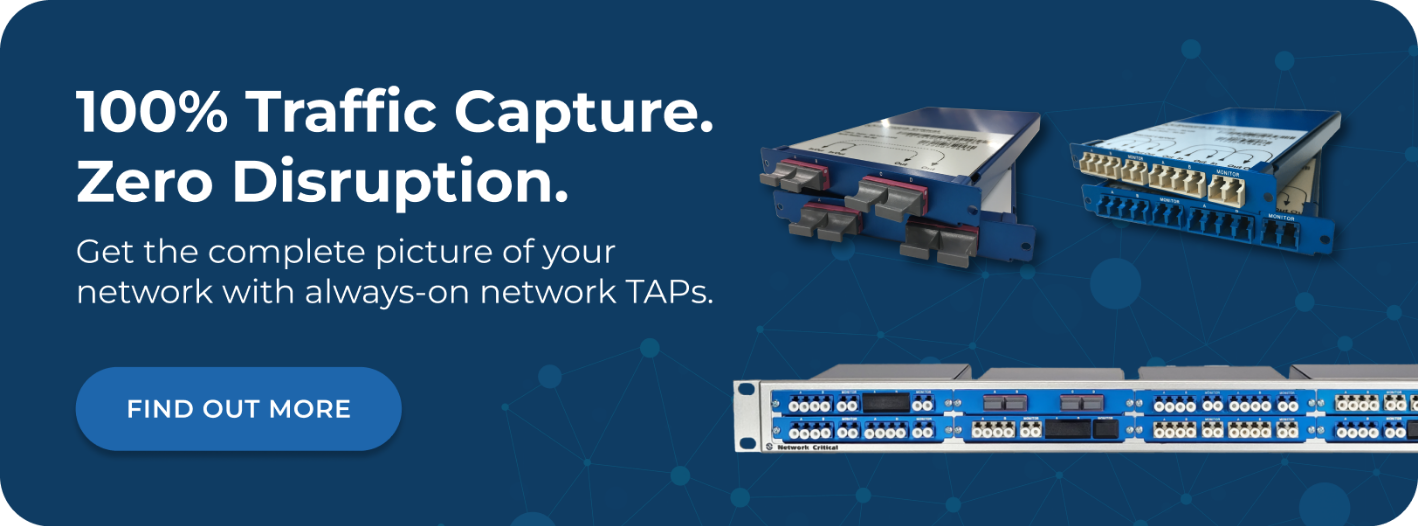
Network Critical has deployed passive visibility solutions across some of the world's most demanding industrial environments, including oil and gas refineries and aerospace test networks. Their portfolio covers the full range of deployment scenarios relevant to IEC 62443 – from passive fiber taps on critical conduit links to the modular SmartNA-XL and SmartNA-PortPlus for environments that need aggregation and filtering alongside access.
The SmartNA-XL supports 1G to 40G with a modular chassis. It accommodates passive, bypass, and optical TAP modules in the same 1RU unit. This makes it practical for mixed-media OT environments where copper and fiber links coexist. The SmartNA-PortPlus HyperCore scales to 400G for high-throughput process networks. Passive fiber TAPs require no power and contain no active electronics. They maintain link continuity even during complete power failures. This is a critical requirement in NERC CIP and IEC 62443 environments alike.
Drag-n-Vu software provides graphical, error-free configuration with a RESTful API for integration with security orchestration platforms. This supports the audit and change management requirements that accompany IEC 62443 compliance programmes. The hybrid TAP and packet broker architecture reduces infrastructure complexity by combining access and traffic management in a single chassis.
Proven results:
- BP: Passive fiber TAPs enabled centralized monitoring of IT and OT systems across refinery buildings, with zero impact on production traffic
- Airbus: SmartNA TAPs delivered 100% packet capture across mission-critical aircraft test rigs with failsafe technology ensuring uninterrupted testing schedules
- Vodafone: Achieved 100% accurate traffic visibility on key links across a multi-generation network spanning multiple countries
2. Garland Technology
Garland Technology is a TAP-specialist vendor with one of the most explicitly OT-focused product lines in the market. Their P1GCCB-OT copper TAP is purpose-built for industrial control system networks, with TAA compliance for government and regulated infrastructure deployments. The EdgeSafe bypass TAP series provides inline tool protection with sub-millisecond failover, keeping security appliances in the monitoring path without risking link disruption.
Garland's aggregator TAPs support traffic consolidation from multiple conduit links into fewer monitoring tool connections. This is a practical fit for the zone and conduit architecture that IEC 62443 defines. Their product range spans 1G to 100G in copper and fiber variants. This covers the link speeds typical of Level 2 and Level 3 Purdue Model networks. Garland maintains a strong partner ecosystem with OT security platforms including Dragos. This enables integrated threat detection workflows aligned with IEC 62443's security level requirements.
3. Profitap
Profitap addresses OT environments with a combination of rack-mounted fiber TAPs and portable field units suited to distributed industrial sites. Their ProfiShark series supports hardware timestamping with 8ns resolution – valuable for correlating events across ICS network zones during incident investigation. The IOTA network probe series provides inline capture with analysis capabilities, supporting industrial protocols including PROFINET, Modbus, and EtherNet/IP.
Profitap's rack-mounted fiber TAPs support 24V DC power, enabling deployment in industrial control cabinets where standard AC supply is unavailable. DIN rail mounting options reduce installation complexity in PLC enclosures and sub-panel environments. Their products carry a 10-year warranty. This reflects build quality suited to OT environments where equipment replacement cycles are long and maintenance windows are rare. Specifications include support for speeds from 10M to 100G across copper and fiber interfaces.
4. Cubro Network Visibility
Cubro Network Visibility offers a range of TAPs individually tested and certified prior to shipment – a quality assurance measure that aligns well with the documentation requirements of IEC 62443 compliance audits. Their OptoSlim TAP series covers 1G to 400G in compact 1RU and 3RU form factors, supporting both single-mode and multi-mode fiber. Copper TAP models extend coverage to 10/100/1000BASE-T links common in operational technology networks.
The 400G SR8 TAP targets high-throughput industrial data collection environments. Cubro's wider visibility portfolio includes converter TAPs for media type mismatches. These are relevant in OT environments where legacy copper plant infrastructure connects to newer fiber-based monitoring systems. Their products support speeds from 10Mbps to 400Gbps, covering the full range of link speeds encountered across Purdue Model levels. Cubro is an approved Vodafone supplier, indicating carrier-grade reliability expectations met.
5. Niagara Networks
Niagara Networks offers a modular Open Visibility Platform with passive fiber TAPs, bypass TAPs, and aggregation capabilities in a unified architecture. Their fail-safe design ensures that link continuity is maintained under all conditions, including complete power loss – a non-negotiable requirement in OT environments where production continuity takes priority over monitoring availability.
Niagara's platform supports passive TAP splits at configurable ratios, enabling monitoring tool feed optimization without affecting production traffic levels. Their bypass TAP options provide protection for inline security appliances at 1G to 100G+ speeds. The platform supports centralized visibility management across multiple deployment points. This is useful for operators managing IEC 62443 zone monitoring across geographically distributed facilities. Specifications include support for a wide range of connector types and fiber modes.
6. APCON
APCON provides chassis-based visibility solutions with integrated TAP functionality and advanced packet processing. Their IntellaView modular chassis system scales from 1RU to 9RU and supports 400G QSFP-DD connections with multiple breakout speeds. The HyperEngine processor provides real-time packet processing at 100G, with automatic detection of over 1,600 applications and 400 protocols.
For IEC 62443 environments, APCON's application-aware visibility helps operators identify specific industrial protocols traversing conduit links. This supports the traffic analysis and anomaly detection that IEC 62443 security programmes require. Their platform supports deduplication, time-stamping, and packet slicing, reducing the load on connected security tools. APCON's compliance features include audit logging and role-based access control. These support the operational and configuration security requirements in IEC 62443 Part 2-1.
How to Choose a Network TAP for IEC 62443 Compliance
Understand Your Zone and Conduit Architecture
IEC 62443 organises industrial networks into security zones connected by conduits. Each conduit is a candidate monitoring point. Map your conduit links before selecting TAPs – the number of links, their speeds, and their media types (copper vs. fiber) will define your hardware requirements. Environments with many low-speed copper links need different solutions than those with a handful of high-throughput fiber interconnects.
Prioritise Passive, Fail-Safe Design
IEC 62443 compliance monitoring must never introduce risk to availability. Passive fiber TAPs require no power and contain no active electronics, making them inherently fail-safe. Copper TAPs should include fail-safe relay circuitry that maintains link continuity if power is lost. Confirm fail-safe behavior at the hardware level – software-based monitoring approaches cannot provide equivalent guarantees.
Verify Industrial Environment Suitability
Standard data center TAPs may not tolerate the conditions found in OT environments. If you're selecting TAPs for OT network monitoring, check:
- Operating temperature range (industrial environments can exceed 50°C or drop below 0°C)
- Resistance to electromagnetic interference from industrial machinery
- Mounting options (DIN rail, panel mount) for control cabinet installation
- Power input compatibility (24V DC is common in OT environments)
Consider Protocol Visibility Requirements
IEC 62443 compliance programmes often require visibility into specific industrial protocols – PROFINET, Modbus TCP, EtherNet/IP, DNP3. Most hardware TAPs pass all traffic without protocol awareness, which is sufficient for feeding dedicated industrial protocol analyzers. If you need inline protocol classification at the TAP layer, verify vendor support explicitly.
Evaluate Aggregation and Tool Connectivity Needs
A passive TAP copies traffic to one or two monitoring ports. Environments with multiple tools need either a multi-output TAP or a network packet broker downstream. Common examples include an Intrusion Detection System (IDS), a protocol analyzer, and a Security Information and Event Management (SIEM) feed. Some vendors offer hybrid solutions combining TAP access and packet brokering in one chassis. This reduces infrastructure complexity in your IEC 62443 architecture.
Account for Documentation and Audit Requirements
IEC 62443 compliance includes documentation requirements for security controls. Choose vendors who provide detailed specifications, configuration change logs, and integration with asset management or network security monitoring tools. API-driven configuration platforms simplify audit trail maintenance across large monitoring deployments.
Frequently Asked Questions
What Is IEC 62443 and Why Does It Require Network TAPs?
IEC 62443 is an international cybersecurity standard for IACS. It requires continuous monitoring of network zones and conduits to detect threats, enforce segmentation, and maintain audit records. Network TAPs provide the passive, non-intrusive traffic access that lets security tools fulfill these requirements without affecting production systems.
What Is the Difference Between a Passive and an Active Network TAP?
A passive TAP uses optical splitting or copper relay circuitry to copy traffic without any active processing. It requires no power for the traffic path and maintains link continuity even during power failure. An ethernet TAP with active electronics processes the signal before forwarding it. This can introduce latency and creates a dependency on power availability. For IEC 62443 environments, passive designs are preferred for critical link monitoring.
Can a SPAN Port Replace a Network TAP for IEC 62443 Compliance?
A SPAN port cannot reliably replace a hardware network TAP in a compliance context. SPAN ports drop packets under high load, miss certain error frames, and depend on switch availability. IEC 62443 requires 100% traffic capture for accurate threat detection and audit. Hardware TAPs provide deterministic, complete capture regardless of traffic volume or switch state.
How Many Network TAPs Do I Need for IEC 62443?
You need at least one TAP per monitored conduit link in your IEC 62443 zone architecture. A typical industrial site may require 10–30 TAP points. This covers conduit interconnects between Levels 2, 3, and 3.5 of the Purdue Model. The exact number depends on your site's zone map and which conduits carry traffic your security tools need to inspect. A visibility assessment can help you scope requirements accurately.
Do Network TAPs Work With OT Security Platforms Like Dragos or Claroty?
Yes. Hardware network TAPs are protocol-agnostic – they forward all traffic to connected tools without modification. OT security platforms including Dragos, Claroty, and Nozomi Networks ingest traffic via TAP feeds. They perform industrial protocol analysis at the application layer. The TAP ensures those platforms receive a complete, unaltered copy of the traffic traversing each monitored conduit.
What Speed Network TAPs Do I Need for IEC 62443?
Most Purdue Model Level 2 and Level 3 networks operate at 1G or 10G. Interconnects between Level 3 and enterprise networks may reach 40G or 100G. Match TAP speed to the monitored link – a mismatch will cause dropped packets or wasted capacity. Modular TAP platforms supporting multiple speeds in a single chassis simplify mixed-speed deployments across the same facility.
Build Your IEC 62443 Visibility Architecture With Network Critical
Choosing the right network TAPs for an IEC 62443 programme means selecting hardware that will never disrupt production. It must capture every packet across every conduit and integrate cleanly with your security tools for the long term.
Network Critical's passive and hybrid TAP portfolio covers the full range of OT deployment scenarios. Solutions range from zero-power passive fiber TAPs on critical conduit links to modular hybrid platforms. Each combines TAP access and network packet broker functionality in a single chassis. The architecture reduces complexity and simplifies your compliance audit trail.
With deployments across energy, aerospace, finance, and telecommunications, Network Critical brings proven industrial experience to every engagement. To discuss your IEC 62443 monitoring requirements and receive a free network audit, speak to the Network Critical team.